Singapore's public discourse intensifies following Halimah Yacob's comments on Israel-Hamas conflict
Former Singapore President Halimah Yacob sparks vital conversation, urging alignment with humanity amidst the Israel-Hamas conflict. Users discuss concerns over international laws, UN involvement, and Singapore's role, prompting a call for stronger diplomatic stance.
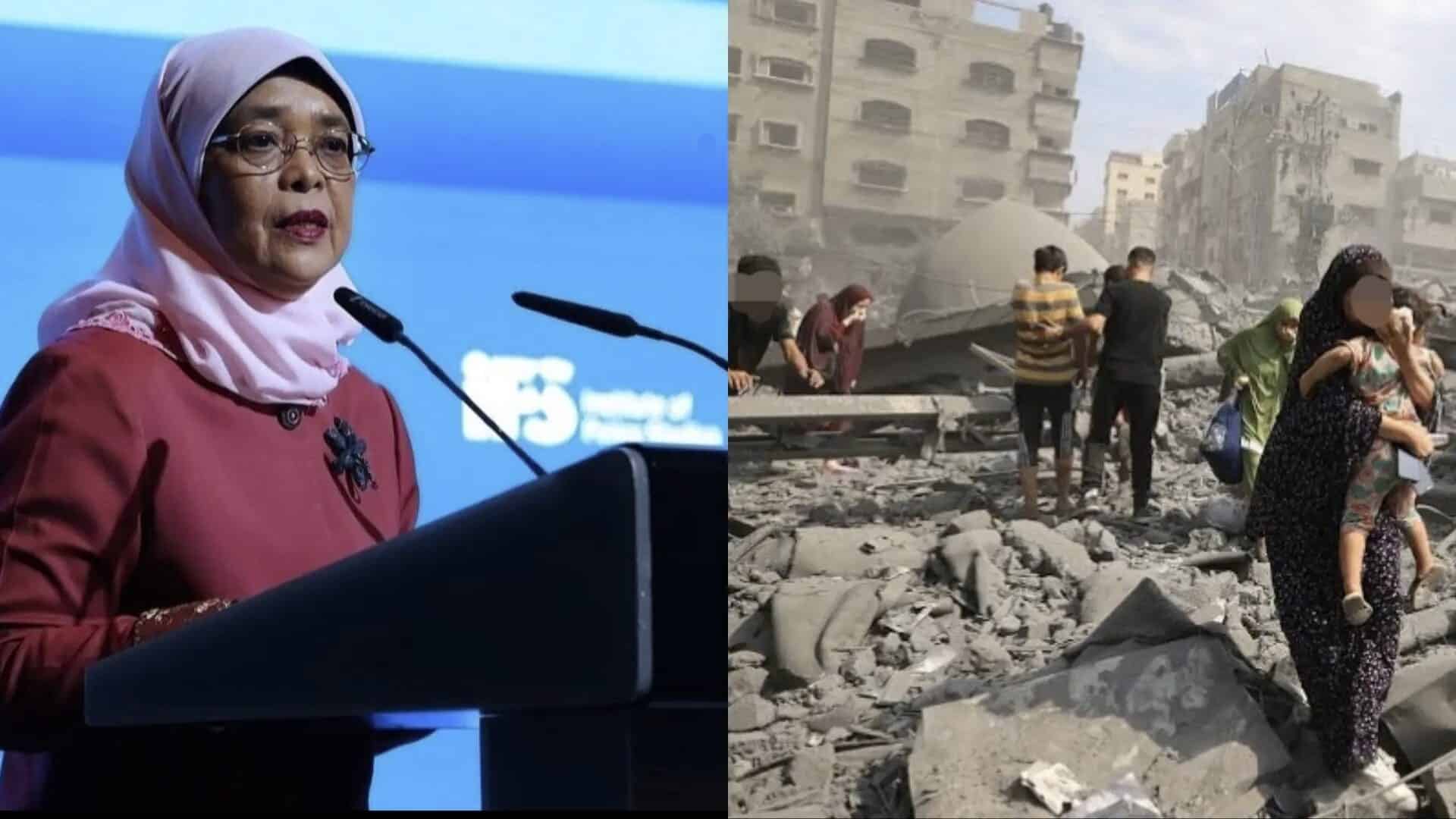

SINGAPORE: Former Singapore president Halimah Yacob addressed the ongoing Israel-Hamas conflict on 12 December, using Facebook as a platform to urge individuals to align themselves with the cause of humanity.
Expressing deep concern about the escalating death toll in Gaza, which surpassed 17,000 in the past two months, she highlighted the significant number of women and children among the casualties.
Mdm Halimah, who stepped down as President earlier in September, questioned the apparent difficulty in standing on the side of humanity, emphasizing the selective invocation of humanitarian principles.
She criticized the global response for being immobilized in the face of the staggering loss of Palestinian lives.
Additionally, Mdm Halimah raises pointed questions about the blatant violation of international laws designed to safeguard civilians in the Israel-Hamas conflict.
She reflects on the role of these laws in conflicts worldwide, emphasizing the gravity of the situation and the compromised standing of the United Nations amid the ongoing war.
Mdm Halimah stresses the importance of humanitarian international laws prohibiting the collective punishment of innocent civilians, highlighting Israel’s repeated violations and their impact on the credibility of international legal frameworks.
She urges contemplation on the potential ramifications of the rule of the mighty over the weak and the perilous implications for smaller, more vulnerable states.
The United Nations General Assembly recently approved a resolution, with more than two-thirds of participating countries voting in favour—153 countries to be exact, demanding an immediate ceasefire in Gaza and the release of all hostages held by Palestinian resistance groups.
The resolution was proposed after a resolution for a ceasefire at the United Nations Security Council was vetoed by the United States, a permanent member of the council.
Singapore has aligned itself with the 152 other nations, collectively urging an urgent humanitarian ceasefire in the Gaza Strip.
This call comes at a time when Israel finds itself increasingly isolated on the international stage due to its ongoing military operations in the enclave.
Halimah Yacob's advocacy sparks conversation on Israel-Hamas conflict, prompting calls for Singapore's stronger stance in diplomacy
Mdm Halimah's recent Facebook post has sparked a heated discussion among users regarding the ongoing Israel-Hamas conflict.
Many individuals expressed their gratitude towards Mdm Halimah in the comment section for addressing this critical matter, appreciating her stance on behalf of humanity.
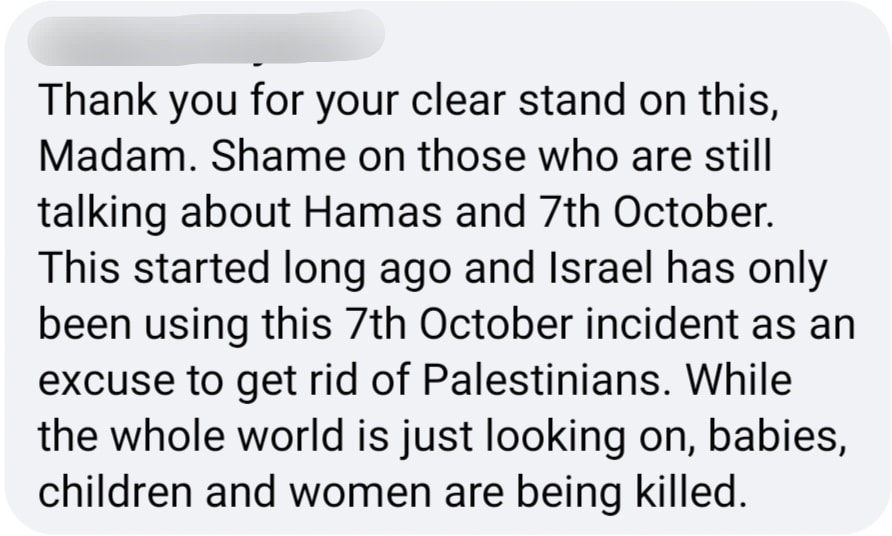
In response to the post, one thanked Mdm Halimah for her clear position, criticizing those who still focus on specific incidents like the 7 October event.
The FB user pointed out a perceived manipulation by Israel, using this incident as a pretext to displace Palestinians while the global community remains passive to the suffering of innocent civilians, including babies, children, and women.
Another FB user echoed the sentiments, expressing gratitude to Mdm Halimah for speaking out.
The user hopes that Singapore, as a nation, will take a more assertive stance in its diplomatic ties with Israel, emphasizing the importance of standing with humanity rather than supporting what they perceive as war criminals with no regard for international law.
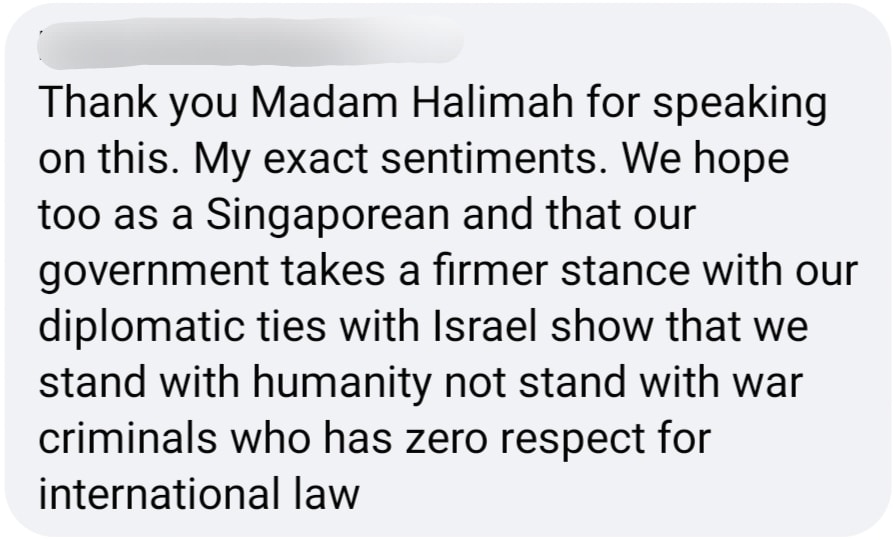
These comments reflect a broader sentiment among users who not only appreciate Mdm Halimah's vocal position on the Israel-Hamas conflict but also desire a stronger and more humanitarian approach from their own government in dealing with this international crisis.
Users critique double standards in global response to conflicts, drawing parallels between Israel-Hamas and Ukraine-Russia situations
In response to Mdm Halimah's Facebook post, users engaged in a thoughtful discussion, drawing parallels between the Israel-Hamas conflict and other geopolitical situations.
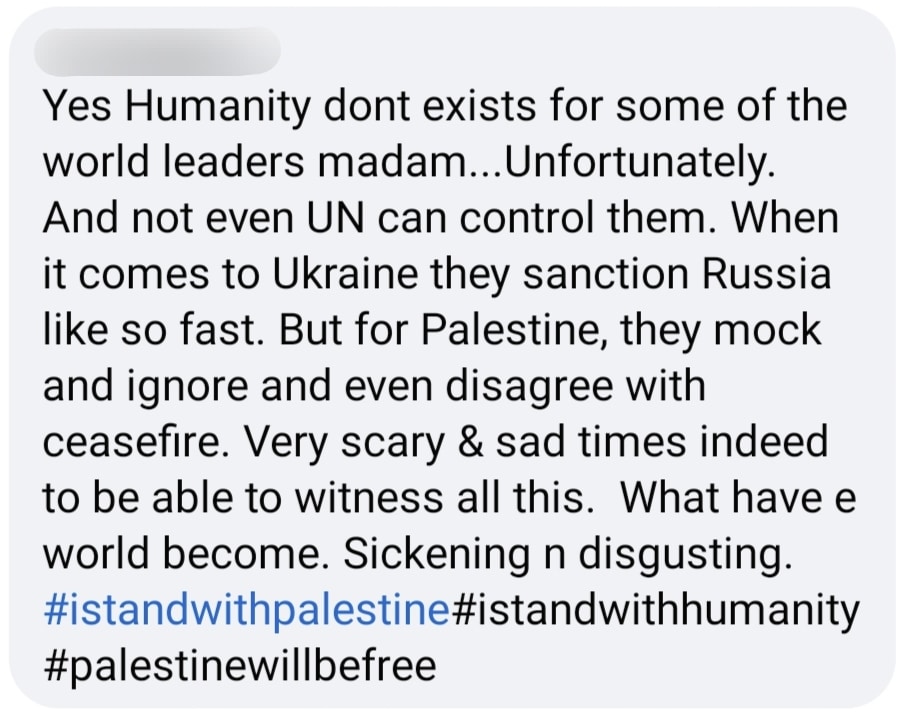
One FB user highlighted the perceived inconsistency in the international response, comparing it to the Ukraine-Russia conflict.
It is observed that world leaders seem selective in acknowledging humanity, with the United Nations facing challenges in exerting control.
The netizen criticized the swift sanctions imposed on Russia during the Ukraine crisis, contrasting it with the perceived indifference and disagreement concerning a ceasefire in the Palestine-Israel conflict.
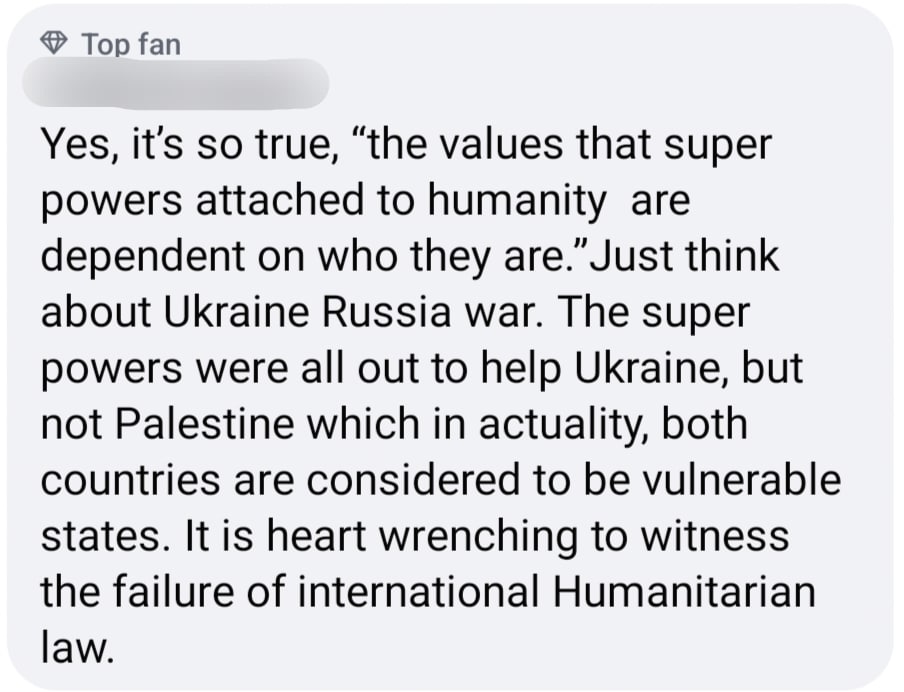
Another FB user echoed this sentiment, noting the disparity in how superpowers attach values to humanity based on geopolitical considerations.
Reflecting on the Ukraine-Russia war, the user pointed out that while superpowers rallied to support Ukraine, a similar level of concern and assistance was lacking in the case of Palestine.
The netizen expressed distress over the apparent failure of International humanitarian law in addressing these disparities.
Concerns arise as netizens question Israel's actions and scrutinize the role of veto power and the United Nations in the ongoing conflict
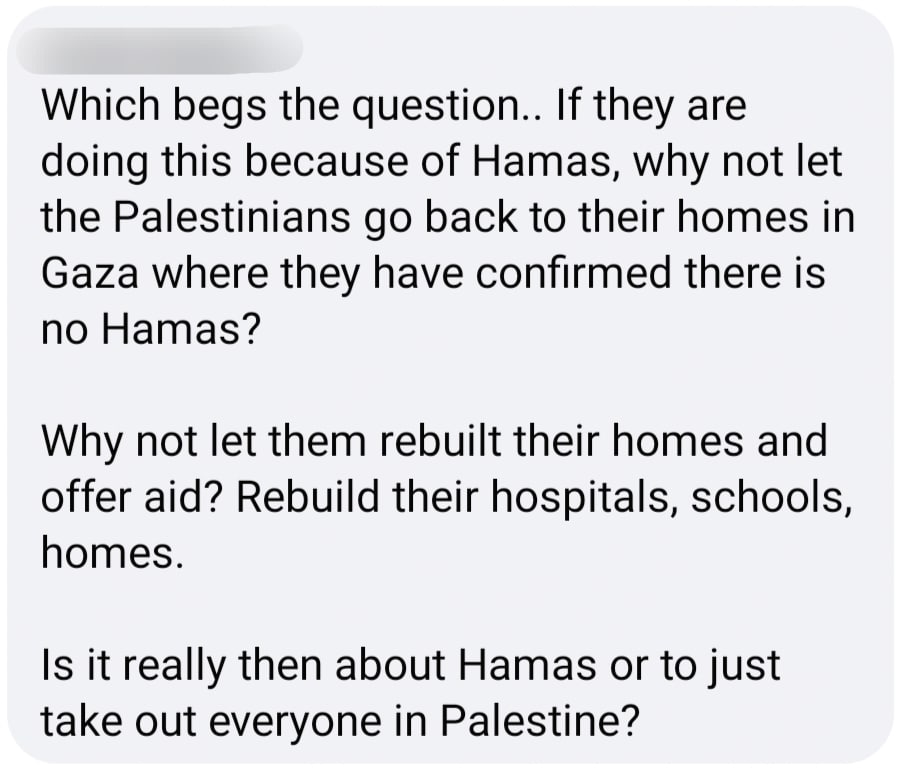
In response to the ongoing Israel-Hamas conflict, one FB user raised a poignant question about Israel's actions.
They questioned the rationale behind not allowing Palestinians to return to their homes in Gaza, where it has been confirmed that there is no Hamas presence.
The netizen pondered whether the conflict was genuinely about addressing the threat posed by Hamas or if it extended to a broader objective of removing the entire Palestinian population.
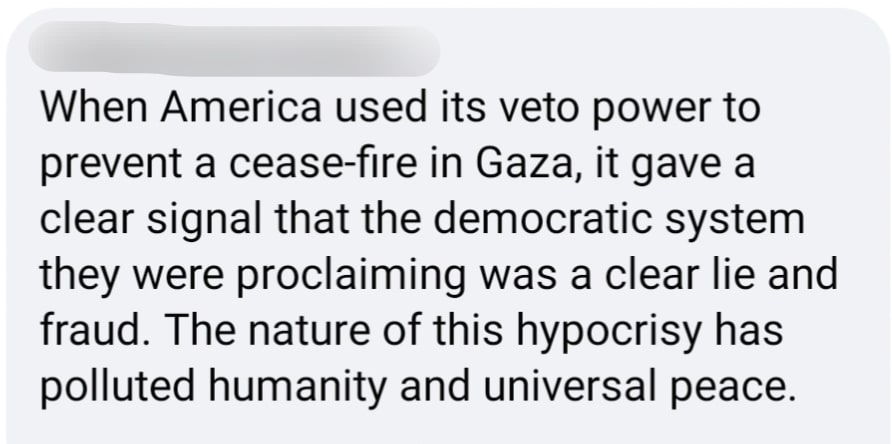
Another FB user highlighted the role of the United States and its use of veto power in the context of a proposed ceasefire in Gaza.
The netizen expressed concern that the exercise of veto power by the U.S. indicated a discrepancy between the proclaimed democratic system and its actual implementation.
It is also suggested that such actions contribute to hypocrisy, contaminating the principles of humanity and universal peace.
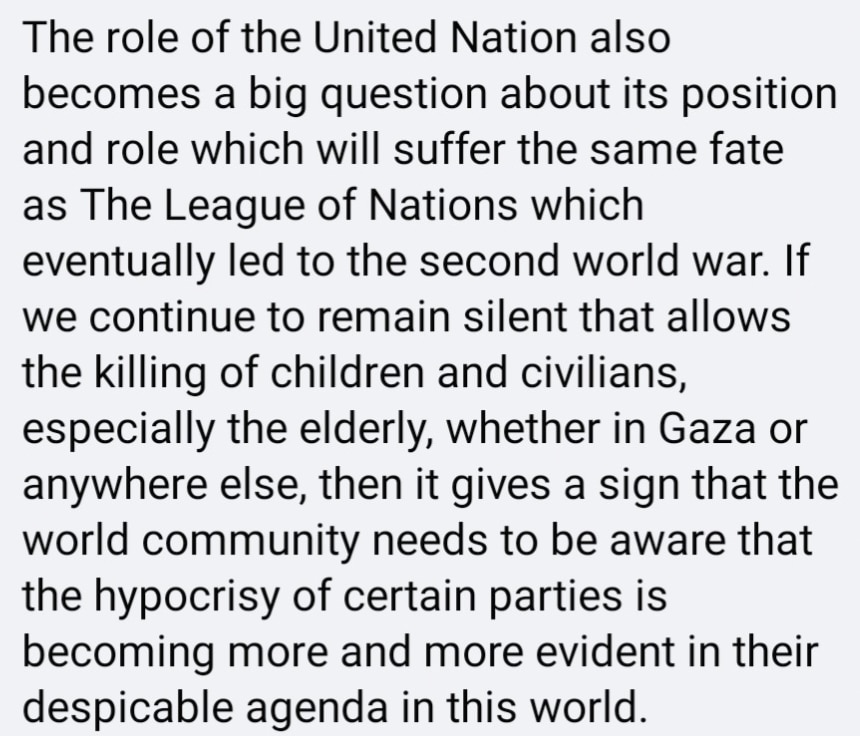
Another netizen also questioned the role of the United Nations in the conflict.
Parallels were drawn between the current situation and the League of Nations, suggesting that silence in the face of the killing of civilians, including children and the elderly, could lead to dire consequences.
The netizen emphasized the need for global awareness, stating that the increasingly evident hypocrisy of certain parties and their agendas demands attention from the world community to prevent a repeat of history.