Singapore's birth rates decline by 5.8% as total fertility rate drops below 1
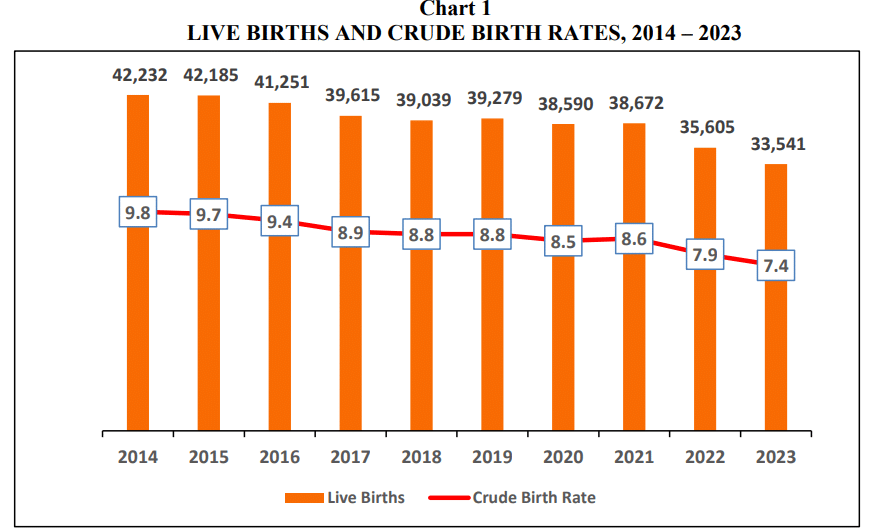
In 2023, Singapore's live births dropped by 5.8%, totaling 33,541, down from 35,605 in 2022. This decline is underscored by the total fertility rate falling below 1 for the first time in the country's history.


In 2023, Singapore witnessed a significant decline in live births, reflecting ongoing demographic challenges. The number of live births dropped to 33,541, marking a 5.8% decrease from the 35,605 births recorded in 2022. This decline is accompanied by a crude birth rate of 7.4 per 1,000 Singapore residents, lower than the previous year's rate.
At the same time, the total number of registered deaths was 26,888, slightly down from 26,891 in 2022. Heart and hypertensive diseases, along with lung and respiratory system diseases, were the leading causes of death, collectively accounting for 50.8% of all deaths.
The median age at death was 78.3 years, with females generally living longer than males (82.8 years compared to 75.1 years for males).
A particularly notable development was the announcement in February that the resident total fertility rate (TFR) fell below 1 for the first time in Singapore's history.
Although the exact number of babies born in 2023 was not disclosed, this milestone indicates a critical juncture for the nation's demographic trajectory. For sustainable long-term population replacement, a TFR of 2.1 is generally required.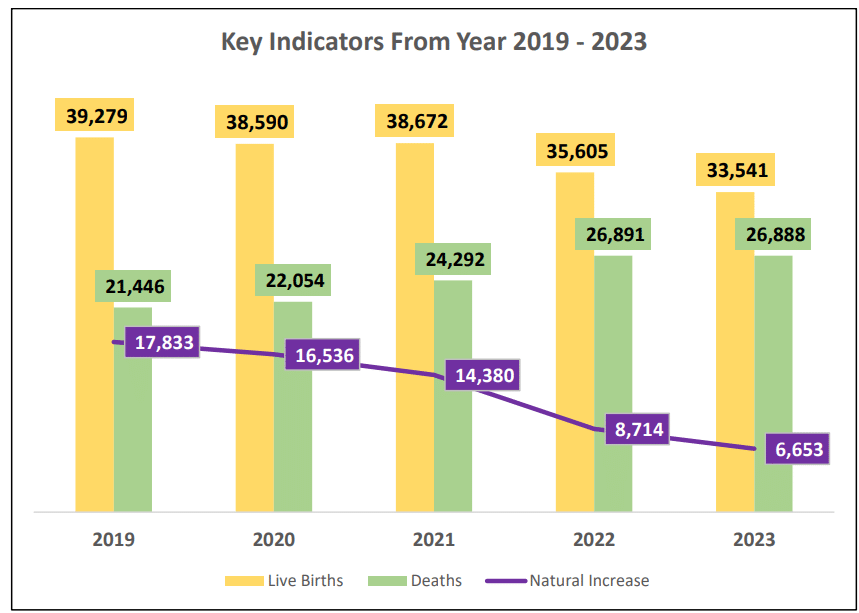
Out of the total live births in 2023, Chinese newborns constituted 57.4% (19,258), Malays accounted for 21.5% (7,212), Indians made up 11.4% (3,821), and other races comprised 9.7% (3,250). Among these groups, Malays exhibited the highest birth rate at 12.8 per 1,000 residents, followed by Indians at 7.7 per 1,000 residents, with Chinese having the lowest rate at 6.2 per 1,000 residents.
An area of concern is the increase in births among teenagers aged 19 and below. In 2023, there were 228 live births in this age group, a 4.6% rise from the 218 births in 2022. Of these, 64.9% were born to Malays, 22.4% to Chinese, 9.2% to Indians, and 3.5% to other ethnic groups.
The data also highlights an increase in single-parent births, with 334 live births registered without the father's name in 2023. Of these, 80 births were to teenagers aged 19 and below. Chinese made up the largest proportion of single-parent births at 45.2%, followed by Malays at 38.9%, Indians at 8.1%, and other ethnic groups at 7.8%.
A significant trend is the increasing age of first-time mothers. The median age of first-time mothers rose from 30.8 years in 2019 to 31.6 years in 2023.
Specifically, Chinese mothers had their first child at a median age of 32.4 years, Malay mothers at 28.4 years, Indian mothers at 30.3 years, and mothers from other ethnic groups at 31.9 years. A considerable 65.5% of these first-time mothers held university degrees.
In 2023, there were 32,623 single births, 894 twin births, and 24 triplet births. Among single births, the most common gestation period was 38 weeks, while twin births predominantly occurred at 37 weeks. Premature single births, defined as those occurring at 36 weeks or less, numbered 2,180, comprising 6.7% of all single births.
The number of babies of mixed parentage continues to rise, with 8,190 babies of mixed parentage born in 2023. Of these, 2,326 were registered with a double-barrelled race, a trend that has increased from 12.9% in 2014 to 28.4% in 2023.
The decline in live births and the unprecedented drop in the total fertility rate signal critical challenges for Singapore's population sustainability.