Lawrence Wong signals strong, independent leadership in The Economist interview amid political transition
Deputy Prime Minister Lawrence Wong, set to become Singapore's Prime Minister on 15 May, expressed his readiness to make tough decisions "in the interest of Singapore and Singaporeans" in an interview with The Economist.
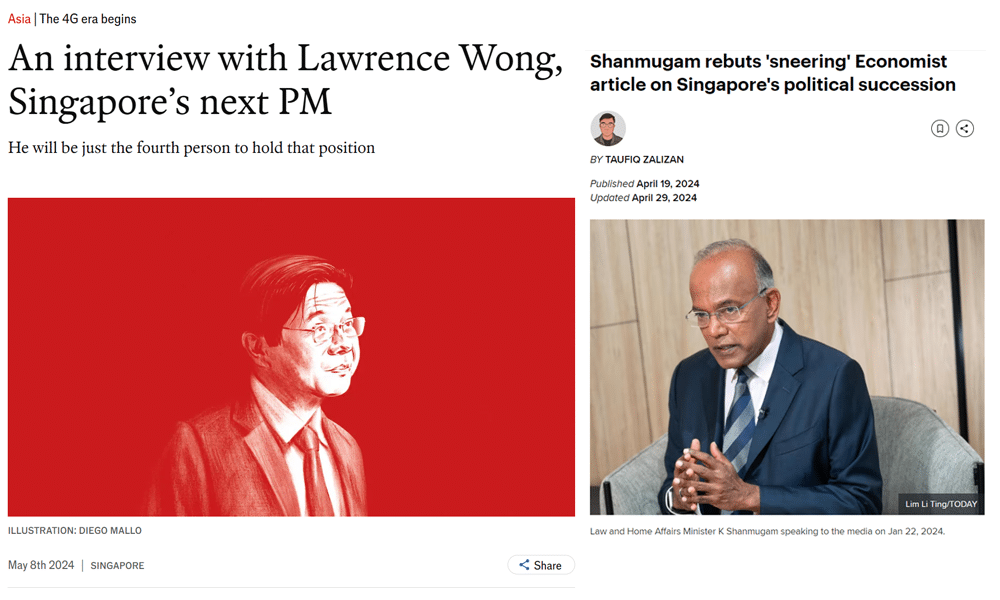

In a revealing interview with The Economist published on Wednesday, 8 May, Deputy Prime Minister Lawrence Wong, who is poised to become Singapore's next Prime Minister on 15 May, expressed his commitment to making tough, necessary decisions in the interest of the nation.
The Prime Minister's Office confirmed this transition in a statement on 15 April, noting that Prime Minister Lee Hsien Loong, who has served for two decades since 2004, will officially step down on 15 May 2024.
Mr Wong, who also currently serves as Minister for Finance, is said to have received unanimous support from the PAP MPs to succeed PM Lee.
In his interview, Mr Wong outlined his approach to leadership, reminiscent of the qualities espoused by Lee Kuan Yew, Singapore's founding Prime Minister, known for his decisive and sometimes iron-handed leadership style.
"I believe when push comes to shove and the time comes to take hard decisions, I would do so, as long as the decision is in the interest of Singapore and Singaporeans," Mr Wong stated during the interview. He was responding to questions about whether he possesses the 'iron' that Lee Kuan Yew had deemed essential for governing Singapore.
Regarding PM Lee taking on the role of senior minister in his new Cabinet, Mr Wong said this is a "long-standing Singapore tradition" that has never prevented the new prime minister from setting the tone and making his own decisions.
He does not envision any difficulties on this front, he added.
"Each time we have a leadership transition, we do not just kick out all the older ministers and then have a completely new team come in. We value the more experienced ministers, and we invite them to continue contributing in different ways, in their own ways."
Similarly, he will take over as secretary-general of the PAP in due course, Mr Wong said.
During the interview, Mr Wong also touched on his leadership philosophy, which involves a blend of firmness in decision-making with an openness to diverse perspectives. He emphasized his methodological approach to meetings and decision-making processes: "I listen carefully to everyone’s views. When I go into a meeting, I do not start off assuming that I know all the answers. I want to get people’s insights, I want to get people’s perspectives, eventually thinking about what makes for the best decisions and outcomes for Singapore."
Examples of difficult decisions cited by Mr Wong included the recent hike in the goods and services tax from 7% to 9%, and the implementation of stringent social restrictions during the COVID-19 pandemic. These decisions, according to Mr Wong, showcase his capability to prioritize the nation’s long-term interests over short-term popularity.
This interview comes in the wake of pointed criticism from Minister for Home Affairs and Law K Shanmugam towards The Economist for its commentary on Singapore's political succession.
On 19 April, Mr Shanmugam took to Facebook to launch a fierce defense of Mr Wong and Singapore’s political system in response to what he perceived as patronizing and biased coverage by The Economist.
He criticized the publication for its portrayal of Mr Wong as a "compromise candidate" and its broader skepticism about the transparency and fairness of Singapore's political succession.
Mr Shanmugam accused The Economist of maintaining a colonialist attitude towards Singapore, suggesting that British observers could not accept Singapore's success.
"They can’t stand that a people they were accustomed to lecturing are now doing better than they are, across the board," Mr Shanmugam stated, contrasting Singapore's political stability with the UK's tumultuous political landscape post-Brexit.
He further highlighted Singapore's superior economic performance and societal metrics, such as healthcare, housing, education, public safety, and social cohesion, to underscore his argument. Mr Shanmugam's critique extended to the broader media landscape, where he claimed that Singapore’s media is less influenced by media moguls compared to Britain, leading to more balanced and constructive journalism.
It is intriguing that Mr Wong chose to engage with The Economist for an interview on 6 May despite his colleague, Minister for Home Affairs and Law K Shanmugam, having previously criticized the publication for poor journalism less than a month ago. This could suggest that Mr Wong may not fully align with Mr Shanmugam's views, especially as he prepares to announce his reshuffled cabinet soon.