Second accused in S$3B money laundering case sentenced 14-month jail
Accused Su Haijin in S$3B money laundering case sentenced to 14 months, following Su Wenqiang's 13-month term. Legal expert suggests Su Wenqiang may be released by late April if sentence is backdated and granted remission.

SINGAPORE: Su Haijin (苏海金), one of the ten individuals implicated in Singapore’s landmark S$3 billion money laundering case, received a 14-month prison sentence on Thursday (4 April) after pleading guilty to one count of resisting arrest and two counts of money laundering.
This follows the sentencing of another individual among the ten, Su Wenqiang (苏文强), to 13 months in jail for money laundering charges three days ago.
Su Haijin, a 41-year-old Cypriot national originally from Fujian, China, becomes the second among the accused to be convicted in the case.
As part of a plea bargain, he agreed to forfeit approximately 90 per cent of seized assets worth S$170 million to the state.
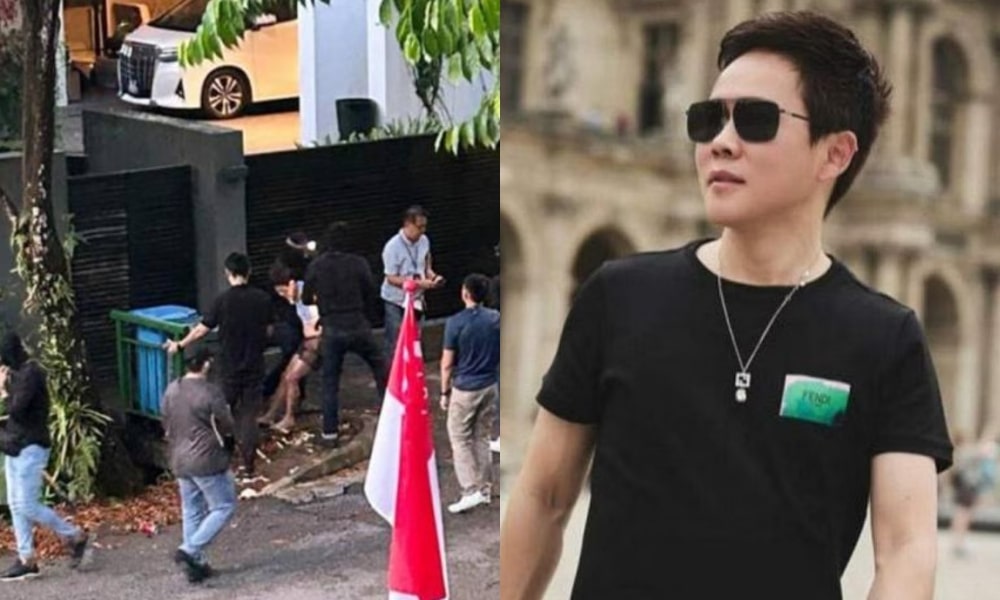
Su Haijin refused to cooperate with authorities when they attempted to arrest him at a Good Class Bungalow in Ewart Park, Bukit Timah, at around 6:40 am on 15 August 2023, during an islandwide anti-money-laundering operation.
He attempted to flee by leaping from a second-floor balcony but was apprehended hiding in a nearby drain, sustaining injuries to his feet and wrist in the process.
11 additional charges taken into consideration for sentencing purposes
His 11 additional charges, including offences related to abetting the making of false statements to the Ministry of Manpower (MOM), were taken into consideration for sentencing purposes by Senior District Judge Ong Hian Sun.
Su's jail term has been retroactively dated to the day of his arrest.
Since then, the former director of the Singapore Catalist-listed food and beverage operator No Signboard has remained in custody.
The prosecution pushed for a jail term ranging from 12 to 15 months, highlighting several aggravating factors, such as the transnational nature of the money laundering and the substantial amounts involved.
"It is clear that the accused has engaged in an abuse of Singapore’s economic and social infrastructure," said the prosecution.
The culpability of Su was further emphasized due to his resistance during arrest, as stated by the deputy public prosecutor.
According to court proceedings, on the day of Su's arrest, the police were guided to his bedroom by his son after their arrival at the Ewart Park bungalow early in the morning.
They forcibly entered the locked room after Su failed to respond to their identification.
Su was subsequently discovered to have exited the room by leaping from the second-floor balcony of the master bedroom.
The prosecution highlighted that despite Su's physical limitations from his injuries, he managed to navigate down a flight of stairs to leave the premises through a side gate and then concealed himself in a drain, where he was apprehended.
They argued that by refusing to cooperate and fleeing from his bedroom, Su knowingly resisted his lawful arrest.
Company registered under Su Haijin's name found to lack legitimate business operations in Singapore
The two money laundering charges to which Su pleaded guilty were associated with funds held in DBS and UOB bank accounts under Yihao Cyber Technologies, a company of which Su was the director and sole shareholder.
Investigations revealed that the company, incorporated in January 2017, had no legitimate business operations in Singapore and operated solely to receive letters at its Marina View office.
Additionally, the company's declared revenue for the financial years 2019 to 2022 was fictitious.
Su colluded with Wang Junjie of LW Business Consultancy to fabricate inflated revenue and receivable figures, as well as forge false business agreements with third parties.
These fraudulent statements were submitted to DBS, OCBC, and UOB to open bank accounts under Yihao Cyber Technologies.
Wang, a resident of Singapore originally from Shanghai, was associated with 185 companies as a director, secretary, and shareholder. However, in January, his registration as a qualified individual was revoked by the Accounting and Corporate Regulatory Authority (Acra).
Local media uncovered that Wang holds secretarial positions in Yihao Cyber Technologies, Daily Glory International, and Aiqinhai Investment, three companies where Su Haijin was listed as a director.
Su was also a shareholder in Meining (Asia) International Electronic Commerce and Sg-Gree, firms where Wang was appointed as director.
Notably, Su Haijin is the younger sibling of another individual who was apprehended, namely Su Baolin.
S$2.4 million from overseas company involved in remote gambling
The court on Thursday heard that the OCBC account received approximately S$2.4 million in ten transactions from Marketrole Asia Pacific Services, an overseas company engaged in remote gambling activities targeting foreign nationals.
The prosecution argued that the funds received by Su were likely proceeds from these illegal remote gambling activities.
Su claimed that the funds in the account were earnings from providing IT or website development and maintenance services, but the prosecution contended that the business agreements supporting these claims were forged, and Su failed to provide evidence of rendering such services.
Following the closure of the OCBC account in January 2022, Su transferred S$1 million to Yihao Cyber Technologies' DBS account, which held around S$438,947.20 when seized by the police in August of the same year.
Additionally, another S$999,920 was discovered in Yihao Cyber Technologies' UOB account.
Given that these sums were likely derived from the S$2.4 million in the closed OCBC account, the prosecution argued that they represented Su's gains from unlawful remote gambling activities.
In his mitigation plea, Su's lawyer stated that the accused had agreed to surrender approximately S$165 million worth of assets, including S$91.2 million in real estate properties, cash, and bank account balances, along with the forfeiture of jewellery, gold bars, liquor, and toy figures Bearbricks.
Su's defence counsel, Julian Tay of Lee & Lee, expressed his client's genuine remorse by stating, "He's not just paying lip service, he's literally walking the talk... He put money where his mouth is."
Tay highlighted that Su has relinquished more than what was specified in the money laundering charges.
As a result, he advocated for a jail term not exceeding 11 months for his client.
Third accused individual to plead guilty on 16 April
A third accused individual, Wang Baosen, besides Su Wenqiang and Su Haijin, has expressed his intention to plead guilty. He is scheduled to appear in court on 16 April.
The cases of the remaining seven accused are currently in the pre-trial conference stages.
All of them have been remanded as they were denied bail.
Additionally, the police are actively seeking two more suspects, Cambodian nationals Su Yongcan and Wang Huoqiang, who departed Singapore before the raids.
On 4 April, the Immigration and Checkpoints Authority (ICA) informed Singapore state media CNA that both Su Wenqiang and Su Haijin would face deportation following the completion of their jail terms.
ICA said: "Foreigners convicted of offences in Singapore will be deported after serving their sentences and barred from re-entering Singapore.
"The location of deportation is dependent on the admissibility of the foreigner based on his/her valid passport."
Legal expert highlights potential release of Su Wenqiang by end of April or Early May with retroactive sentencing
Su Wenqiang acquired Cambodian nationality on 7 October 2019. Apart from holding a Cambodian passport, he also possesses passports from China and Vanuatu. Su Haijin holds a Cypriot passport.
All the accused, originally from Fujian, China, hold multiple passports from countries including Vanuatu, Saint Kitts and Nevis, Cyprus, Turkey, and Cambodia.
According to Associate Professor Mervyn Cheong of the National University of Singapore, as reported by the Straits Times, if Su's sentence is retroactively dated to his arrest, he could potentially be released by the end of April or early May.
The Prisons Act stipulates that inmates typically receive a one-third remission unless they are involved in incidents such as committing offences like rioting while serving their sentence, he added.
Professor Cheong further explained that with the remission factored in, Su's effective jail term would be approximately 8½ months.