PRC Govt warns citizens that its illegal to gamble even if it’s in Singapore
The Chinese embassy in Singapore on Monday urged its citizens to refrain from gambling, warned that even if overseas casinos are legal, engaging in such activities may result in punitive actions under Chinese law.
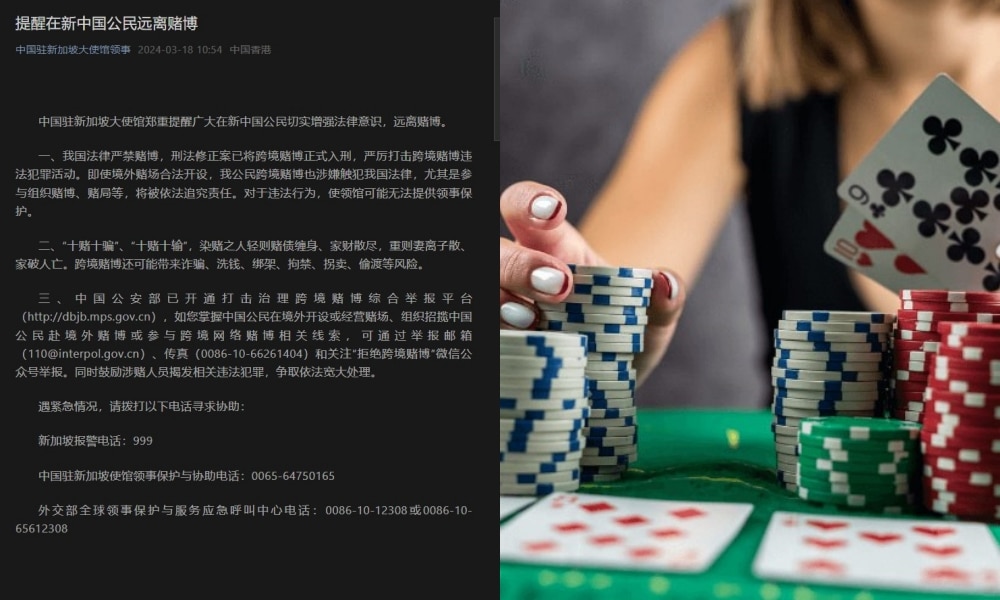

SINGAPORE: The Chinese embassy in Singapore issued a statement on Monday (18 March) urging its citizens in the city-state to abstain from gambling, emphasizing that engaging in cross-border gambling contravenes Chinese laws.
In a solemn reminder posted on its official WeChat account, the embassy emphasized the importance for Chinese citizens in Singapore to enhance their legal awareness and refrain from participating in gambling activities, which are strictly prohibited under Chinese law.
The embassy cautioned that even if overseas casinos are legally operated, Chinese citizens engaging in cross-border gambling could potentially be in violation of Chinese laws and may face punitive measures.
"Even if overseas casinos are legally operated, Chinese citizens engaging in cross-border gambling may still be suspected of violating our country's laws, especially those involved in organizing gambling activities or gambling operations, who will be held accountable according to the law," the statement wrote.
It also highlighted the possibility that embassies may be unable to offer consular protection for individuals involved in illegal gambling activities.
Drawing on a Chinese idiom to illustrate the consequences of gambling, the embassy underscored in its notice that "ten gambles, ten cheats (十赌十骗)" or "ten gambles, ten losses (十赌十输)."
It warned that individuals who engage in gambling risk accumulating debts, financial ruin, and the dissolution of their families.
Furthermore, the embassy emphasized that cross-border gambling could be associated with various illegal activities beyond gambling itself, including scams, money laundering, kidnapping, and smuggling.
The embassy also urged anyone with knowledge of Chinese citizens operating casinos overseas or enticing fellow Chinese to gamble to promptly report such activities through official reporting platforms or to the Singapore police.
Apart from state-sanctioned lotteries, gambling is strictly prohibited throughout China. The exception lies within the special administrative region of Macau, the sole region where gambling activities are legally permitted within China.
China has previously issued reminders to its citizens residing in various countries, including Malaysia, Italy, Angola, Sri Lanka, and South Korea, emphasizing that travelling abroad for the purpose of gambling is unlawful.
Efforts have been made by China, particularly in collaboration with countries in Southeast Asia, to combat cross-border gambling activities.
UNODC: Transnational Organized Crime continues to thrive due to ASEAN’s disorganized and reactionary response
According to the United Nations Office on Drugs and Crime (UNODC), transnational organized crime thrives in Southeast Asia due to the region's disorganized and reactionary response.
The region's casinos and compounds that host online gaming operators also frequently host online fraud operators.
Both industries use the same physical and logistical infrastructure, and online gaming and scam operators depend on regional money laundering networks to move proceeds.
These networks work across countries and help conceal the source of funds and move it between countries.
In 2020, Chinese authorities arrested over 75,000 suspects involved in illegal cross-border gambling, with at least 600 extradited to China with the cooperation of local authorities in Cambodia, Malaysia, Myanmar, the Philippines, and Vietnam.
Chinese authorities also reported the dismantling of more than 2,260 online betting platforms and 1,160 betting promotion platforms in 2020, along with the closure of around 1,960 illegal payment platforms and underground banks while handling over 3,500 cross-border gambling cases.
In 2022, Chinese police investigated over 37,000 cases related to cross-border gambling.
However, UNODC noted that the fact that new scam compounds are continuously emerging in Southeast Asia points to the urgency of enhanced information sharing and responses to organized crime in the region.
In September 2023, six ASEAN member nations, namely Malaysia, Laos, Thailand, Vietnam, Cambodia, and the Philippines, in partnership with UNODC signed an agreement aimed at jointly combating transnational gambling crimes in the region.
This agreement notably focuses on targeting organized crime syndicates that exploit thousands of individuals by offering jobs in casinos or fraudulent schemes promising high-paying wages.