Chan Chun Sing: MOE's Israel-Hamas education to foster multiracial cohesion reflection
Addressing concerns by parents over lessons on Gaza conflict, Chan Chun Sing emphasized its role in fostering unity. However, he doesn't directly respond to parents' worries over Gaza conflict misinformation.
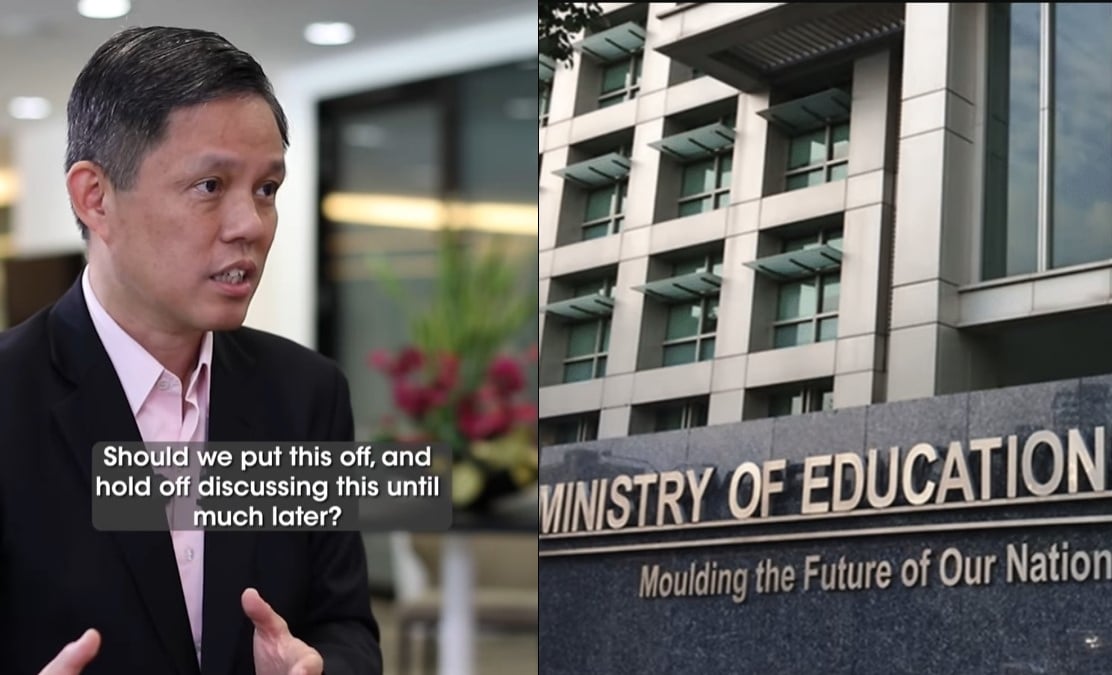

SINGAPORE: Education Minister Chan Chun Sing defended that the Ministry of Education's (MOE) Character and Citizenship Education (CCE) lessons on the Israel-Hamas conflict are specifically designed to prompt students to reflect on how to uphold cohesion and harmony in a multiracial society.
In response to concerns from parents and the Singaporean community about the educational content of CCE, Minister Chan, during a media interview on Sunday (25 Feb), clarified that the class is not intended to function as a history lesson nor to assign blame to any party involved.
He emphasized that MOE aims to cultivate a culture where students learn to respond responsibly.
This involves understanding their own emotions, contemplating how to preserve cohesion and harmony, and verifying information sources before responsibly sharing them.
Additionally, the curriculum encourages students to appreciate the diversity of views and acquire the skills to conduct conversations with sensitivity and respect.
"So, we may have the question, why are the slides not covering this aspect? Because it may not be necessary to cover all that because this is not a history lesson. "
"It is to extract from the various things that happened and ask ourselves “What can we do?” We must be very clear what we want to achieve," he told Singapore's mainstream media reporters.
Mr Chan highlighted the importance of fostering empathy for all individuals facing suffering, regardless of their race or creed.
"As for another example, for older students, we encourage them to verify the information they receive, read from diverse sources, appreciate the diversity of views respectfully before coming to their own conclusions."
Backlash against CCE lessons: Critiques of historical accuracy in the Israeli-Palestinian issue narration
Mr Chan's comments followed online concerns surfaced recently regarding the content taught in schools about the Gaza conflict.
Some posts alleged that students were exposed to a narrative lacking neutrality and objectivity, focusing solely on developments from October without providing the necessary historical context of the longstanding conflict between Israel and Palestine spanning several decades.
This prompted MOE to respond to social media critique earlier and defend its balanced teaching on the conflict, emphasizing empathy and critical thinking in lessons, despite concerns over content neutrality and historical depth.
Some posts also asserted that teachers were restricted from offering additional insights beyond the prescribed curriculum.
During the media interview, Minister Chan underscored that this is precisely what the MOE seeks to avoid.
The primary purpose of education is not to propagate anger and hatred but to instil knowledge, understanding, and empathy for all human beings, regardless of race or creed, he said.
Minister Chan acknowledged the profound impact of the conflict on many Singaporeans, especially the youth who empathize with the suffering of humanity.
He reiterated Singapore's commitment, along with many other nations in the UN, to advocate for a ceasefire, provide humanitarian support to victims, and endorse calls for a long-term two-state solution.
Minister Chan: impossible to shield our children from global events shared online
Expressing concern about potential divisions caused by the conflict and the need to preserve social fabric and harmony, Minister Chan noted that despite the geographical distance of the Gaza conflict, its accessibility online exposes people to various sources, narratives, and viewpoints.
He acknowledged the impossibility of shielding children from global events, as they are active online and on social media.
He asserted that this approach is both the right and responsible thing to do.
He also pointed out instances of heated conversations and the circulation of unverified information on social media, stressing the importance of preventing the planting of seeds of hatred and distrust in younger generations.
Minister Chan emphasized that CCE lessons aim to achieve four main objectives for students:
- Understanding Emotions and Empathy: Helping students understand their own emotions and fostering empathy for others.
- Safeguarding Cohesion and Harmony: Encouraging reflection on how to maintain cohesion and harmony in a multiracial society.
- Responsible Information Sharing: Teaching students to verify information sources before sharing them responsibly.
- Respecting Diverse Views: Promoting an appreciation of diverse views and teaching students how to conduct conversations sensitively and respectfully.
Addressing diverse teacher concerns across faiths and backgrounds
In addressing concerns about potential conflicts arising from teachers who might find the CCE lessons conflicting with their personal beliefs, Mr Chan shared insights from internal sessions held at the MOE.
“We understand that different teachers may have their individual concerns and this is not just about the Malay Muslim community. It can also apply to the Jewish community, the Christian communities, or any other people of different faiths, or from different backgrounds."
“Our school leaders will therefore systematically facilitate the process by forming teams who are able to deliver the lessons. We make it a point to make sure that we help the schools to form the teams to deliver it as a team rather than individuals.”
Minister Chan's response to opt-out option inquiry
When asked about the possibility of offering an opt-out option for parents uncomfortable with their child's participation in CCE lessons, Mr Chan did not directly address the reporter's question, but instead, he reiterated the fundamental purpose of the lessons, which is to foster mutual understanding and social harmony.
“If we approach it from this perspective, then we can understand the importance of inculcating such values to our students. It is not issue-specific; it is not conflict-specific. "
"It is a set of values on how we work together with people from diverse backgrounds to promote our social harmony and cohesion, how we work together to verify facts, how we work together such that at the end of the day, even if we hold different perspectives, we can have a respectful conversation.”
While acknowledging the difficulty of achieving these objectives, Mr Chan asserted that MOE must make the effort for the sake of the students, ensuring they are not left to grapple with external influences on their own.
Mr Chan shared that extensive discussions have been held at MOE since the outbreak of the latest conflict in October, considering how to guide students and curate age-appropriate materials for different levels.
Collaborating with agencies like the Ministry of Foreign Affairs, MOE curated materials, with the first batch updated until December 2023, and a commitment to continuous updates as events unfold.
Discussions also involved professional educators, including principals and CCE teachers, on how to effectively conduct lessons for students at various levels. School leaders played a vital role in selecting and preparing educators.
“All of us, teachers and principals, acknowledge the challenges and risks involved. "
"I must credit them for the conviction to do this well, despite the challenges, for the sake of our children and country. To help our children understand complex issues happening around the world today,” said Mr Chan.
Mr. Chan acknowledged the challenges and risks involved, crediting teachers and principals for their conviction to navigate these challenges for the sake of children and the country.
The Gaza Health Ministry reported on 21 February that since the war began on 7 October, a total of 69,333 people have been injured in Gaza, in addition to 29,313 deaths.
The final death toll from the 7 October attack by Hamas is now estimated to be 695 Israeli civilians, including 36 children, as well as 373 security forces and 71 foreigners, totalling 1,139 casualties.
It is important to note that some of the fatalities on 7 October were from Israeli forces; for example, an Israeli helicopter opened fire on Israelis at a festival as Hamas fighters were hiding among the crowd.
Additionally, the Hannibal Directive, a policy of the Israeli military, mandates that no hostage should be taken, authorizing lethal force against its own citizens and forces to prevent such situations.