Minister Shanmugam reprimands LMW's COI proposal on death of late Sgt. Uvaraja
Minister K Shanmugam rebuked NCMP Leong Mun Wai's inquiry regarding the absence of a COI for Uvaraja Gopal, a police officer who committed suicide amid workplace bullying allegations, citing the low morale among UK police resulting from similar investigations.
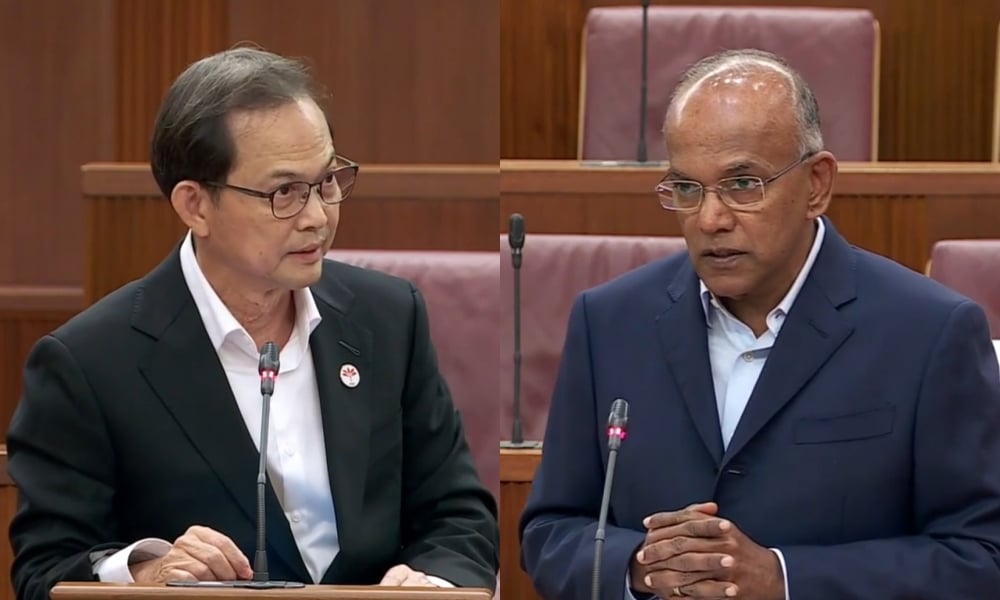

SINGAPORE: During a Parliamentary session on Tuesday (6 February), Home Affairs and Law Minister K Shanmugam shocked the Parliament when he reprimanded Leong Mun Wai, Non-Constituency Member of Parliament (NCMP) from Progress Singapore Party (PSP).
Mr Leong underscored the gravity of the case of the late Police Sergeant Uvaraja Gopal and suggested that a more transparent approach might involve appointing a Committee of Inquiry (COI) to investigate the matter instead of relying solely on an internal investigation.
In response, Minister Shanmugam expressed dissatisfaction with Mr Leong's apparent questioning of the effectiveness of Singapore's internal investigation process.
He challenged Mr Leong to specify which aspect of the current investigation outcome he disagreed with; and admonished Mr Leong for implying that Singapore should emulate systems from other countries, such as the UK, where police officers reportedly face low morale.
Minister Shanmugam then argued that Singapore's approach to law enforcement has yielded better results, with higher levels of public trust in the police force, and cautioned against drawing comparisons without considering the context.
Minister Shanmugam: Late police officer's allegations of ostracism and unfair treatment deemed untrue
On 21 July 2023, Police Sergeant Uvaraja Gopal, unfortunately, took his own life at age 35 years old, he was found lying motionless at the foot of a Housing Board block in Yishun.
With over a decade of service, he had last served as an officer with the Ang Mo Kio Police Division.
Before his unfortunate demise, Uvaraja had posted on Facebook, since removed, alleging workplace bullying, racial discrimination, and family issues. The post hinted at his tragic fate, stating that he would be deceased by the time people read it.
Last July, Mr Shanmugam requested the police to reinvestigate certain claims of racial discrimination and workplace bullying made by Uvaraja.
On Tuesday, Minister Shanmugam in a ministerial statement, revealed to the Parliament that the police review had uncovered some of the allegations to be untrue.
For those found to be true, appropriate actions were taken when Uvaraja initially filed the complaint, and he had been informed of the measures implemented.
The Minister further conveyed that the police findings underwent scrutiny by the Attorney-General's Chambers, which, after review, determined that no further actions were necessary.
Mr Leong suggests COI for better transparency in the case
Seeking clarification from Minister Shanmugam, Mr Leong initially acknowledged that there was no reason to doubt the findings presented in the police's internal investigation report.
He concurred with the minister's emphasis on the importance of maintaining the morale of the Singapore police force.
However, given the gravity of the case involving a police officer who had blown the whistle before tragically taking his own life, Mr Leong expressed his belief that a more effective approach to dispelling any doubts might be to appoint a COI to thoroughly investigate the case instead of relying solely on an internal investigation.
Minister Shanmugam challenges Mr Leong's COI suggestion
However, Minister Shanmugam countered Mr Leong's suggestion by citing a specific example from the United Kingdom, where police officers reportedly face challenges with low morale, as indicated by a recent survey conducted by the Police Federation of England.
The survey revealed that 87 per cent of police officers stated that morale within the force is currently low or very low, and a substantial 70 per cent expressed that they would not recommend others to join the police.
Minister Shanmugam emphasized a crucial point – in the UK, 95 per cent of police officers claimed that their morale was adversely affected by the government's treatment, especially in instances involving COI.
This is In Tuesday's Parliament Session, NCMP Leong Mun Wai Advocates for COI in Uvaraja Gopal Case
Directly addressing Mr Leong, Minister Shanmugam questioned whether the intent was to subject the Singapore police force to a situation akin to that of the UK.
"Do you think more people are going to join the police force? Is that good for Singapore? Is that the kind of society we want?"
Highlighting the significant trust that Singaporeans place in their police force, Minister Shanmugam challenged Mr Leong to provide specifics regarding which part of the explanation he found questionable or disagreed with.
"When you talk about a COI, I would invite you to say which part of this explanation you disagree with or you find questionable?"
In response, Mr Leong reiterated that he does not doubt the findings.
"I think people know why I raise the question because justice must not only be done, it must also be seen to be done," said Mr Leong, suggesting a concern about public perception and transparency in the handling of the case.
He again reiterated that, given the unique circumstances of a police officer's suicide, he thought it would be appropriate to investigate this case with a COI.
"We respect the decisions made by the minister. I'm just asking the minister what was in his mind when he made the decision. "
Minister emphasizes comprehensive support measures for the deceased officer
In a subsequent response, Mr Shanmugam, seemingly finally grasped the essence of Mr Leong's question, responded in a lighter tone, asserting that while there are appropriate cases for a COI, he believed that, in this particular instance, the facts had been publicly disclosed, allowing people to form their assessments.
The Minister again conveyed the deepest condolences to the family and highlighted the measures taken by the police force to support the officer, including providing psychological assistance, days off, and leave.
He detailed the extensive flexibility granted, citing examples of the officer being on leave for a significant number of days.
"If you take 2015, if a person doesn't turn up for work 150 days, 100 days of no pay leave and 40 days of medical leaves. "
In the following year, the officer took 216 days of no-pay leave and 70 days of medical leave, totalling 286 days out of 360.
He then provided information about the officer's leave days in 2022, stating that he took 160 days of no-pay leave and 80 days of medical leave, totalling 240 days out of 360, excluding weekends.
"I don't think you will see this in many organizations, certainly not in the private sector but the police force had been very very supportive of trying to help this officer."
He explained that every allegation, especially when made by a police officer, needs to be taken seriously and investigated thoroughly.
The case in question was investigated by the police, and the findings were reviewed by the Attorney General's Chambers and himself.
Uvaraja's health and family challenges
In his ministerial statement, Minister Shanmugam disclosed that Uvaraja grappled with health and family challenges leading up to his suicide and spanning his police career.
The investigation by the police revealed Uvaraja's ongoing personal struggles, primarily centred around health issues.
Throughout his tenure as a police officer, Uvaraja consistently applied for medical leave, often extending to several months each year.
Additionally, he sought no-pay leave in certain years when his paid leave entitlement was exhausted, a request granted by SPF.
Mr Shanmugam elaborated on Uvaraja's psychological struggles, highlighting his chronic insomnia and psychological stress. Since 2017, Uvaraja has attended multiple psychological consultations to address his persistent insomnia. The officer also exhibited symptoms of anxiety and depression.
Mr Shanmugam disclosed Uvaraja's strained relationships, detailing police interventions: Uvaraja's wife sought help in April 2023 during a domestic dispute, where he prevented her from leaving.
On 13 July, police received multiple calls from Uvaraja's parents' home, reporting an alleged assault on his brother. The following day, Uvaraja's mother filed a report, expressing safety concerns. Simultaneously, his sister-in-law summoned the police when Uvaraja visited, searching for his parents.
Mr Shanmugam added that Uvaraja faced three ongoing investigations at the time of his suicide.
Firstly, a criminal probe for offences under the Penal Code and Protection from Harassment Act. Secondly, an internal disciplinary inquiry in July 2023 for violating orders during medical leave. This repeated a 2016 incident, resulting in a verbal warning.
Thirdly, another internal disciplinary investigation for neglecting unfinished work and resisting orders to return and complete tasks, only complying after being instructed for the third time.
Minister Shanmugam revealed that over nine years, Uvaraja, before his suicide, received substantial support from the police, availing an average of 120 days of leave annually.
Some years, exhausted paid leave led to approved no-pay leave, exceeding standard entitlements.
Uvaraja's mental health has been attended to since 2016, with counselling and psychological assistance.
In January 2023, facing work stress, a para-counselor was assigned, followed by a psychologist involvement due to signs of instability.
Superiors offered coaching and guidance when assessing below-average performance. In the Community Policing Unit (2018-2021), colleagues provided resources.