Former editor Bertha Henson urges Straits Times to focus on quality content, rather than tinkering "newsroom strategies"
Bertha Henson emphasized the need for high-quality content in news media and the significance of providing accurate, timely responses instead of engaging in speculative reporting, despite the risk of being "POFMAed." \n \nShe emphasized the importance of representing diverse viewpoints and delivering valuable information beyond establishment perspectives.


Bertha Henson, former Associate Editor of The Straits Times, underscored the imperative for news media to prioritize quality content and educate newsmakers about the principles of public service journalism, even if it contradicts their preferences.
Moreover, she stressed the importance of delivering accurate and prompt responses to events, rather than indulging in speculative reporting, even though such reporting might expose the news outlet to being "POFMAed" by the Singapore ruling government's instrument to counter falsehoods.
She also highlighted the importance of delivering valuable and informative statements and being a platform that represents diverse viewpoints, rather than merely aligning with the views of the establishment and its supporters.
"I'd rather have news in all its naked glory than spun to give a positive feel. How do we know what is really happening when news articles tip toe around bad news and don't answer key questions? "
Ms Henson made these remarks in response to an article authored by Jaime Ho, the Editor of The Straits Times (ST), who discussed the dynamic evolution of news consumption, the challenges confronted by the news media, and the adaptive strategies implemented by The ST to navigate these changes.
The Straits Times' strategies in response to shifting media consumption patterns
In his article titled "How The Straits Times is gearing up for rapid change in news consumption," Mr Ho highlights the decline in direct access to news publications through URLs or apps, as noted by the Reuter Institude; and the rising phenomena of "news avoidance" and "news fatigue" as critical issues needing attention.
Mr Ho then went on to praise the ST for maintaining its trustworthiness (73%) according to the Reuter Institute report, however, he pointed out that "being trusted doesn’t necessarily mean you’re widely read, and being widely read doesn’t always mean you’re trusted. "
Emphasizing the growing trend of news avoidance, particularly regarding news that feels distant, distressing, or irrelevant to readers' lives, Mr Ho points out that while some readers may avoid certain types of news, they still consume content, often preferring non-traditional, softer stories such as the recently popular tale of a sun bear in a Chinese zoo.
However, Mr Ho cautions that a professional newsroom cannot rely solely on such soft content. ttempting to do so could potentially lead to a decrease in trust scores.
He highlights The Straits Times' strategy of addressing contemporary challenges by expanding its coverage and enhancing its relevance while remaining committed to the principles of public service journalism. The newly established ST Now team is instrumental in engaging the audience with current and trending news, showcasing the publication's unique value through a robust editorial ethos.
"In the opinions we publish, some of you might have seen a growing variety in views and topics that are finding a voice. Some might call this being “softer”. I’d rather see these as being more relevant to, and reflective of, the multi-faceted dimensions of our lives, interests and concerns."
"This broadening range is already happening across all our coverage. It’s a gradual process, more about progressively widening news diets, rather than big statements about dietary changes. "
He underscored the ST also emphasizes cultivating a progressive newsroom culture that values data insights while maintaining editorial autonomy, encourages experimentation and creativity, and prioritizes talent development and well-being for sustained growth and success.
Questions surrounding SPH Media Trust's impact on public trust
Commenting on Mr Ho's article, Ms Henson first raises a pertinent question: since Singapore Press Holdings (SPH) became SPH Media Trust (SMT), the public remains unaware of the implications for the relationship with readers and the nature of the content.
Taxpayers lack insight into the KPIs or editorial policies, while print readers face a lack of transparency regarding the newsroom's structure.
"We don't know why some stories are online only and not in print. We don't know how/why changes are made to certain stories. "
Addressing the concept of "soft features" mentioned by Mr Ho, Ms Henson emphasizes that soft features are ubiquitous across various online platforms, challenging their significance and distinctiveness from typical lifestyle content found in magazines or other online portals.
Ms. Henson underscored the importance of journalistic access in producing in-depth analyses and hard-hitting features, expressing concern over the current shortage of analytical content.
"Only a NEWS journalist with access can put together hard features and analyses. Right now, there is a dearth of analysis."
"As always, I wish that the focus is on better content, getting newsmakers to understand the imperatives of public service journalism (which may not always be to their liking), the need for rapid responses instead of allowing for speculation - which can be POFMAed, how to add value to pronouncements and being a voice that reports all sorts of opinions and not just the establishment and its cheerleaders."
"I'd rather have news in all its naked glory than spun to give a positive feel. How do we know what is really happening when news articles tip toe around bad news and don't answer key questions? "
She asserts her preference for a dedicated team of journalists focusing on editorial content while assigning a separate consulting team to address newsroom strategies.
"As for "news fatigue'', it's easy to point the blame all sorts of other causes other than the idea that this might be because the content is dull and boring."
Criticism on ST's apparent decline in content quality
Commenting on Ms Henson's Facebook post, Ravi Samuel, a Singaporean lawyer, highlighted that The Straits Times may be perceived as the "Daily Petir," (a term often used to describe the state media as a "party newspaper"), however, he emphasized that this comparison does not excuse the newspaper's poor standards.
Mr Samuel expressed that he wouldn't mind a high-quality "Daily Petir," even if it led to disagreements. Presently, he observed that the newspaper often lacks substantial content, which he finds to be even more concerning.

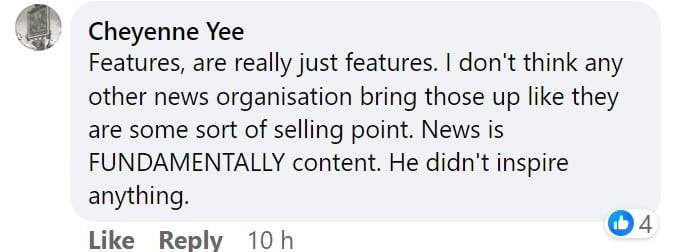
Art director Cheyenne Yee commented that features should be recognized for what they are – features.
He pointed out that no other news organization promotes them as a major selling point, highlighting that news is fundamentally about content.
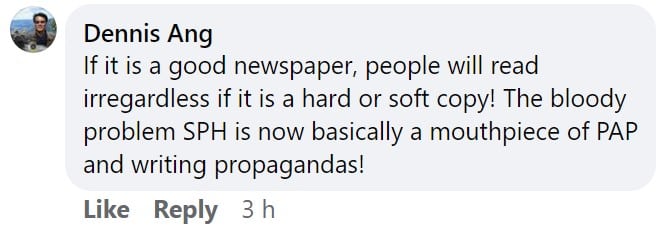
Dennis Ang added that if a newspaper is of high quality, people will read it, whether in print or digitally.
He criticized SPH, suggesting that it has become a mouthpiece for the People's Action Party (PAP) and is publishing propaganda.