

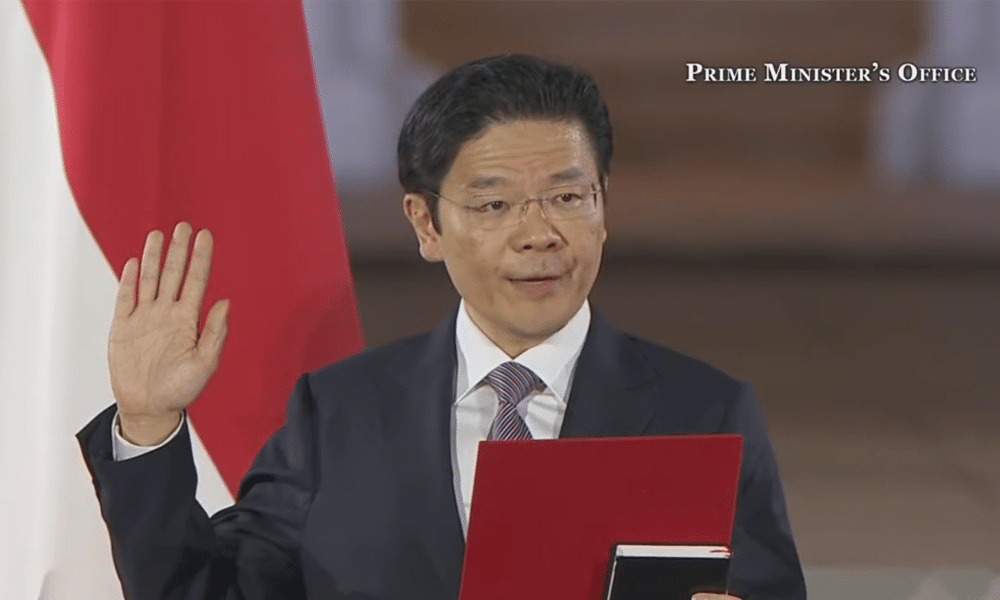
Will Prime Minister Lawrence Wong chart a new path for Singapore?
Opinion: Amidst Lawrence Wong's ascension as Singapore's Prime Minister and upcoming key events, a reevaluation of foundational policies on issues like capital punishment and drug laws seems imminent. With Minister Shanmugam holding firm on traditional stances, and Pope Francis's visit on the horizon, the nation stands at a crossroads between old guard policies and potential new directions in governance and civil liberties.

by Simone Galimberti
Perhaps it is time to do a bit of triangulation on what’s going on in Singapore.
With Singapore embracing Lawrence Wong as its new Prime Minister, with Pope Francis visiting town a few months down the line, and with Minister for Home Affairs and Law K Shanmugam pugnaciously reasserting the Government’s stance on drugs and capital punishment, an exercise in connecting the dots might be useful.
Let’s start with the new Prime Minister.
In his swearing-in speech, Mr Wong promised that his number one mission will be the continuation of the “miracle called Singapore”.
Interestingly enough, he is going to do it with some positive twists.
“We will foster a “fairer, more just and more equal society” he stated.
While no one expects tectonic changes from the orthodoxy of the People's Action Party (PAP), Mr Wong will pursue his “mission” by being open to “reconsider all the assumptions” underpinning the Singaporean success story.
This is a bold statement. Will he really stick to it?
How different from now could Singapore become one or two decades from now?
What about the dreams and aspirations of those citizens that are not always or often aligned with the PAP policies? Can they also dare to imagine a different Singapore?
Would it be conceivable to think that Singapore can be better and deliver better also in areas that have been traditionally neglected by the PAP?
What if people continue to deprioritize the five famous 5 Cs (Cash, Credit Card, Condominium, Card, Club membership) but also start reconsidering other aspects that have been almost untouchable for the PAP?
Mr Wong agreed that a different view of 5 Cs should not be condemned and a less focus on materialistic greed, is welcome.
Perhaps Singapore will be a pioneer in an agile form of welfare society, a society that truly cares about those lagging behind while remaining entrepreneurial and keeps putting a premium on its citizens’ resilience and hard work.
In this area, PM Wong is truly well-positioned to change and modernize the existing paradigm because, in many aspects, the Rubicon has already passed, and he was among those leading the crossing.
But would the Prime Minister also, albeit reluctantly, agree to say that it is OK to open at least a conversation on certain foundational and unnegotiable “credos” at the core of the PAP’s ideology?
What about higher levels of speech freedoms and other political freedoms? What about the sacred caw called capital punishment?
With the latter, let’s get to Minister Shanmugam.
On 8 May, he made sure to affirm, in unmistakably clear terms, that the Government is on the right side of the debate in regard to the death penalty for drug traffickers and that it is correct to say that a vast majority of citizens still agree with it.
Surely, the nation’s approach to security won’t change anytime soon, but what about in a decade or more?
I am intrigued to imagine a Singapore that can remain safe and secure but also freer for its citizens, where dissenting opinions, including those related to the most sensitive topics, are valued and appreciated.
After all, there might be a day when old assumptions, like the ones that for decades have been guiding decision-making, are challenged.
For example, the shifting of the official stance on gay sex with the scrapping of the archaic 377A law.
This means that change is not unfathomable within the PAP, and Mr. Wong is adamant about this point.
But on issues like capital punishment, Mr Shanmugam, the government's firmest enforcer of the rule of law in Singapore’s way, must come around, and it’s going to be tough.
If you are an anti-death campaigner or a human rights activist, it is hard not to dislike him.
There is no question that, at least from the PAP’s perspective, if he has been doing the job for so many years, it means that Mr. Shanmugam is extremely capable and effective at it.
Even if I disapprove or disagree with his argument, I admire him for his tenacity and his grip on the subjects he always seems to master.
Interestingly, Mr Shanmugam felt the need or perhaps the pressure to address the Parliament on 8 May to explain, once again, the government's official stance towards drugs.
Yet even with his comprehensive speech in Parliament, I wonder if his positions contain some confirmation biases.
I certainly welcome the efforts he mentioned in the final part of it about the upcoming efforts to create more awareness in society against drug use.
Another positive news from his speech is that the full report of a major survey conducted in 2023 on people’s attitudes towards capital punishment will be released this year, and this can help further the conversation.
Moreover, Mr Shanmugam stressed, with many examples, that a path to recovery is indeed possible for drug addicts, and the Government is serious about supporting this difficult journey.
These are welcome developments.
But he did single out several international cases that prove that the Government is doing the right thing in upholding extremely harsh measures against drug peddlers.
This part is more problematic.
While it is true in Europe or in North America, there are very serious instances of drug-caused devastations within the society (a crime emergency and a public health emergency compounded together), Mr Shanmugam has been very selective in his analysis.
To understand what I mean, I encourage you to read a rebuke from Kirsten Han, who herself was singled out by the minister in his speech.
Why can’t the Minister mention San Marino, an independent state smaller than Singapore?
It is a place where the rule of law is truly universal, and it is not selectively upheld and trails closely behind Singapore's 3rd position and highest GDP per capita as 9th.
It is a developed and prosperous nation without capital punishment, even though it is practically borderless and open to the world.
While fighting drug trafficking remains a priority and a concern, there are no drug-induced devastations, and neither is there a heightened problem with drugs.
In the Global Organized Crime Index, funded by the American Government, the oldest republic in the world score 3.48 while Singapore 3.47.
This is perhaps a silly example. Yes, it is a sort of provocation because San Marino and Singapore are hardly comparable, but we cannot allow generalization to dictate policy arguments.
In the end, Mr Shanmugam's selectivity of the examples risks undermining the whole case that he was trying to make.
I am sure his team of analysts can do a better job.
For sure Minister Shanmugam, in his speech, did not pass what I call the “SATO” test and with it I refer to a study made by Professor Mai Sato debunking many of the positions made by the Singapore Government on capital punishment.
For example, the government often cites its surveys to claim widespread support for its policies in Singapore as did Mr Shanmugam in his speeches.
However, research conducted by NUS Law suggests that such assertions might be misleading, particularly regarding public backing for the death penalty. The study indicates that support for the mandatory death penalty, the predominant form of capital punishment in Singapore, is notably weak.
Therefore, it is not fair, I think, for the Minister to pick some anti-death penalty activists, including Kirsten Han, for the work they are doing because of their convictions and beliefs.
Let’s admit that Minister Shanmugam’s positions are 100% correct. Would it be better to give some respite to these citizens?
It isn’t ok to have other citizens who think differently on the matter, even if they are a tiny minority.
Scaremongering is an easy tactic.
The same can be said when even vailed forms of contempt or even despise are shown towards those who have a different position.
And here I am going back to Mr Wong.
How far can he go to project a vision of the nation that is open and welcoming of different views?
Let’s forget for a moment about capital punishment.
Can Singapore rise to the international press freedom charts?
Why not take the bold step of rising to the occasion and signing the International Convent on Civil and Political Rights?
The death penalty should not be an obstacle.
Singapore could submit an official reservation to the Convent, as many signatory states did, including those that retain capital punishment.
Alternatively he could simply ignore the Convent’s Second Optional Protocol aiming at abolition of the death penalty.
Can’t the next Singapore Forward conversation be open to freedoms and civil and political rights?
Now, finally, Pope Francis.
He and the Catholic Church, in general, have been among the staunchest defenders of the right to life, completely opposing and rejecting capital punishment in any forms and ways.
Even if I am not a practising Catholic and I am quite delusional about the church, its stance on the death penalty is something I am very proud of.
I am also writing this as a proud European.
In Singapore, capital punishment is something that the local catholic church has been conveniently silent about.
While it’s understandable, it should not be this way. Francis should call this out, and that’s why his visit to Singapore assumes such importance.
Indeed, Pope Francis will have a particular task when visiting Singapore: share a vision of a more human society, a society where people can repent and improve, where safety should not be an end in itself but rather a means to guarantee the enjoyment of many inalienable rights.
I am confident that Prime Minister Lawrence will do a great job at improving the lives of millions of Singaporeans.
“We seek pragmatic compromises and find as much common ground as possible. We do so always in an atmosphere of mutual respect and trust. This is the ethos that will guide me and my team. This is how we will continue to evolve and strengthen our Singapore identity” he said in his inaugural speech.
Thanks to this new approach, the City State can continue to shine and double its global brightness.
Perhaps the Prime Minister’s understanding of broadening and revamping the social contract might, one day, also include stronger civil rights and freedoms for his compatriots.
But he should also muster the courage to give a space and a voice to those who truly think differently, even though this means going against and challenging traditionalist mindsets in his government and party.
“I am convinced we can, and we must, do better”, he also said in his speech.
Indeed, I hope that the Prime Minister will continue to carry Singapore forward, even in ways and manners that initially might make many PAP members uncomfortable.
I have the conviction that even Mr Shanmugam will one day be open to re-considering some of his assumptions.
Perhaps he could even change his mind without compromising in any way the golden standards of safety he helped establish.
In Singapore, there is now a real possibility, an opportunity, and hope: it can become much more than a red dot on the map. It can turn itself a “light house” and not only for its thriving economy and innovations.
I wish Prime Minister Wong all the best.
Disclaimer: The opinions expressed in this article are the author's own and do not reflect the views of any other individual or organization.


