Survey: nearly half in Singapore fear being misled by their government leaders
Edelman's annual survey reveals in Singapore, 46% respondents fear being misled by their government leaders, with over half believe that journalists deliberately attempt to mislead them.


In Singapore, nearly half (46 %) of the population expresses worry about being misled by their government leaders, while over half believe that journalists deliberately attempt to mislead them.
These findings stem from an annual survey conducted by the global public relations firm Edelman. The survey highlights a notable rise in distrust towards government leaders, with a 4% increase from the previous year's figures.
Similarly, scepticism towards journalists and reporters has surged by 7% compared to the 2023 report.
Furthermore, the survey reveals that more than half (55 %) of respondents feel that business leaders engage in intentional deception, marking a 5% increase from the previous year's data.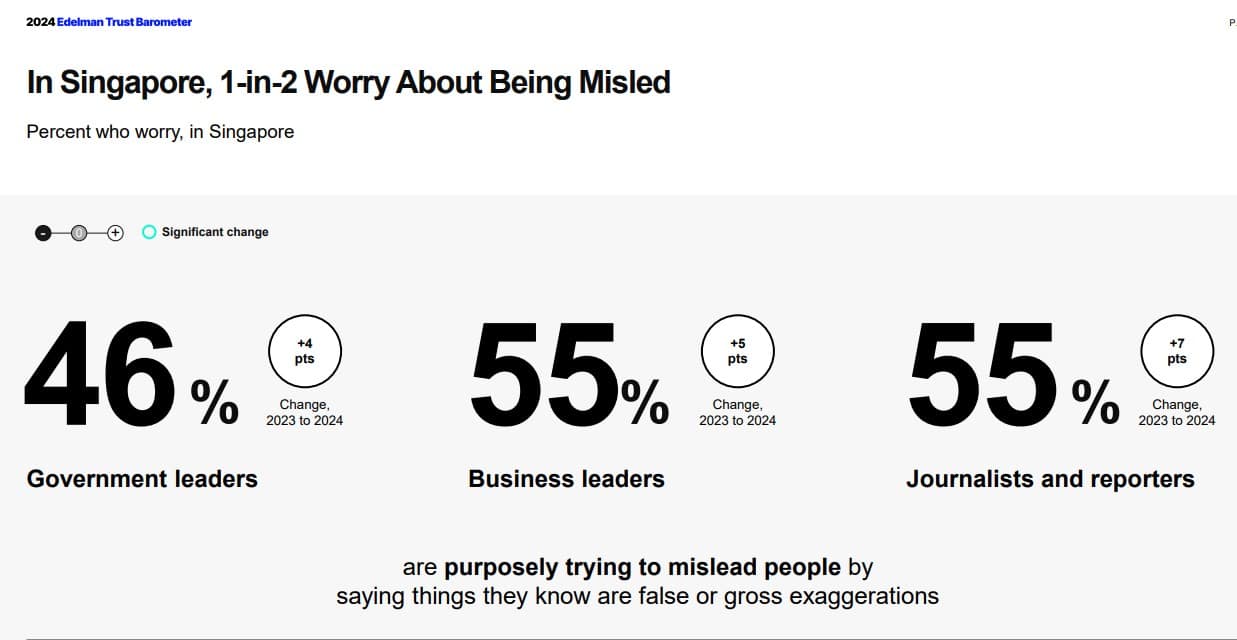
On Tuesday (12 March), Edelman released the 2024 Edelman Trust Barometer.
Conducted in November of the previous year, the firm surveyed over 32,000 respondents across 28 countries, amounting to approximately 1,150 respondents per country, including Singapore, for its 24th annual global survey on trust and credibility.
According to the report, China emerged as the global leader in trust with a score of 79 on the trust index, while Singapore scored 67, trailing behind countries such as Indonesia (73), Saudi Arabia (72), Thailand (70), and Malaysia (68).
The Trust Index represents the average percentage of trust in non-governmental organizations (NGOs), businesses, government entities, and media within each country.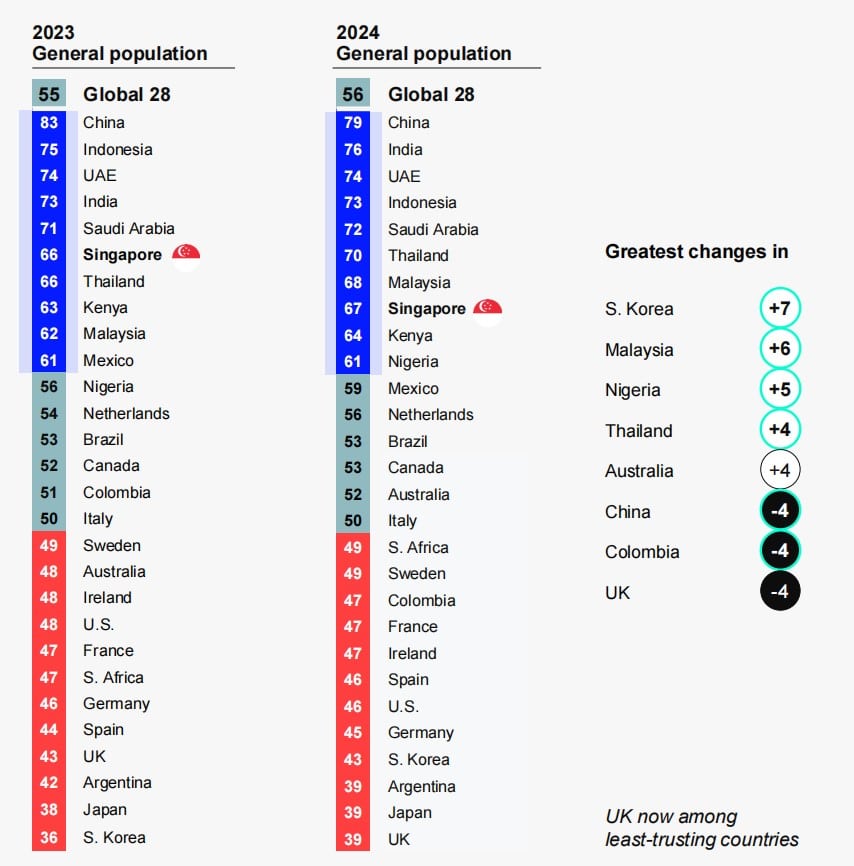
93% of employed Singaporean respondents fear job loss
Nevertheless, the report highlights that respondents in Singapore still perceive the government as the most trusted institution, with all institutions—including businesses and NGOs—regarded as both competent and ethical.
Among the four institutions surveyed, Singaporean respondents exhibited the highest level of trust in the Government's ability to "do what is right" (77 %), followed by NGOs (66 %), businesses (63 %), and the media (60 %).
The survey also unveiled that over half of the respondents in Singapore believe that society and technology are evolving too rapidly and in ways that do not necessarily benefit them.
Furthermore, more than a quarter (28 %) of Singaporean respondents feel that innovation is poorly managed, while 24 % express satisfaction with its management.
Despite this, when it comes to regulating emerging innovations, half of Singaporeans—compared to 59 % globally—believe that government regulators lack adequate understanding of emerging technologies to regulate them effectively.
There is a notable correlation between feelings of mismanaged innovation and the belief that both technology and society are leaving individuals behind.
In addition, almost six in ten (57%) Singaporeans feel that the government and organizations that fund research exert too much influence on the direction of scientific endeavours.
The report also indicates that 93% of employed respondents in the country are anxious about job loss—a 3 percentage point increase from 2023.
The anxiety supported by the growing number of retrenchments taking place in the country is evident in the latest report by the country’s manpower ministry.
The total number of retrenchments in 2023 reached 14,590, more than doubling the record low observed in 2022.
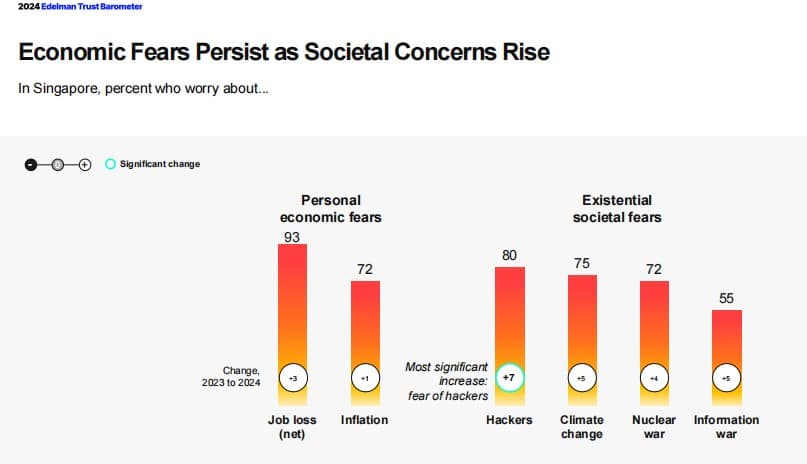
There is also a 7 percentage point rise in Singapore’s general population (80%) who worry about hackers, and a surge of 5 percentage points in those who are concerned about climate change (75%).
Ms Julia Wei, the Chief Executive Officer of Edelman Singapore, observes that an "enduring and stable ecosystem of trust" has emerged in the country following the COVID-19 pandemic.
"Despite this ecosystem of trust, people in Singapore ... are wary of what they read and hear," she said.
"This scepticism could be a negative outcome of an increasingly polarised world, where traditionally trusted spokespersons and sources of information are viewed as partisan and biased," Ms Wei added.