

Minister Fu suggests mindfulness showering as water-saving advice amidst 18% hike over 2 years
Grace Fu, Singapore's Minister for Sustainability, has emphasized habit changes to promote eco-friendliness and conserve water and electricity. \n \nHer suggestions included setting air conditioning at 25°C and practicing mindful showering. Additionally, she proudly highlighted her bathroom's "smart metering" for efficient water use. \n \nThis advice from Ms Fu is issued at the back of an 18% hike in water prices between 2024 and 2025, and a 5% increase in electricity tariffs from Jan-Mar 2024, attributed to the current and expected rise in carbon tax.
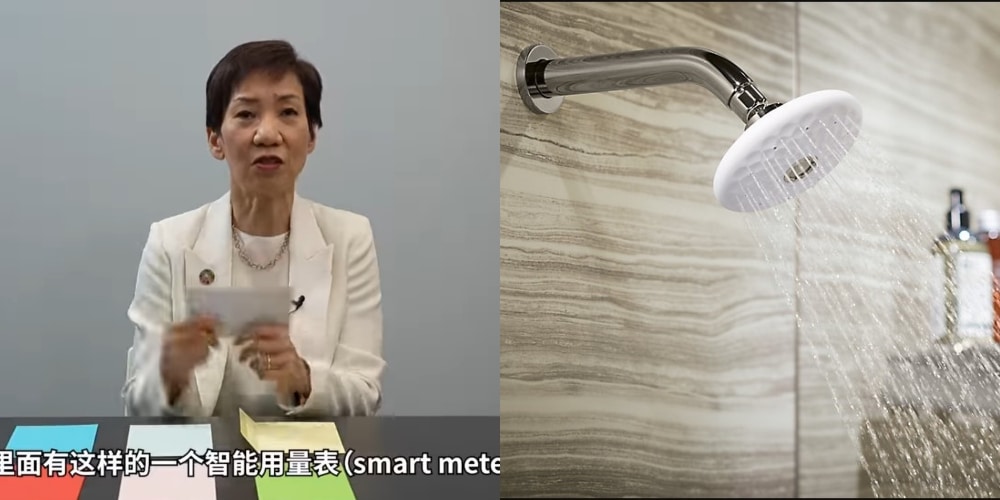

Addressing inquiries on environmentally friendly practices and conserving water and electricity, Singapore's Minister for Sustainability and the Environment, Grace Fu, emphasized the importance of altering habits.
Among the suggestions, she recommended adjusting the air conditioning to 25 degrees Celsius and practising water mindfulness during showers.
Ms Fu even proudly highlighted her home bathroom's "smart metering system," showcasing its ability to demonstrate efficient water use.
During a pre-2023 Christmas Q&A with Lianhe Zaobao, Fu delved into advice on eco-friendly habits, responding to Singaporeans' concerns about embracing sustainable lifestyles.
Among the public's inquiries were worries about excessive festive packaging and online shopping habits.
In response, she advocated for businesses to opt for recyclable packaging materials and suggested consumers consolidate their orders to reduce transportation and resource consumption.
"For instance, businesses could make packaging more environmentally friendly by reducing the quantity used or using materials that are more easily recyclable."
"As for consumers, consolidating orders can reduce the frequency of transportation logistics, which contributes to saving fuel, electricity, and energy," she added during the interview conducted in Mandarin.
Ms Fu cautioned against impulsive buying due to online discounts, "Sometimes, we're tempted by exaggerated discounts and rush to order, only to realize later that we've ordered the same thing from multiple places and regretted it, leading to discarding the excess. "
When asked about her experience with excessive online shopping, Minister Grace Fu responded humorously, recalling that during the Black Friday sale, she and her son " seemed to be competing to see who received more parcels. "
Another query raised by the public addressed the rising prices for goods and whether government procurement contracts consider prioritizing environmental protection, posing a challenge for businesses or contractors to profit.
The question also inquired if the government would offer more discounts for environmentally friendly bidders.
In response, Minister Fu affirmed the government's proactive stance in promoting eco-friendly practices.
She mentions that sometimes environmentally friendly technologies may not be the cheapest initially, but through government procurement, the aim is to increase demand, reduce costs, and make these technologies more accessible.
"For example, solar panels were initially expensive, but as the procurement volume increased, the cost per unit decreased."
During the MSE's Committee of Supply (COS) debate in March 2023, Ms Fu announced plans to integrate environmental sustainability criteria into the assessment of large construction and information and communications technology (ICT) tenders starting in 2024. This move aims to green the government's supply chain.
She further explained that the government would assess tenderers' efforts in reducing packaging waste and carbon footprint during bid evaluations. As this is a new initiative, the government plans to allocate up to 5 per cent of evaluation points to environmental sustainability criteria.
"Habit changes" as water and electricity saving advices
Concerns about water and electricity consumption are rising among ordinary Singaporeans, particularly as Singapore plans an 18% increase in water prices between 2024 and 2025.
The upcoming price adjustments will see households paying an additional 20 cents per 1,000 litres of water in 2024, followed by a further 30 cents in 2025.
At the same time, electricity tariffs for households supplied by SP Group will see a 5% hike from 1 January to 31 March 2024, reaching 32.58 cents per kilowatt-hour (kWh) after the Goods and Services Tax (GST).
This increase from the current rate of 31 cents is partly attributed to a forthcoming rise in carbon tax, from S$5 to S$25 per tonne of emissions, aimed at steering the nation towards a low-carbon economy.
Responding to public concerns about increased air conditioning usage and more showers due to hotter weather linked to climate change, Minister Fu highlighted the importance of altering habits to conserve water and electricity.
She recommended setting air conditioning at 25 degrees Celsius and adopting mindful shower practices, such as pausing water flow while shampooing and then resuming for rinsing.
"This can save a lot of water, something I've experienced personally, " she added that her bathroom has a "smart metering" that shows how water can be used more efficiently.
It is not known whether Ms Fu's "smart water metering" in her private bathroom is the same as the Smart Water Meter Programme, which was progressively rolled out by Singapore's National Water Agency, PUB.
A Smart Water Meter records the volume of water used and transmits the data remotely to PUB daily via the digital communications network, thus removing the need for manual readings.
Such data would enable PUB to better optimise water demand management and customers to better track and manage their water usage habits. Under the first phase of the programme, PUB commenced the installation of smart water meters in Tampines Central since January 2022.
PUB still aims to install about 300,000 smart water meters in Bukit Batok, Hougang, Jurong West, Tuas, Tampines, and Tengah by 2023 under the first phase of the programme.
PAP Minister defended that water price needs to be increased to cater for future consumption
In a 4 October 2023 Parliamentary session, Dr Amy Khor, the Senior Minister of MSE, shed light on the financial intricacies of PUB (Singapore’s National Water Agency) and the reasons behind the water price revision.
Dr Khor emphasized that despite popular misconceptions, PUB operates without generating profits.
A scrutiny of the PUB’s annual reports reveals a Net Income of $2.4b after Government Grants and Contributions to the Consolidated Fund and Tax over the decade preceding FY2021.
Dr Khor pointed out that taking a closer look at PUB’s financial statements, in 2020, the agency had a net operating income of a positive S$10 million.
However, fiscal year 2021 witnessed a significant shift, with net operating income before government grants plummeting to a negative S$109 million, further widening to a negative S$264 million.
“After government grants, yes, it has become positive, but actually if you look at the revenue, the net income generated, whatever is generated is actually plowback reinvested to fund the operating expenditure of the water system as well as ongoing investments, in fact, it’s not enough.”
The revenues generated are consistently reinvested into the system to ensure its sustainability and reliability, said Dr Khor.
Dr Khor provided an illustrative example, noting that the net income after government grants for the fiscal years 2018 to 2022 amounted to 1.5 billion dollars.
“Some people talk about S$2.4 billion and so on net surplus. But between 18 2018 to 2022 is S$1.5 billion, and actually, that is really needed as I’ve said to fund the operating expenditure as well as investments. ”
She stressed that the capital investments required to meet future water demand amounted to a substantial $3 billion.
“Therefore PUB has actually had to in addition borrow from the market, and issue bonds, which we did for instance last year, S$800 million green bonds borrowed from the market for long-term infrastructure projects.”
Pritam Singh, the Leader of the Opposition, asked why there was a relatively short period between the 2018 water price increase of 30 per cent and the latest announcement of an 18 per cent increase.
He questioned the relevance of the water conservation tax, especially given the declining household water consumption patterns in recent years.
He suggested that implementing more water-efficient features for households might be a more effective policy tool.
Regarding the water conservation tax, Dr Khor clarified that the tax was not meant to generate profits but rather to reflect the actual cost of water and incentivize consumers to use water wisely.
She explained that the water tariff, together with the water conservation tax, constituted the price of water, reflecting the cost of production, supply, and conveyance of water.
Singapore’s water consumption per head declined from 165 litres per day in 2000 to 149 litres per day in 2022.
With the Green Plan 2030 serving Singapore's strategy for a sustainable future and outlining environmental goals, the nation aims to lower daily water usage per individual to 130 litres.


