Photos from US troops reveal extensive damage at bases hit by Iranian strikes
Photos from US service members show destroyed aircraft, barracks and vehicles at US bases across the Middle East, a day after a Pentagon watchdog put US equipment losses from the Iran war at up to US$3.7 billion.
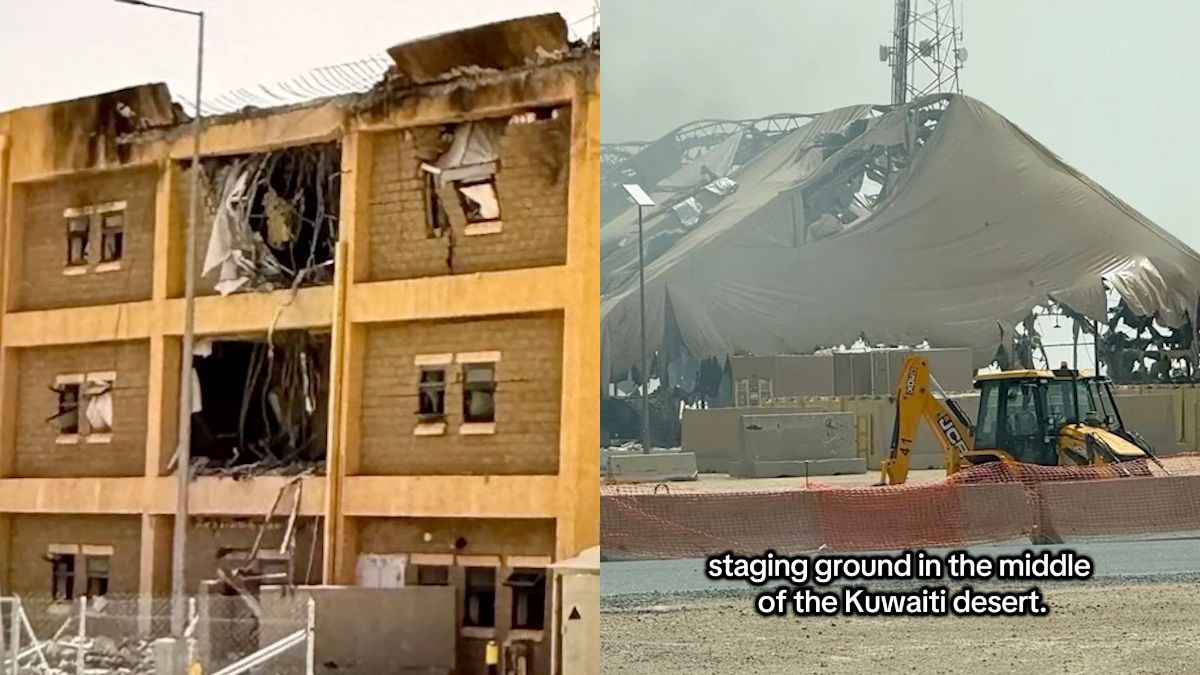
- Photos from US service members show destroyed aircraft and buildings at US bases in Saudi Arabia and Kuwait.
- Pentagon watchdog puts Iran war equipment losses at US$3.7 billion, including nearly 60 aircraft.
- A service member rejected Pete Hegseth's "squirter" framing, saying US bases are not being defended.

Photographs obtained by CBS News show extensive destruction of buildings, vehicles and aircraft at several United States military positions across the Middle East, caused by Iranian missile and drone strikes.
Jonah Kaplan reported the images for CBS News on 15 September 2026. They were supplied by active-duty service members, who asked not to be named because of strict military restrictions on speaking to the media.
The images emerged shortly after the Department of Defense Office of Inspector General (DoD OIG) published its first public report on the war with Iran. The report put US equipment losses at up to US$3.7 billion.
Service members say the damage was not disclosed
One deployed service member told CBS News that the major damage to US bases had not been communicated to the American public. The service member compared the troops' position to being struck repeatedly without being able to see the blows coming.
The same service member rejected the idea that only isolated projectiles had got past US air defences. "We're not defending these bases. We're just watching them get destroyed," the service member said.
The Pentagon did not respond to a request for comment from CBS News.
Damage at Prince Sultan Air Base
One photograph from Prince Sultan Air Base in Saudi Arabia shows a direct hit on the rear half of a Boeing E-3 Sentry, a four-engine airborne warning and control aircraft. According to CBS News, its tail was severed from the charred fuselage.
The fuselage also carried the aircraft's rotating radar, which is essential for gathering intelligence in flight.
When the loss of an E-3 at the base was reported earlier in the conflict, retired US Air Force Colonel Cedric Leighton told CNN that the loss of its radar dome was a serious setback to US surveillance capabilities.
According to The War Zone (TWZ), the US fleet then had only 16 E-3 aircraft, not all of them ready to fly. The aircraft are used to detect incoming missiles and to help coordinate airstrikes.
Other photographs from the base, CBS News reported, show hollowed-out buildings and barracks standing beside undamaged concrete "T-wall" barriers.
Such barriers were once regarded as essential protection against grenade and mortar attacks. According to CBS News, they proved largely ineffective against attacks from the air.
Kuwaiti bases also hit
Similar scenes were photographed at Camp Buehring in Kuwait. The post lies in a remote desert area far north-west of Kuwait City and is a major staging area for US Army ground troops, armoured vehicles and some aircraft.
Images from Camp Buehring show destroyed trailers and a wrecked car. Another photograph shows a damaged building at Camp Arifjan, a separate US installation in Kuwait. None of the images published by CBS News is dated.
Inspector general tallies the losses
The DoD OIG report was released on Monday, 14 September 2026. It is the first report of its kind that the law requires the inspector general to send to Congress.
It covers Operation Epic Fury, the US military campaign against Iran, from its launch on 28 February 2026 to 30 June 2026.
According to CBS News, the report lists equipment losses that include nearly 60 aircraft. It also states that US Central Command (CENTCOM) reported Iranian strikes on US bases in eight countries.
Those countries are Kuwait, Bahrain, Qatar, the United Arab Emirates (UAE), Saudi Arabia, Iraq, Oman and Jordan.
Breaking Defense reported that the inspector general describes hundreds of buildings and dozens of aircraft as damaged or destroyed. The report also warns that munitions use during the operation has created "strategic inventory shortfalls".
NBC News reported that the aircraft lost or damaged include four F-15E fighter jets, an F-35A and an A-10. The list also includes 12 KC-135 refuelling tankers and nine other aircraft.
The drone industry publication DroneXL reported that the report counts as many as 30 MQ-9 Reaper drones destroyed over the same period. According to DroneXL, that exceeds all crewed aircraft losses in the report combined.
The cost of the war
The inspector general estimates the cost of the operation at US$33.4 billion as of 29 June 2026. That figure comprises US$22.3 billion in expended munitions, US$3.7 billion in equipment losses and US$7.4 billion in other obligations.
The estimate does not include the cost of repairing damaged facilities. According to Breaking Defense, damage totals will rise in future reports because the current one covers only the period to 30 June.
NBC News reported in July that US officials and people familiar with internal assessments put the war's cost at between US$80 billion and US$100 billion. At the time, the Pentagon publicly estimated it at US$37.5 billion.
According to NBC News, the report also records more than US$208 million in damage to State Department assets in Iraq, Kuwait, Saudi Arabia and the UAE, including US$184 million in damage to diplomatic facilities.
DroneXL reported that the report lists 417 US service members wounded in action by 30 June 2026.
Dispute over the Port of Shuaiba attack
The service member's comments referred to language used by US Secretary of Defense Pete Hegseth after the attack on the Port of Shuaiba in Kuwait.
On 1 March 2026, the second day of the war, an Iranian drone struck a tactical operations centre at the port, killing six US soldiers.
According to IBTimes UK, all six belonged to the 103rd Sustainment Command, an Army Reserve unit based in Des Moines, Iowa. More than 20 others were wounded.
At a Pentagon news conference the day after the attack, Hegseth said US air defences intercepted most incoming threats. According to CBS News, he said that occasionally one got through, adding, "we call it a squirter".
Hegseth also described the struck operations centre as fortified. In April 2026, survivors disputed his account. NewsNation reported that one injured soldier told CBS News the site had not been fortified and called the Pentagon's portrayal "a falsehood".
Representative Pat Ryan, a Democrat, later led a group of House Democratic veterans in writing to Hegseth to demand an investigation into force protection failures.
The lawmakers' letter argued that the deaths resulted from insufficient overhead protection against one-way attack drones, a threat they described as known and predictable.
House votes again to end the war
On 15 September 2026, the US House of Representatives passed a resolution directing President Donald Trump to end the war with Iran, according to the Washington Examiner. The measure passed by 220 votes to 204.
It was the third time the House had approved such a resolution. Seven Republicans voted in favour, three more than in the two previous votes.
Republican Representatives Thomas Massie, Tom Barrett, Warren Davidson and Brian Fitzpatrick again supported the measure. Representatives Nancy Mace, Mariannette Miller-Meeks and Zach Nunn backed it for the first time.
The House had earlier passed similar resolutions by 215 votes to 208 on 3 June 2026 and by 214 votes to 208 on 23 July 2026. The June measure was also approved by the Senate, though its binding force remains disputed.
NPR also reported that a Senate Democratic war powers resolution failed by 47 votes to 49 after the July vote. Trump has dismissed the war powers votes as "meaningless".