Trump drops 20% Hormuz toll plan, opts for Gulf investment deals instead
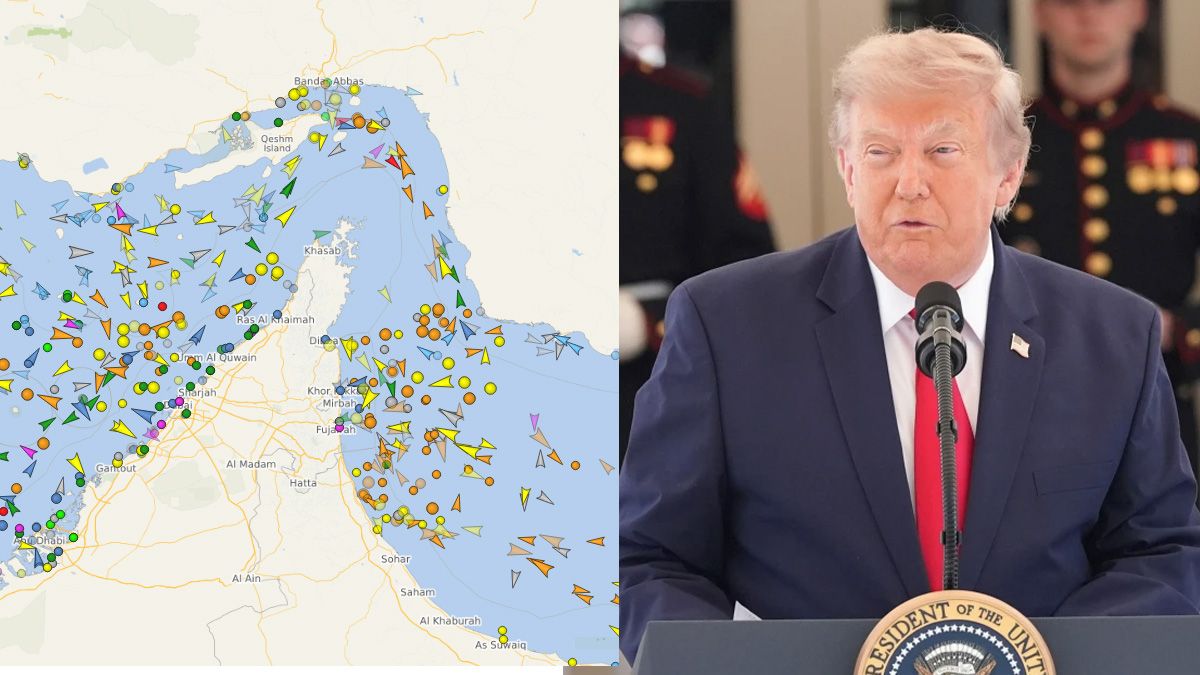
US President Donald Trump has scrapped a proposed 20% toll on cargo transiting the Strait of Hormuz, saying Gulf states will instead make "massive" investment and trade deals with the United States.
- Trump scraps 20% Hormuz toll, cites forthcoming Gulf investment deals instead.
- US resumes naval blockade of Iranian ports; fresh strikes and retaliation reported.
- Oil prices rise as ceasefire deal falters; mediators scramble to prevent wider war.

President Donald Trump has abandoned a proposal to impose a 20% toll on cargo transiting the Strait of Hormuz, saying Gulf states will instead pursue investment and trade deals with the United States.
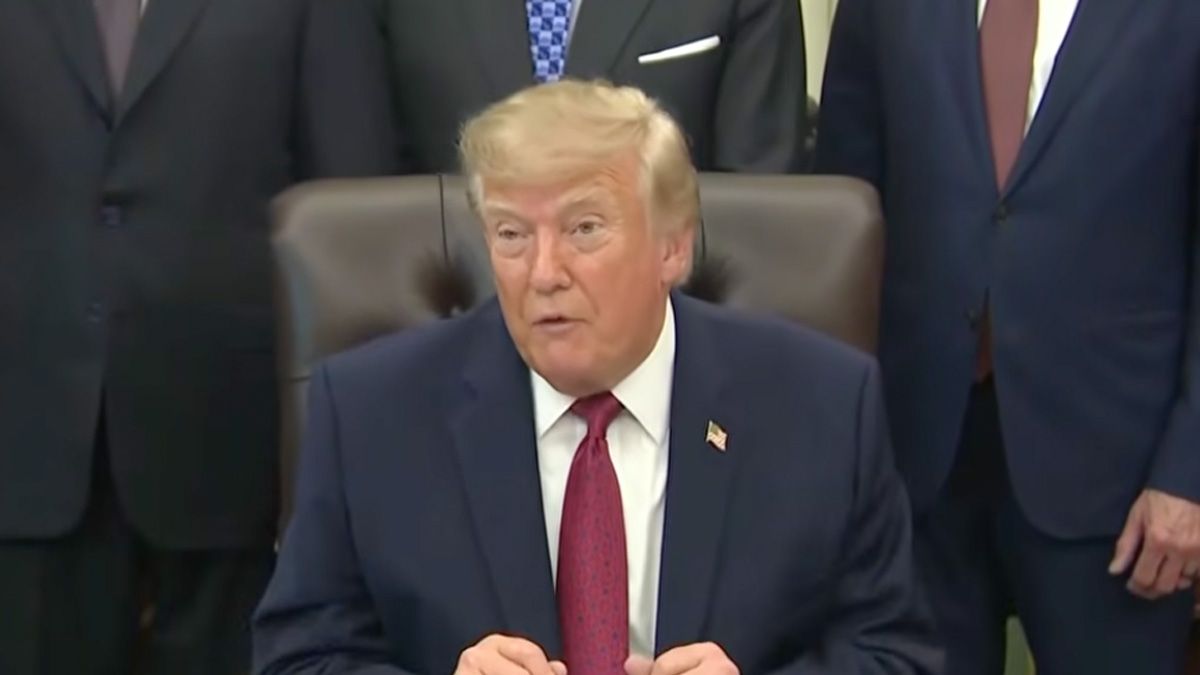
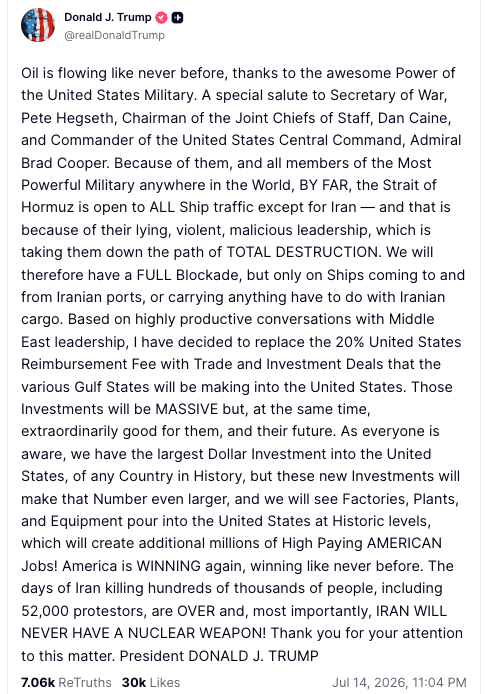
"Based on highly productive conversations with Middle East leadership, I have decided to replace the 20% United States Reimbursement Fee with Trade and Investment Deals that the various Gulf States will be making into the United States," Trump said in a social media post on Tuesday, 14 July 2026.
Trump said the investments "will be MASSIVE" and would bring factories, plants and equipment into the United States "at Historic levels", creating "millions of High Paying AMERICAN Jobs". He did not provide further details, and it remains unclear whether these would represent new commitments beyond those he announced following a visit to the Middle East last year.
The reversal came a day after Trump first proposed the toll, and amid a fresh escalation in the conflict between the United States and Iran. The interim ceasefire agreement, intended to reopen the strait and give negotiators 60 days to reach a permanent settlement, appeared close to collapse.
Strikes and retaliation across the region
The US military's Central Command said it struck several areas inside Iran on Tuesday, targeting coastal defence systems, missile and drone sites, and maritime capabilities. Iran acknowledged the strikes but gave no immediate casualty or damage figures.
"These strikes will continue imposing a heavy cost on Iranian forces and degrade their ability to attack innocent civilians and commercial shipping in the Strait of Hormuz," Central Command said in a statement.
Iran responded with attacks on Bahrain and Jordan and against three tankers transiting the strait. Kuwait's military said it had responded to a separate aerial attack, without providing further details.
Two tankers associated with the United Arab Emirates, the Mombasa and the Al Bahiyah, were set ablaze after being struck while passing through Omani territorial waters. The UAE's Ministry of Defence said the attack, involving two Iranian cruise missiles, killed one mariner and wounded eight others. The Emirates said it would retaliate.
Dutch shipping firm Stolt Tankers said its vessel, the Stolt Magnesium, was also attacked off Oman, sparking a fire in the engine room. The company said all crew members were safe.
Iran's Revolutionary Guard said the Mombasa and Al Bahiyah had "ignored repeated warnings" before being struck.
Hours after the United States said it had ended its wave of strikes, the Iranian city of Bushehr was hit in at least four locations, according to the state-run IRNA news agency, raising the possibility that Gulf Arab states had carried out retaliatory attacks of their own.
Bahrain, home to the US Navy's Fifth Fleet, sounded missile alert sirens three times on Tuesday. Jordan's military said it had intercepted four missiles fired from Iran. The European Union Aviation Safety Agency warned airlines against operating in the airspace of Bahrain, Kuwait, Qatar and the UAE, as well as over the Gulf of Oman, citing a "high risk to civil flights".
Blockade resumes, toll plan scrapped
Central Command confirmed that a naval blockade of Iranian ports resumed at 4pm US Eastern Time on Tuesday, equivalent to midnight Wednesday, 15 July 2026, in Dubai. The blockade replaces one the United States had lifted in mid-April as part of the interim deal.
"We will therefore have a FULL Blockade, but only on Ships coming to and from Iranian ports, or carrying anything have to do with Iranian cargo," Trump said, adding that the Strait of Hormuz remained "open to ALL Ship traffic except for Iran".
The now-abandoned 20% toll would have marked a departure from longstanding US policy guaranteeing free passage through the strait, and from recent assurances given by US Secretary of State Marco Rubio during a trip to the region.
Under the interim deal, Iran had agreed that passage would remain free of charge for 60 days, though the agreement left unresolved what would happen afterwards. Iran maintains it has the right to manage, and potentially charge for, traffic through the strait, a position the United States disputes.
Market and diplomatic fallout
Oil prices rose on the news. Front-month Brent crude futures climbed 2.6% to above US$85 a barrel, trading as high as US$87 at one point on Tuesday, still well below the near US$120 reached at the height of the earlier war. West Texas Intermediate futures rose 2.2% to US$79.89, trading as high as US$81. US natural gas benchmark Henry Hub futures held stable at US$2.92 per million British thermal units.
Regional mediators were working to bring the United States and Iran back to the negotiating table, according to two regional officials speaking on condition of anonymity. Pakistan-led mediation efforts were said to be under way around the clock in an attempt to reactivate the ceasefire.
Separately, Lebanese and Israeli delegations were due to meet in Rome on Tuesday to continue US-mediated talks. Hezbollah, an ally of Iran, had joined the earlier war in support of Tehran after the United States and Israel launched their campaign on 28 February, prompting an Israeli ground invasion of Lebanon.
Last month, Lebanon and Israel announced a framework agreement providing for Israeli withdrawal from southern Lebanon in exchange for Hezbollah's disarmament, though implementation has stalled.
Analysts noted that a broader return to war between the United States and Iran could further threaten that fragile truce.