Desmond Lee: Singapore reclaimed 74.5 sq km of land, costs S$13 billion from Past Reserves in 2000-2023
From 2000 to Jun 2023, Singapore reclaimed around 74.5 sq km of land, costing S$13 billion from Past Reserves. \n \nThis was disclosed by National Development Minister Desmond Lee in response to a PQ filed by NCMP Hazel Poa. \n \nIn November last year, Minister Lee unveiled the "Long Island" reclamation project, prompting public concerns about its potential long-term environmental impact and concerns from MPs over measures in place to ensure the sand used in the reclamation are ethically sourced from other countries.

SINGAPORE: From 2000 to Jun 2023, approximately 74.5 square kilometres of land has been reclaimed in Singapore, as disclosed by National Development Minister Desmond Lee.
Since the year 2000, the expenses associated with land reclamation projects have been drawn from the Past Reserves, with the cumulative cost reaching approximately S$13 billion (approximately US$97 billion) for projects completed during this timeframe.
Minister Lee shared this information in a written response to a Parliamentary inquiry submitted by Hazel Poa, a Non-constituency Member of Parliament (NCMP) from the Progress Singapore Party (PSP).
Ms Hazel Poa had asked the Minister for the total cost incurred by land reclamation projects and the total area reclaimed since 2000.
She further sought details of the reclaimed land that had since been sold via Government Land Sales (GLS), and what is the total area original costs incurred and land sales proceeds.
In response, Minister Lee divulged that approximately 0.5 square kilometres of the reclaimed land had been sold through GLS, generating proceeds amounting to approximately S$462 million.
"As reclaimed land forms part of our Past Reserves, the proceeds from the sale of reclaimed land accrue back to the Past Reserves, " Mr Lee added.
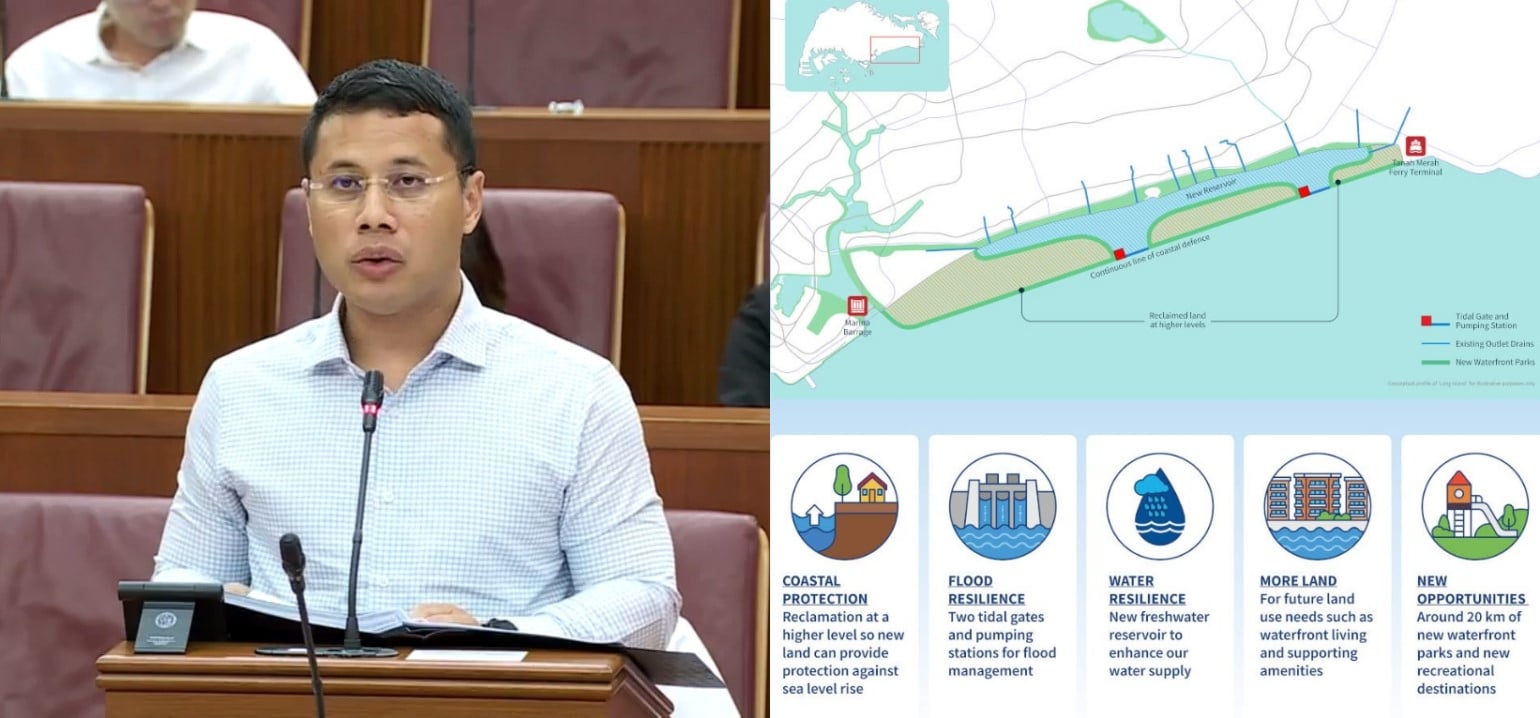
On 28 November 2023, Minister Desmond Lee unveiled a new reclamation initiative focused on integrating coastal defence strategies along the East Coast.
Referred to as the “Long Island” concept, this project is slated to undergo comprehensive technical studies over the next five years to assess its feasibility.
Envisioned as an expansive endeavour, the “Long Island” project aims to reclaim approximately 800 hectares of land—equivalent to about 1,142 football fields—an area twice the size of the iconic Marina Bay.
Minister Lee: Sand imported from 'variety of sources'
Nevertheless, members of the public have expressed valid concerns about the project, particularly regarding its potential long-term environmental impact.
In response to separate PQs filed by Workers' Party MPs—Associate Professor Jamus Lim, Mr Louis Ng, and Ms He Ting Ru—Minister Lee emphasized that importers bringing reclamation sand to Singapore must adhere to the laws and regulations of source countries, sourcing sand only from legally permissible areas.
Importers are also required to obtain proper export documentation and permits from relevant authorities, ensuring compliance with local environmental regulations for the extraction and transportation of sand within source countries, Mr Lee told the House during a Parliamentary session on Tuesday (9 Jan).
When queried by Assoc Prof Jamus Lim about the sand's origin and the potential social and ecological impact of sand-dredging, Minister Lee underscored that the import of reclamation sand is a commercial process involving sourcing from a variety of global locations.
Mr Louis Ng sought details on the countries from which Singapore plans to import sand and inquired about a responsible sourcing framework.
Mr Lee responded that the import process is commercial, highlighting that information about the quantity of sand imported from various countries is available online.
“The list of countries where we import from – some of this is available online in terms of the quantity of sand,” he added.
“Where applicable, our agencies will check that the necessary environmental-related approvals from source countries are in order before contractors are allowed to commence sand imports,” Mr Lee added.
According to the Observatory of Economic Complexity (OEC), Singapore has been the world's largest importer of sand for the last 20 years.
In 2021, Singapore imported US$72.4 million in sand, becoming the 9th largest importer of Sand in the world.
In the same year, sand was the 359th most imported product in Singapore. Singapore imports Sand primarily from: Malaysia (US$45.4 million), Philippines (US$17.2 million), Australia (US$6.29 million), Burma (US$1.18 million), and Uzbekistan (US$1 million).
Questions arise over long-term environmental impact and population worries with Singapore’s ‘Long Island’ plan
The concept of ‘Long Island’ was first mooted under the Concept Plan in 1991.
Initially proposed as part of Singapore’s urban development framework, the idea gained traction as a potential safeguard against the escalating impacts of climate change, particularly in mitigating the rise of sea level along the East Coast.
Prime Minister Lee Hsien Loong officially brought attention to the ‘Long Island’ initiative during the 2019 National Day Rally address.
Subsequently, it was prominently featured at the Urban Redevelopment Authority’s long-term planning exhibition the following year.
In November 2023, Minister Lee emphasized the vast opportunities the "Long Island" could offer to future generations of Singaporeans.
“This creates opportunities for future generations of Singaporeans,” said Desmond Lee in a speech delivered on Tuesday during an event.
“They could build homes, create jobs, develop services and amenities that they need, and add around 20 km of new coastal and reservoir parks, extending from the current East Coast Park. ”
“This would triple the length of the existing waterfront area along East Coast Park today.”
According to Mr Lee, The concept of “Long Island” is to project coastal protection seawards, by reclaiming three new tracts of land, at a higher level, away from the current coastline.
“This will allow us to retain the existing East Coast Park, largely as it is. It will also create an enclosed waterbody, preserving the waterfront character of the original East Coast Park. ”
“Over time, the waterbody will become a freshwater reservoir, which the public can use for water activities such as canoeing and dragon-boating. The reservoir will also add to our water supply.”
Upon the conclusion of the technical studies, Mr Lee highlighted the authorities’ commitment to involve the public in shaping the design and masterplan for ‘Long Island.’
Minister Lee emphasized the vast scale of the “Long Island” initiative, noting that its planning and execution will span several decades.