PM Lee says PAP stands for "pro-growth" and "pro-worker", netizens express disagreement
PM Lee lauded Singapore's Tripartism at the recent NTUC National Delegate’s Conference, crediting PAP's 'pro-growth and pro-worker' approach. \n \nYet, online discourse reveals divergent views—many voice ongoing struggles, questioning the reality of grappling with high living costs despite governmental assertions.
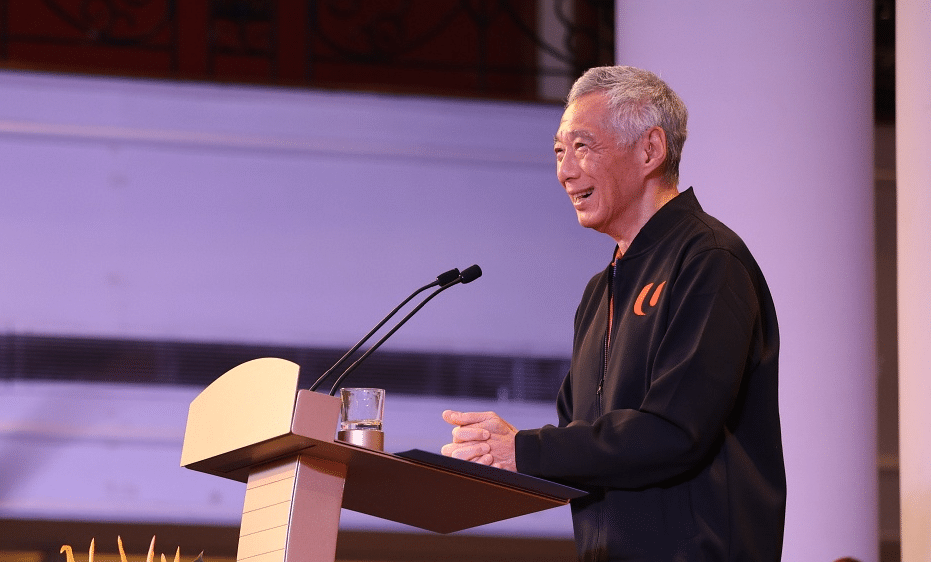

SINGAPORE: Prime Minister Lee Hsien Loong emphasized the efficacy of Tripartism in Singapore, attributing its success to the "pro-growth and pro-worker" stance of the People’s Action Party (PAP) government.
During the NTUC National Delegate’s Conference (NDC) held on Wednesday (22 Nov), Prime Minister Lee highlighted the dual focus of the PAP government at the national level: driving economic growth and ensuring that the workforce reaps the full rewards of this progress.
PM Lee, who is also the ruling party's secretary-general, underscored the government's substantial subsidies in crucial areas such as housing, healthcare, and education, emphasizing that these provisions are accessible to every Singaporean.
“We not only create good jobs but educate and train workers to enable them to perform these jobs. And that is why Singaporeans can look forward to better wages, higher standards of living, and brighter opportunities,” said PM Lee.
"With the government leading the country in the right direction, it is much easier for the tripartite partners to work together to create prosperity and to share the fruits of growth."
PM Lee elaborated on the concept of a “Singapore premium,” wherein companies and investors willingly invest more due to the nation’s harmonious industrial relations and business-friendly climate.
“They value being in a country that knows where it's heading, where everyone pulls together for the common good, everything works, and life can get better for all,” said PM Lee.
PM Lee emphasizes PAP's focus on "lean and efficient government"
PM Lee claimed the PAP committed not only to administering sound national policies but also to maintaining a government with minimal operational costs.
He stressed the PAP's endeavor to ensure that the expenses of governance remain as restrained as possible.
“Even as standards of living rise, our expectations and aspirations have all gone up. So although incomes have risen steadily year by year, many households still feel the pressures of the cost of living,” he said
PM Lee emphasized the PAP's focus on operating a "lean and efficient government", recognizing that all governmental initiatives and projects are ultimately financed by taxpayers.
He underscored the significance of maintaining low government spending and taxes, allowing workers to directly reap the rewards of their labor.
Furthermore, PM Lee highlighted the government's commitment to ensuring that essential public services such as public transport, water, electricity, and healthcare are not only cost-effective but also efficiently managed.
Addressing a common argument about public services not needing to generate profits, he countered, "I think that would be the wrong approach. Because that way, the transport operators and utilities providers would have no pressure to run efficiently."
PM Lee advocated for allowing these entities to earn reasonable profits, enabling them to reinvest in service improvements.
PM Lee says "some price increases will not be avoidable or ‘postpone-able’."
Addressing the cost of living concerns, PM Lee recognized the government's effective measures in moderating these expenses for many but acknowledged that specific households might still require additional aid.
Highlighting the contrast with broad subsidies prevalent in certain countries for utilities like electricity or water, PM Lee stressed the efficacy of Singapore's targeted approach.
He emphasized that generalized subsidies tend to benefit higher-resource-consuming households rather than those facing financial difficulties.
During challenging periods, PM Lee emphasized the government's thorough evaluation of fee increments, intending to defer or moderate non-essential hikes to alleviate immediate financial strains.
For instance, he noted the government's absorption of a substantial portion—two-thirds—of the anticipated increase in public transport fares for the year, amounting to S$300 million.
However, PM Lee acknowledged that some price adjustments might be unavoidable, cautioning against postponing them as it leads to larger shortfalls in the future.
"But some price increases will not be avoidable or ‘postpone-able’. And if you just push them off, it does not solve the problem. Because next year the shortfall will become bigger. Then what do you do?"
"And in that case, sometimes after thinking about it, we have no choice but to proceed, but we will also definitely be more generous with the targeted support to households.”
Netizens challenge PM Lee's view, pointing out persistent struggles amid rising living costs
While PM Lee has underscored the People's Action Party (PAP) as being "pro-growth" and "pro-worker," observations from the comments sections of mainstream media outlets like The Straits Times and CNA reveal that netizens have expressed significant concerns about the prevailing reality on the ground.
Many individuals continue to grapple with the challenges of making ends meet and coping with the cost of living.
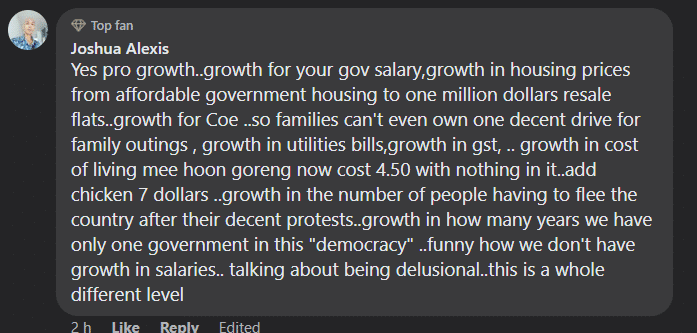
One netizen raised the question to PM Lee, highlighting citizens' ongoing struggles in putting food on the table.
The comment shed light on the plight of the isolated elderly population facing mobility issues and dealing with either no income or low income. Despite the presence of the Assurance Package aimed at assisting citizens, it appears to provide inadequate relief to those in dire need.
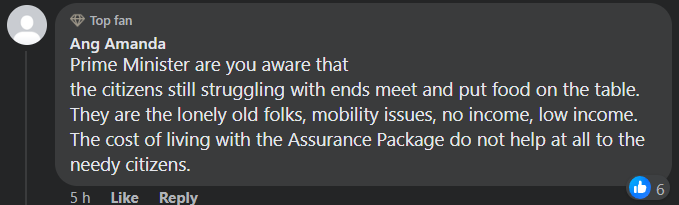
Another netizen sarcastically mentioned growth in government salaries, contrasting it with the soaring prices of government housing, which have escalated from affordable rates to reach exorbitant values of up to one million dollars in resale.
Additionally, the netizen highlighted the surge in utility bills, the growth in Goods and Services Tax (GST), and the rising cost of living, but the lack of growth in salaries despite various other aspects experiencing apparent growth.
Netizens question the necessity of certain highly paid Government positions
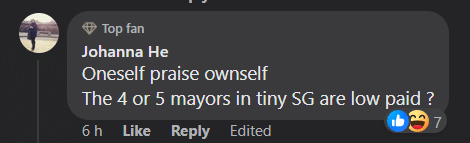
While PM Lee highlighted the People's Action Party's (PAP) commitment to a "lean and efficient government," some netizens raised pertinent queries challenging this claim. They questioned the necessity of certain highly-paid positions within the government structure.
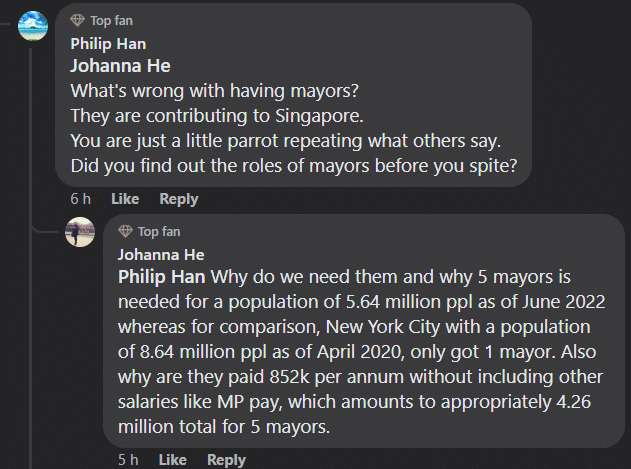
For instance, one netizen scrutinized the need for the appointment of five Singapore mayors.
While a pro-establishment IB argued in favor of the contribution made by mayors in Singapore, the netizen responded with critical questions regarding the necessity of multiple mayors in relation to Singapore's population size.
The netizen questioned the need for five mayors to manage a population of 5.64 million people as of June 2022, highlighting the disparity compared to New York City, which, as of April 2020, had a population of 8.64 million people but only one mayor overseeing the entire city.
Notably, Singapore Mayors earn quite a hefty paycheck, considering the size of the population they serve in each of the five districts.
According to the 2012 White Paper on Government salaries, Singapore Mayors earn an annual salary of S$660,000, on top of their annual MP allowance of S$192,500, excluding bonuses.
This is despite each of the five CDCs having a population of not more than one million residents.

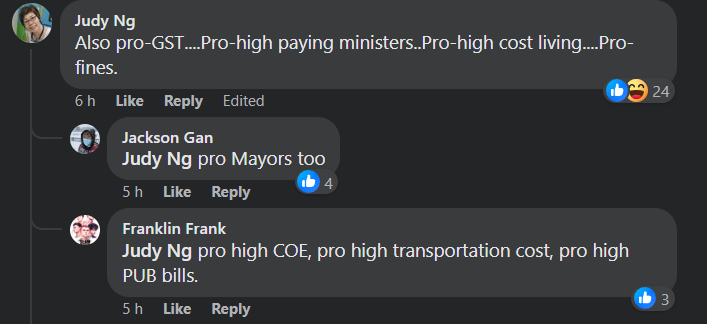
Netizens ridicule "PAP" could also stand for "pro-GST, and Pro-high cost living"
Certain comments made a wry remark, suggesting an alternative interpretation of the acronym "PAP" as "pro-GST, Pro-high paying ministers, Pro-high cost living," among other pointed criticisms.
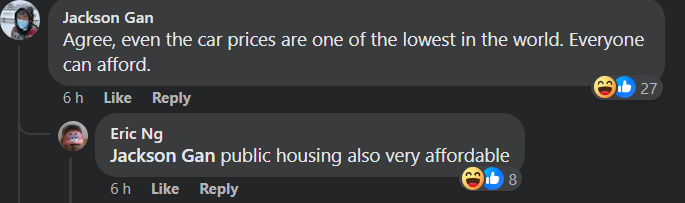
A netizen ridiculed that PM Lee might persistently tell voters that everything is still affordable as long as people keep voting ruling party every 5 years.