Israeli minister Ben Gvir unveils plan to remove most Palestinians from Gaza
Israel's National Security Minister Itamar Ben Gvir has unveiled a plan to remove 1.86 million Palestinians from Gaza within seven years through what he terms "voluntary emigration", demanding a dedicated emigration ministry as a condition for joining the next government after the 27 October election.
- Ben Gvir's plan seeks removal of 1.86 million Palestinians from Gaza within seven years.
- Scheme requires initial NIS 10 billion (US$3 billion) outlay, with Turkey and Ethiopia among destinations considered.
- Proposal comes amid sustained settler violence in the West Bank condemned by the US ambassador.

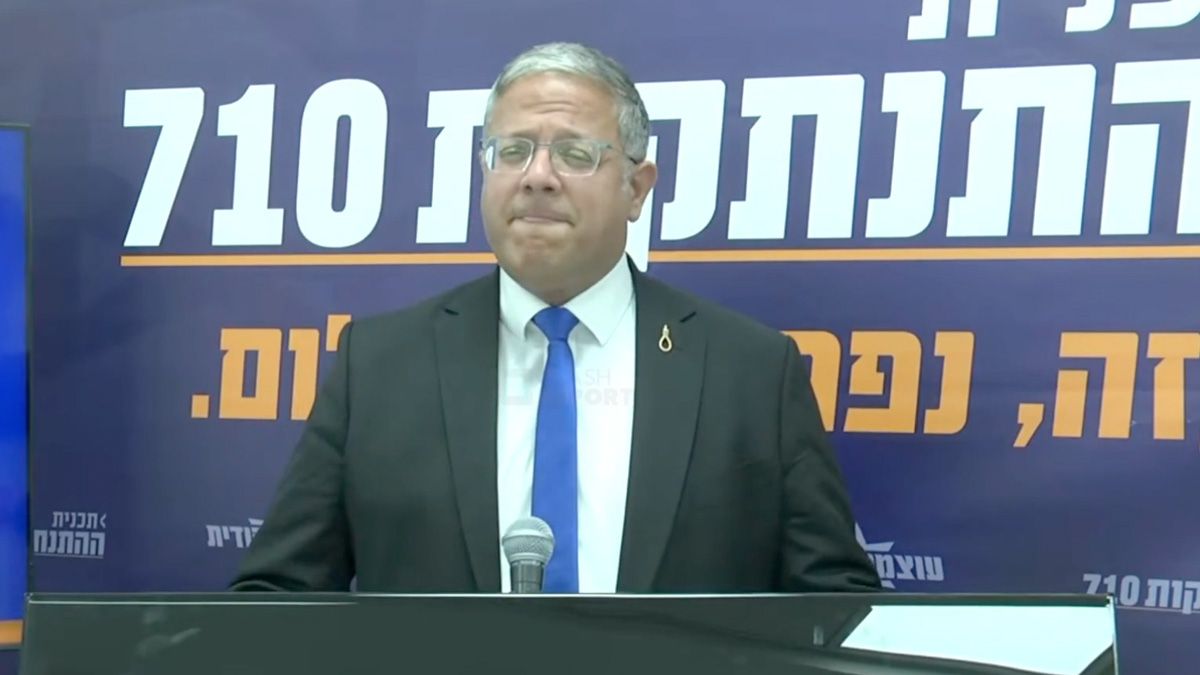
Israel's National Security Minister Itamar Ben Gvir on Thursday, 3 September 2026, unveiled a plan for the removal of the vast majority of Gaza's Palestinian population from the territory, describing the proposal as "realistic" and "concrete".
The plan seeks the departure of 250,000 Palestinians in its first year, 1.11 million within three years, and 1.86 million within seven years. Gaza's population is estimated at around 2 million.
Ben Gvir named the scheme "Disengagement 710", a reference to Israel's 2005 withdrawal from Gaza and to the Hamas-led attacks of 7 October 2023. Sections of the Israeli right have attributed the latter partly to the former.
The proposal is set out in a 20-page document titled "National Work Plan for Voluntary Emigration from the Gaza Strip". Ben Gvir said it represented "the result of a year and a half of work".
A senior cabinet position, not a fringe voice
Ben Gvir is not a backbench figure. As National Security Minister he holds ministerial responsibility for the Israel Police and the Israel Prison Service, placing him at the head of the state's principal domestic enforcement apparatus.
He chairs Otzma Yehudit, or Jewish Power, a coalition partner in the current government. Polling cited by The Guardian suggests the party would win around seven seats at the coming election.
According to The Guardian, Ben Gvir holds convictions for incitement to racism and for supporting a terrorist organisation, and has been placed under sanctions by several countries.
He said the establishment and leadership of an "emigration ministry" would rank among Otzma Yehudit's principal demands in negotiations to form the next government.
What the plan offers
Ben Gvir said those who left would receive an "absorption package" covering travel assistance, initial housing, vocational training, employment and support for up to 24 months.
The plan also envisages payments to receiving states calculated on the number of Palestinians each accepts. Otzma Yehudit has identified Turkey, Ethiopia, the Congo and unspecified Arab states as potential destinations.
The party said the proposal requires an initial Israeli investment of NIS 10 billion (US$3 billion), followed by up to NIS 50 billion (US$15.2 billion) in matching funds contingent on international participation.
Ben Gvir claimed there were countries "ready" to receive Palestinians from Gaza, without naming them.
"Instead of illusions of peace now, we need actions of emigration now," he said. "Instead of [Gazans] digging tunnels, it's time to pack suitcases."
He invoked Rehavam Ze'evi, the assassinated far-right minister who advocated population transfers of Palestinians from the West Bank and Gaza. "It's time to admit it: Gandhi was right," Ben Gvir said, using Ze'evi's nickname.
The legal position
The forced displacement of civilians from occupied territory is prohibited under Article 49 of the Fourth Geneva Convention and constitutes a war crime under the Rome Statute of the International Criminal Court.
The same article prohibits transfers in the opposite direction, barring an occupying power from moving its own civilian population into occupied territory. On that basis the UN Security Council, in Resolution 2334 of December 2016, held that Israeli settlement activity has no legal validity.
The International Court of Justice found in an advisory opinion of July 2024 that Israel's continued presence in the Occupied Palestinian Territory is unlawful and must end as rapidly as possible.
The Court treated the occupied territory as a single unit including Gaza, and held that Israel retains obligations as an occupying power there notwithstanding its 2005 withdrawal of settlements. Israel disputes that Gaza remains occupied. Advisory opinions of the Court are not binding.
Although the plan uses the term "voluntary", it is likely to be regarded internationally as coercive, given the conditions imposed on Gaza's population and Ben Gvir's stated objective of removing that population.
Earlier this year, an independent United Nations inquiry found that Israel was continuing to commit genocide through the deliberate targeting of Palestinian children in Gaza.
A pattern of ministerial statements
Ben Gvir's announcement followed remarks a day earlier by Defence Minister Israel Katz, who said plans to facilitate mass departures from Gaza remained under discussion and had merely been "frozen" by US President Donald Trump.
Speaking at a conference hosted by the Israeli newspaper Yedioth Ahronoth, Katz said Israel would facilitate the emigration "by any means". He added that the plan "is being discussed all the time".
Trump proposed relocating Gaza's residents in February 2025, prompting Israel to establish a Defence Ministry directorate tasked with facilitating what officials termed voluntary emigration.
That proposal drew strong objections, including from Egypt, and was rejected by Palestinians. Trump subsequently abandoned it amid international opposition and an absence of willing destination states.
In his Gaza peace plan of October 2025, Trump appeared to move away from the idea entirely, pledging instead to encourage residents to remain and to build a better Gaza.
In June, Israeli security officials were reported to be seeking to revive the shelved plan under a rebranded name intended to soften international resistance.
Ben Gvir said the shift in US rhetoric had legitimised his position. "At first, I was treated as a delusional extremist," he said. "Then, one day, everything changed."
Settler violence and the West Bank
The proposal comes amid sustained settler violence in the occupied West Bank, where attacks have surged since the war in Gaza began, according to the UN humanitarian office.
On Saturday, 5 September 2026, US Ambassador to Israel Mike Huckabee described the conduct as an "act of terror" during a visit to the village of Turmus Ayya, which has reported frequent settler attacks over the past year.
"If there are squatters that come in and put up their own flags and take possession of something that does not belong to them, if they burn a car, if they torch a mosque," Huckabee said, "that's a criminal act. But it extends beyond a criminal act."
He said the US Embassy could not investigate criminal activity but could tell its host government there were "specific crimes and acts of terror that cannot continue" without proper investigation and adjudication.
Huckabee met around ten Palestinian American residents who described the effect of the violence on their lives and property, the municipality told the Associated Press.
A week earlier, Netanyahu condemned the actions of what he called a "handful of rioters", and the Israeli foreign ministry described the settlers' actions as "a disgrace".
Israel has built close to 150 settlements in the West Bank, home to well over 500,000 settlers. Rights groups say the military frequently declines to act against settler violence.
Israel's defence minister recently announced plans to transfer law enforcement over settlers fully to the Israeli police, the force under Ben Gvir's ministerial responsibility.
A crowded far-right field
Israel goes to the polls on 27 October 2026. Parties must secure 3.25 per cent of the vote to enter parliament, and those falling short are excluded with their votes effectively discarded.
CNN reported that this arithmetic has intensified competition for right-wing voters among a growing field of small parties, pushing candidates towards harder positions to distinguish themselves.
Ben Gvir's proposal is not isolated. According to CNN, Ofer Winter, a retired brigadier general who launched his "Your People Israel" party in late August, said at its launch that the solution in Gaza was emigration and that there would never be a Palestinian state.
Moshe Feiglin, who leads the "Identity" party, has advocated the destruction of Gaza and the emigration of Palestinians to third countries, CNN reported. Neither Feiglin nor Avi Maoz of the "Noam" party is expected to cross the threshold.
CNN also reported that Finance Minister Bezalel Smotrich has celebrated settlement expansion in the West Bank and campaigns on a plan to bring a million additional Jewish residents to the Negev and Galilee.
Netanyahu has issued repeated public appeals for Ben Gvir, Smotrich and Winter to run as a single bloc, warning the right risks losing the election if any party falls below the threshold. The parties have so far continued separately.
Campaign messaging
Ben Gvir has made a series of interventions directed at his base. CNN reported that he has posted videos mocking Palestinian prisoners, including footage of detained Gaza flotilla activists, and has campaigned on a law he championed expanding the death penalty for Palestinians convicted of terrorism offences.
An AI-generated campaign video posted to his account showed rows of numbered Palestinian prisoners in brown uniforms moving along a conveyor belt into a fenced compound with watchtowers, appearing thinner and distressed after passing through. The caption read: "We promised - we delivered."
CNN reported the video was removed from Ben Gvir's account on X after more than 4 million views. He has long called for conditions for Palestinian security prisoners to be reduced to the minimum required by law.
He has also called for the deportation of two members of the Knesset and others he described as disloyal to the state of Israel, including Jewish citizens.
Continued occupation
Prime Minister Benjamin Netanyahu visited a military outpost in Gaza on Wednesday, 2 September 2026, and said Israel would not withdraw from the areas it occupies.
"We are not withdrawing. We are staying on this line. We control 60 per cent of the strip," Netanyahu said. Israel's deputy chief of general staff, Major General Tamir Yadai, put the figure at 65 per cent.
Both figures exceed the 53 per cent agreed under the ceasefire brokered last year, which halted major fighting but has not ended Israeli strikes.
The Hamas-run health ministry in Gaza reports that Israel's offensive has killed more than 73,400 people, including over 1,330 since the October 2025 ceasefire. The figure does not distinguish between combatants and civilians.