Netanyahu moves to sue Haaretz over report of UAE warning before 7 October attacks
Israeli Prime Minister Benjamin Netanyahu has instructed lawyers to begin defamation proceedings against Haaretz over a report that the UAE president personally warned him days before the 7 October 2023 Hamas attack. Netanyahu's office calls the report a total lie; Haaretz stands by it.
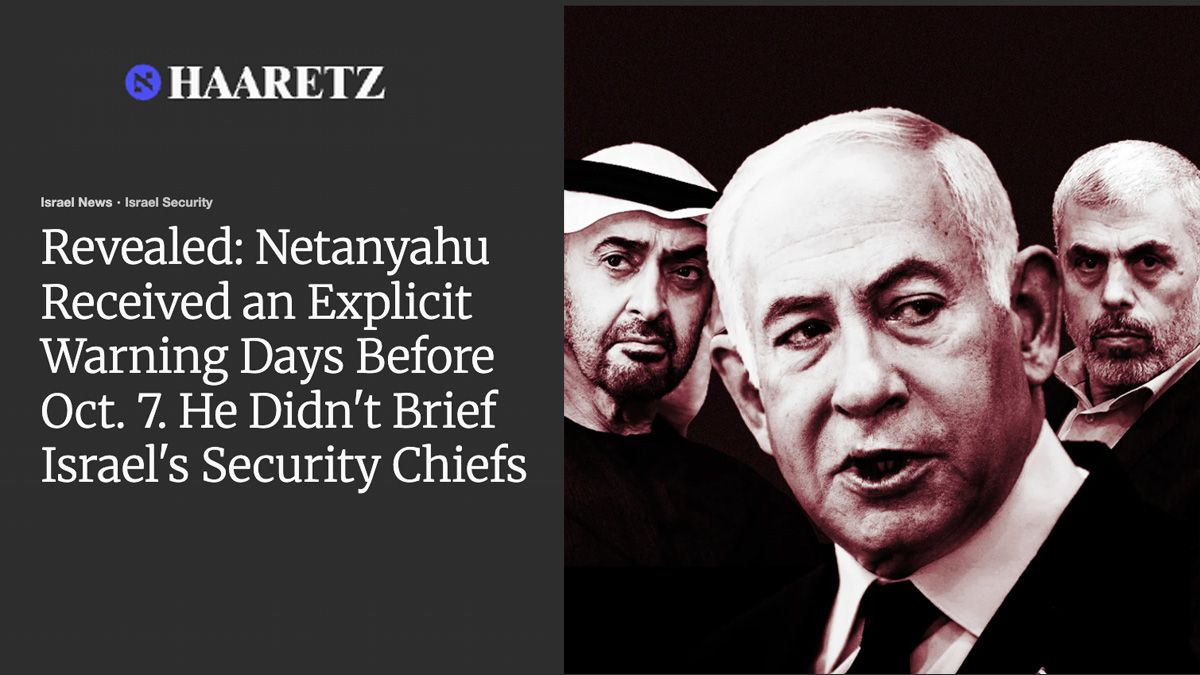

Israeli Prime Minister Benjamin Netanyahu has instructed lawyers to begin defamation proceedings against the newspaper Haaretz over a report that the leader of the United Arab Emirates personally warned him that Hamas was planning a major operation, days before the attacks of 7 October 2023.
The report was published on Tuesday, 8 September 2026. It is based on extracts from a forthcoming book by the journalists Shlomi Eldar and Ruth Yuval, rendered in English as Hostages: 843 Days of Abandonment.
According to Haaretz, the authors drew on interviews with dozens of sources, along with documents and correspondence. Three senior foreign officials were said to have been briefed on the contents of the disputed telephone call.
The newspaper also cited a Palestinian adviser to UAE President Sheikh Mohammed bin Zayed Al Nahyan. The adviser, who emigrated from Gaza to the UAE, was described as having direct knowledge of the conversation.
What the report alleges
Haaretz reported that a representative of the UAE embassy went to the Israeli prime minister's office in the final days of September 2023, carrying a special telephone to keep the conversation confidential.
During the call, said to have lasted 45 minutes, Sheikh Mohammed allegedly warned Netanyahu that the then Hamas chief in Gaza, Yahya Sinwar, was preparing a major operation against Israel.
The Emirati leader was described as concerned that such an event would cause bloodshed, destabilise the region and potentially damage the Abraham Accords, the normalisation agreements signed between Israel and several Arab states.
According to the report, Netanyahu reacted with relative calm. He is said to have assessed that Hamas intended to act in the West Bank, and to have assured Sheikh Mohammed that Israel was prepared for any scenario.
The collapse of prisoner talks
The report traces the warning to indirect negotiations that began in 2023 over a prisoner release. Hamas then held Avera Mengistu and Hisham al-Sayed, and the bodies of two soldiers, Hadar Goldin and Oron Shaul.
Messages were said to pass between a senior Fatah interlocutor, referred to by the codename "Coal Eyes", and Ghazi Hamad, a Hamas politburo member. The arrangement was intended to disguise direct contact between Israel and the group.
In practice, Haaretz reported, the exchanges were virtually direct. The two men met at the home of a former Palestinian Authority official in Gaza, with a Shin Bet officer joining by telephone.
By the summer of 2023, the newspaper said, a deal was close. Sinwar had dropped a demand for 500 prisoners and was willing to accept 50, while the Shin Bet leaned towards 30, a figure Netanyahu approved.
An Israeli security source said Netanyahu repeatedly delayed convening the ministerial committee on hostages and missing persons, whose approval was required. Haaretz suggested he feared political backlash and leaks, though this remains the newspaper's interpretation.
The 'earthquake' warnings
Sinwar cut off contact with negotiators in early September 2023. A senior Shin Bet official told Haaretz that he had vanished from their radar.
He nonetheless held two private meetings with Coal Eyes. In the first, he reportedly said that if Israel did not advance the deal, it should expect a "zilzal", the Arabic word for an earthquake.
The Fatah official was said to be agitated, and afraid both of reporting the remark directly and of being accused of collaboration if he did not. He therefore passed the message to Sheikh Mohammed's adviser.
Asked what "zilzal" meant, the adviser reportedly replied that it meant war. Sheikh Mohammed is said to have decided to withhold any warning until the matter had been investigated thoroughly.
At a second meeting in mid-September, Sinwar allegedly spoke of a formidable operation, and of "the mother of all surprises", again using the word "zilzal".
Haaretz said the warning was eventually conveyed to the Shin Bet in mid-September. Israeli security officials deliberated, but did not read it as a threat of a cross-border assault, and reached no concrete decisions.
Security chiefs say they were not told
The report said Sheikh Mohammed, concerned at the lack of response, then telephoned Netanyahu directly. It added that he relayed the conversation to the then CIA director, William J Burns.
Netanyahu is reported to have failed to brief the heads of the Shin Bet and Mossad, or the Israel Defense Forces (IDF) chief of staff. Ronen Bar and Herzi Halevi told Haaretz they had not been informed.
A senior Shin Bet official said knowledge of the warnings might have given greater weight to Sinwar's earlier message and altered the entire intelligence picture. Officials told Channel 12 they would at least have examined the matter more deeply.
Haaretz noted a similar call, reported previously by Ynet, in which the Egyptian intelligence chief Abbas Kamel warned Netanyahu of an unusual operation. Netanyahu denied that conversation.
Denials and legal action
Netanyahu's office called the account a total lie, stating that he did not speak with the UAE president during the period in question and received no warning from him.
A later statement said no warning was given before 7 October, and that any relevant information would have passed through intelligence channels. The office described the report as part of a "sinister plot".
Lawyers for Haaretz said they would not be deterred, describing the report as the product of an in-depth investigation into an issue of paramount public importance. They said the claim's sole purpose was to silence journalistic criticism.
The UAE foreign ministry said it does not comment on reported conversations between leaders. It added that open and direct lines of communication with Israel had been maintained for more than five years.
Political context
The dispute comes as campaigning intensifies ahead of the general election on 27 October 2026, widely regarded as a referendum on Netanyahu's leadership.
Netanyahu said on X that the story had clear political timing. His Likud party accused Haaretz, a longstanding critic of the prime minister, of blatant foreign interference in the election.
Former prime minister Naftali Bennett said the report was true, without explaining how he knew, and described the disregard of warnings as criminal negligence. Gadi Eisenkot said Netanyahu had led Israel blindly into disaster.
Yair Golan said Netanyahu had been warned. Together with Avigdor Lieberman, the four opposition leaders issued a joint statement calling the prime minister and his partners unfit to continue in office.
Eisenkot said a state commission of inquiry would be established once a new government was formed. Netanyahu has resisted an independent public inquiry into the events of 7 October 2023.
Background
On 7 October 2023, thousands of Hamas-led gunmen breached the Gaza border fence and attacked Israeli communities, military bases and a music festival. About 1,200 people were killed and 251 taken to Gaza as hostages.
Israel's subsequent military campaign in Gaza has killed at least 73,670 people, according to the territory's Hamas-run health ministry, whose figures the United Nations considers reliable.
The Haaretz report appeared on the same day the United Kingdom announced sanctions on illegal settlements in the occupied West Bank. Israel responded with countermeasures, including ordering the closure of the British consulate in occupied East Jerusalem.