Journalists arrested after settler assault near closed gate in West Bank’s Masafer Yatta
Israeli police arrested journalists Andrey Khrzhanovskiy (Andrey X) and Jasper Nathaniel after footage showed settlers assaulting them while they filmed a military gate closed to Palestinians near Umm al-Khair. Both were later released.
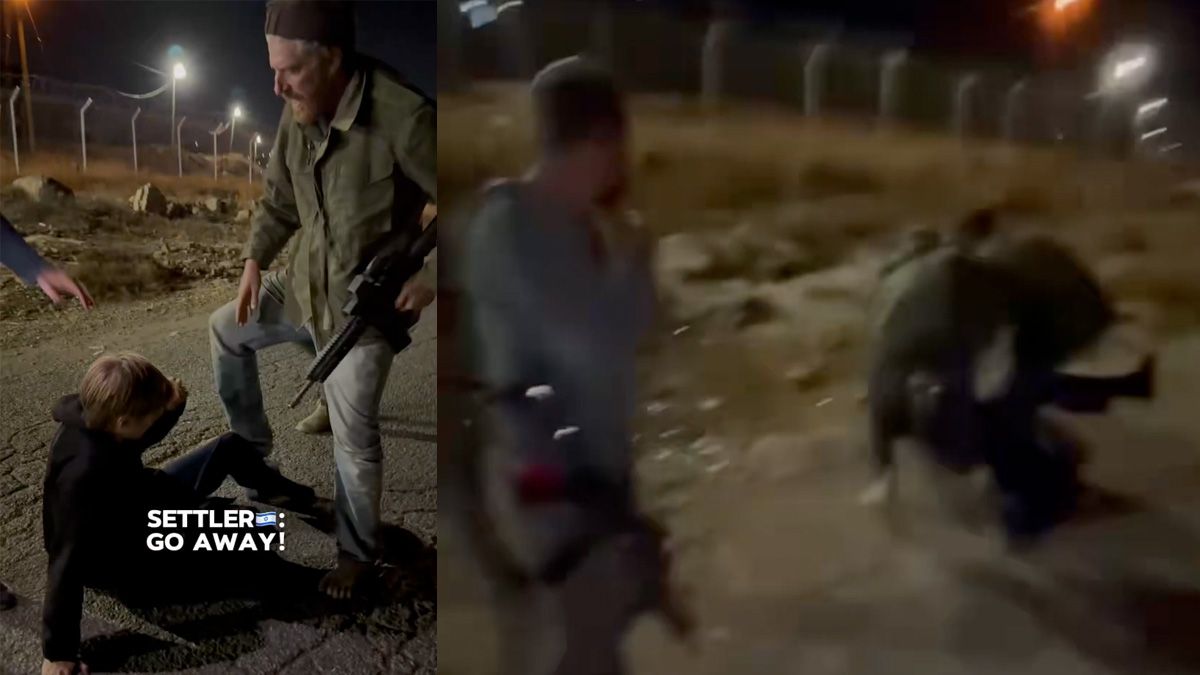
- Settlers assaulted two journalists filming a gate closed to Palestinian traffic near Umm al-Khair in Masafer Yatta.
- Police arrested the journalists, not the settlers; a judge later found the settlers had started the violence.
- CPJ has recorded at least 16 incidents involving 35 journalists in the West Bank in 2026.

Israeli police arrested two journalists and activists, Andrey Khrzhanovskiy and Jasper Nathaniel, in the South Hebron Hills of the occupied West Bank overnight on 28 October 2026, after video footage showed them being assaulted by Israeli settlers.
Khrzhanovskiy, a Russian-Israeli social media figure known online as Andrey X, immigrated to Israel in 2022 and holds Israeli citizenship. Nathaniel is a US freelance journalist. Both document conditions in, and assist, Palestinian communities in the West Bank.
The incident took place near the Palestinian village of Umm al-Khair, in the Masafer Yatta area, where the pair had been filming a military gate closed to Palestinian traffic. A third journalist, Adele Shoko, was present and published footage of the attack.
Both men were released on Thursday afternoon, 29 October 2026. Shoko said they had been banned from the West Bank for 60 days. Haaretz reported that a judge ruled the settlers had initiated the violence and released the pair on bail.
No settlers were reported to have been arrested.
A gate closed to Palestinian traffic
According to Haaretz, the gate has been closed to Palestinian traffic since Friday, 23 October 2026, following an attack near Hebron in which two Israeli soldiers were killed.
The gate serves as a main access point for communities near Umm al-Khair and the Carmel settlement. Palestinian residents told the newspaper the closure had severely disrupted daily life, preventing teachers, doctors and supplies from reaching communities by vehicle.
One resident said food had been passed under the gate while it remained shut. The resident said it was opened for two hours, after which it emerged that the owner of a nearby farm held a key and locked it again.
“If an Israeli vehicle wants to pass, they open it, but not for Palestinian vehicles,” the resident told Haaretz.
Haaretz said it contacted the Israeli military on Monday, 26 October 2026, about the closure and reports that it was being opened for settlers only, but had received no response by the time of publication.
How the confrontation began
According to the same resident, Khrzhanovskiy and Nathaniel had been standing with a Palestinian man who was stranded at the gate after soldiers took his vehicle keys.
“They take your car keys, leaving you stranded for seven or eight hours,” the resident said.
The resident said settlers from nearby farms then arrived and used their own key to open and close the gate. The confrontation began when the activists asked how the settlers had obtained a key. The Times of Israel reported that it was unclear how the confrontation began.
What the footage shows
Footage described by Haaretz shows a young settler in civilian clothes and a military-style jacket locking the gate before Khrzhanovskiy and Nathaniel confront him.
“Why are you locking the gate to several Palestinian communities? Who are you?” one of them asks.
According to Haaretz, a settler carrying a military rifle then grabs Khrzhanovskiy and his mobile phone and strikes him on the head with it.
When Khrzhanovskiy demands the phone back, the settler drags him, steps on his thigh and pulls his hair. One of the settlers can be heard claiming that Khrzhanovskiy had attacked him.
Haaretz reported that the Carmel settlement’s security coordinator and the armed owner of a nearby farm outpost were also present at the scene.
The Times of Israel reported that an armed settler, who at one point appeared to raise his weapon at Khrzhanovskiy, forced him to sit on the ground and shouted: “Sit down, we’ll wait for the police.”
The settlers were subsequently filmed knocking Khrzhanovskiy to the ground again, according to the same report.
Al Jazeera reported that footage posted by Shoko showed several men, some of them armed, beating Nathaniel and Khrzhanovskiy. Further video showed Israeli authorities leading Nathaniel away as he shouted that he had just been beaten.
Injuries and allegations of denied treatment
Shoko said on X that she, Nathaniel and Khrzhanovskiy had been beaten and threatened by armed settlers who stole equipment and personal belongings.
“Jasper and I were also beaten. Jasper was then pepper-sprayed and arrested,” she wrote.
Shoko said Khrzhanovskiy suffered a concussion and lost consciousness several times. “Andrey was severely beaten and lost consciousness several times in front of police. Despite this, he was denied hospital treatment,” she wrote.
She added that he was placed in an ambulance but taken to a police station rather than a hospital, where she said he continued to be denied medical care.
According to the Committee to Protect Journalists (CPJ), Shoko also reported that settlers took Khrzhanovskiy’s phone and her glasses, and blocked an ambulance from evacuating him.
Haaretz reported that a Palestine Red Crescent Society ambulance, an Israeli Magen David Adom ambulance, soldiers and police later arrived at the scene.
Footage shows Khrzhanovskiy dazed on the road as Palestinian paramedics treat his head. The Times of Israel reported that he appeared unable to sit upright as a medic examined him, shortly before police arrested both men.
Police account
Israeli police said on Thursday, 29 October 2026, that they had received a report of a clash in which two Israeli citizens were attacked.
Police said officers and Israel Defense Forces (IDF) troops then arrested an Israeli citizen and a foreign national, referring to Khrzhanovskiy and Nathaniel.
Police said they had opened an investigation and were examining an alleged attempt to steal weapons. The statement did not elaborate on that allegation.
Before the pair’s release, lawyer Alon Sapir told CPJ that they were being held at a police station in Hebron. Sapir confirmed that both had been assaulted and that Khrzhanovskiy was struck on the head and required medical attention.
CPJ said authorities had not disclosed the legal basis, circumstances or expected duration of the detention. The group said it emailed the Israeli police spokesperson for clarification but had received no response.
After his release, Nathaniel said on X that settlers had punched him in the face several times, likely broken Shoko’s wrist and given Khrzhanovskiy a concussion. He said police had confiscated his phone and charged both men with assault.
“The gate is still locked,” Nathaniel wrote.
Khrzhanovskiy also posted on X after his release, saying he was “alive and free”.
He alleged that settlers had tried to kill them because they had caught the settlers locking several Palestinian communities in. He described this as illegal “even by Israeli occupation’s laws”.
“I’m concussed and very tired, so I’ll tell the story tomorrow,” he wrote.
Press freedom group condemns detentions
CPJ condemned the detention of the two journalists, noting that the arrests followed a violent assault by settlers on them and on Shoko.
“Israeli authorities can’t claim to protect public safety while detaining journalists who have been attacked in the course of their work,” said CPJ Regional Director Sara Qudah.
Qudah said holding journalists without disclosing the legal grounds, while they may need medical care, compounded the harm and signalled that those documenting settler violence could themselves become targets of the authorities.
CPJ noted that Khrzhanovskiy had been briefly detained the previous week while filming in Binyamin, and released after an investigation. He has said he faces charges of “supporting a terrorist organisation”, which he describes as unsubstantiated.
Khrzhanovskiy said in a social media post that Israeli police had taken his phone and that he had only just regained access to his Instagram account. He said he was on his fifth phone in three years, with two taken by police, one by the army and one by settlers.
The group said the incident followed assaults by the IDF on journalists covering a military raid in Hebron and the deportation of a Portuguese journalist.
CPJ said it had documented an increase in the intensity of settler attacks on journalists in September. In 2026 alone, it has reviewed at least 16 incidents involving at least 35 local and international journalists.
Those incidents involved physical attacks, harassment, obstruction and intimidation of members of the press.
Attack on Washington Post photojournalist
Among the incidents was an attack on 16 October 2026 in Abu Falah, north-east of Ramallah, where masked settlers set olive trees alight and hurled stones at Palestinian farmers, according to Al Jazeera.
Washington Post photojournalist Heidi Levine, who wore a protective vest marked “PRESS”, said settlers repeatedly kicked and beat her on the ground before stealing her passport, phone and camera equipment. She was hospitalised.
A Palestinian man was shot in the leg by Israeli soldiers who arrived and fired live ammunition and tear gas. Washington Post Executive Editor Matt Murray condemned the attack, while several US lawmakers called for an investigation.
Surge in settler violence during olive harvest
The Times of Israel reported that the arrests came amid a series of settler attacks on Israeli activists assisting Palestinians, and that arrests and prosecutions of settlers remain rare. Critics have accused the government of not doing enough to prevent such attacks.
Earlier in October, masked settlers armed with clubs and stones attacked activists helping with the olive harvest in the village of Janta, injuring four people. Three were taken to hospital.
Separately, Palestinian media reported that two Palestinians were assaulted by settlers near the village of Jamma’in, south of Nablus. Footage showed both receiving medical treatment, one bleeding from the face.
The Israeli rights group Yesh Din said on 23 October 2026 that it had documented 672 incidents of settler violence since the harvest began on 27 September 2026.
These included 135 incidents of physical violence across 194 Palestinian communities. Yesh Din said more than 23 per cent took place while the IDF was present or involved. The IDF has said it acts to enable the harvest to proceed.
The incident also came as Israel held a general election, during which land crossings in the West Bank were closed, according to Haaretz.
Dispute between Tucker Carlson and US ambassador
Also on 29 October 2026, US commentator Tucker Carlson posted footage of what he described as a violent settler attack on a Palestinian-American in the West Bank town of Turmus Ayya earlier in the month.
Carlson accused US Ambassador to Israel Mike Huckabee of having been approached by the man for help and failing to assist. “That’s disgraceful. Do your job,” Carlson wrote on X.
Huckabee rejected the claim, setting out the US Embassy in Jerusalem’s attempts to contact the man’s family, which he said had met with limited success.
“Tucker knows how to contact me, but he’d rather make unfounded accusations than get facts,” Huckabee wrote, also describing Carlson as “deranged”.
Huckabee visited Turmus Ayya on 5 September 2026, calling for “severe consequences” for violent settlers and meeting Palestinian-American families affected by settler violence.
The town’s mayor said at the time that roughly 80 per cent of its approximately 3,000 residents were Palestinian-Americans.