China deploys ‘rescue aircraft carrier’ as Guangxi floods strand thousands
A giant floating rescue vessel dubbed the “rescue aircraft carrier” has been deployed in flood-hit Guangxi, helping evacuate thousands of stranded residents and students as severe flooding continues to affect southern China.
- China deployed a giant floating rescue vessel to assist flood evacuation operations in Guangxi.
- Thousands of students and residents were evacuated after severe flooding inundated parts of the region.
- Rescue efforts continue as authorities respond to widespread flood damage and unusual challenges, including escaped farm animals.

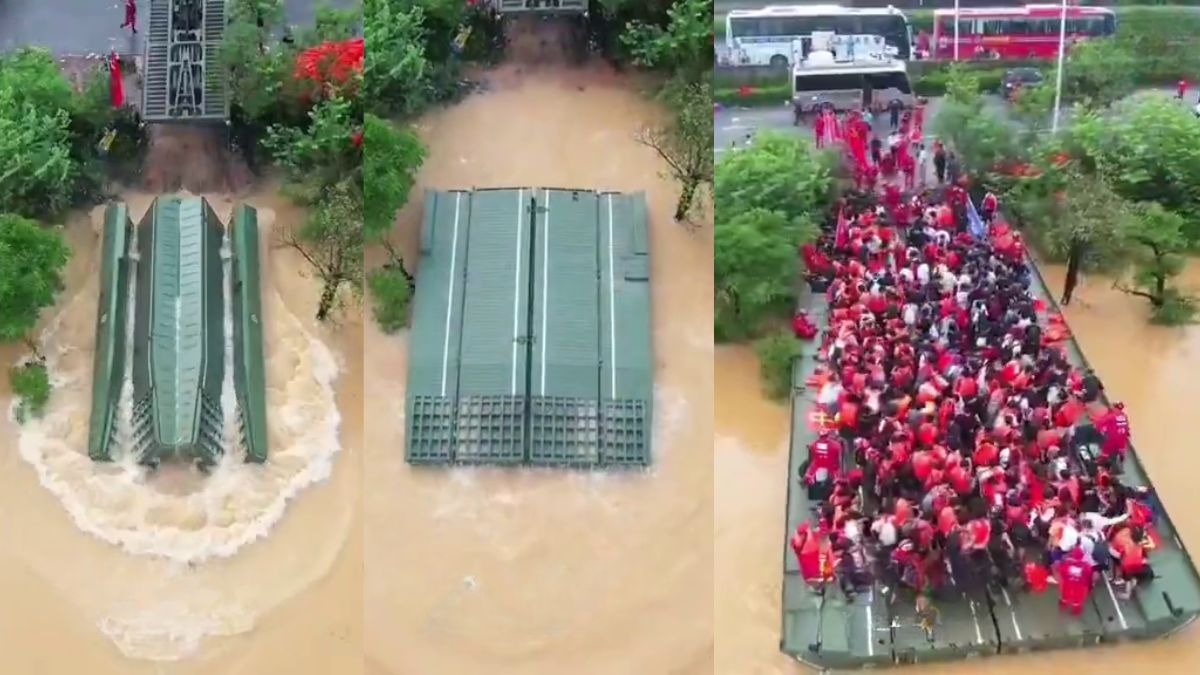
CHINA: Chinese authorities have deployed a giant powered floating vessel nicknamed the “rescue aircraft carrier” to assist evacuation efforts in Guangxi, where severe flooding has stranded thousands of residents and students.
The vessel, measuring about 60 metres in length, was brought into flood-affected areas as part of ongoing emergency operations following days of heavy rainfall and flooding linked to Tropical Storm Maysak.
According to CGTN, the platform can transport more than 300 people at a time and serves as a rapid evacuation and rescue system in areas where conventional vehicles cannot operate.
Thousands evacuated from flooded education park
One of the largest rescue operations took place in an education park in Guigang, Guangxi, where floodwaters trapped more than 10,000 students and teachers.
According to Shanghai Daily, China Anneng Construction Group deployed a series of self-propelled pontoon barges that can be unfolded, linked together and used as temporary ferries in flood conditions.
Chinese state media described the floating platform as a “Noah’s Ark”, reporting that it can carry up to 500 passengers per trip.
Authorities said approximately 6,000 college students were evacuated using the system during rescue operations in Guigang.
Large-scale rescue effort underway
The flooding followed days of intense rainfall that caused rivers to overflow and inundated communities across Guangxi.
Authorities have deployed around 8,000 personnel to support rescue and relief operations, while more than 130,000 residents have been evacuated or rescued from affected areas.
Emergency responders have also utilised helicopters and heavy-lift drones to deliver supplies and reach stranded residents in areas cut off by floodwaters.
Chinese embassies and state media outlets have shared footage of the rescue operations, highlighting the role of the floating platform in moving large numbers of people to safety.
Floods create unusual challenges
Beyond the immediate rescue efforts, the flooding has also created a series of unusual challenges across the region.
According to Chinese media reports, floodwaters damaged a snake breeding facility in Dengwei village, Hengzhou, allowing an estimated 800 to 900 snakes to escape.
Wu Zhi, head of the Dengwei village committee, said one villager was bitten and received hospital treatment.
He said many of the escaped animals were believed to be non-venomous water snakes, although local farms also raise venomous cobras and king rat snakes.
Authorities have advised residents not to attempt to catch snakes themselves and to report sightings to local officials.
Livestock and alligators affected
Chinese media also reported that livestock and other farm animals were affected by the flooding.
According to Shanghai Daily, pigs and ostriches were among the animals stranded after farms and rural communities were inundated.
Videos circulating online have also shown alligators swimming through floodwaters after reports that reptiles escaped from nearby breeding facilities affected by the floods.
Authorities have not released official figures on the number of escaped animals recovered.
Relief operations continue
Rescue and recovery efforts remain ongoing as floodwaters continue to affect parts of Guangxi.
Officials are assessing damage to infrastructure, farmland and residential areas while continuing evacuation, relief and search operations.
Meteorological authorities have warned that continued rainfall could complicate recovery efforts in some areas, with emergency services remaining on standby across the region.