Netizens doubt Govt payout's impact, view it as taxpayer money redistribution
The online community has expressed skepticism about the effectiveness of the S$200 to S$400 Cost-of-Living Special Payment in addressing the rising cost of living. Critics argue that the increased costs are "self-inflicted" due to government policies such as the GST hike, suggesting that the handout is merely a redistribution of taxpayer money.


While the Ministry of Finance (MOF) announced that eligible Singaporeans will receive a one-off special payment of S$200 to S$400 next month to help alleviate the rising cost of living, netizens have expressed doubts about whether this payout will truly address their financial burdens.
Some have criticized the government's approach, arguing that increasing costs and then providing cash handouts funded by taxpayer money is problematic.
On Tuesday (13 August), MOF said the Cost-of-Living Special Payment will benefit over 2.4 million Singaporeans aged 21 and above, whose annual assessable income does not exceed S$100,000.
Individuals who own more than one property are not eligible for this payout. To check their eligibility, citizens can log in to the govbenefits website using their Singpass.
Prime Minister Lawrence Wong, who also serves as Finance Minister, first announced the S$200 to S$400 handout during the Budget 2024 speech in February.
Eligible adult Singapore citizens have previously received between S$300 and S$500 in 2022 and between S$200 and S$400 in 2023 as part of similar support measures.
The current payout, part of the Assurance Package, is intended to mitigate the effects of rising inflation and the GST hike. This package also includes CDC vouchers, U-Save, and S&CC rebates, with each Singaporean household receiving a total of S$800 in CDC vouchers in 2024.
Critics Say Rising Costs Are 'Self-Inflicted'
Observing netizens' comments on CNA and The Straits Times' Facebook posts, some suggested that as the cost of living rises, providing more cash payments and vouchers would be beneficial.
Others argued that the government has failed to address the escalating cost of living, with some describing the rising costs as "self-inflicted" and suggesting that the government is simply redistributing taxpayer money back to Singaporeans.
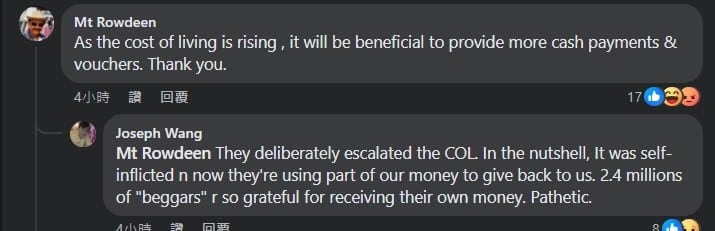
A comment suggests the handout is barely sufficient, as the amount will quickly be used for bills and taxes, offering little real benefit.

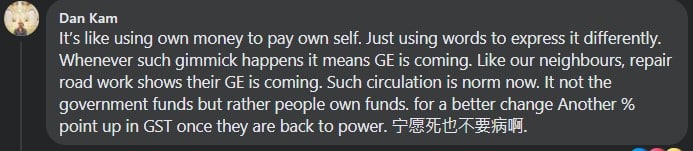
Another netizen criticized the handouts as essentially using taxpayers' own money, repackaged through government rhetoric.
He speculated that such measures are often used as a "gimmick" leading up to a General Election (GE).
A netizen questioned how long such financial aid will last, asking whether individuals with low earnings but exceeding the payout criteria due to overtime pay will still be eligible for the money.

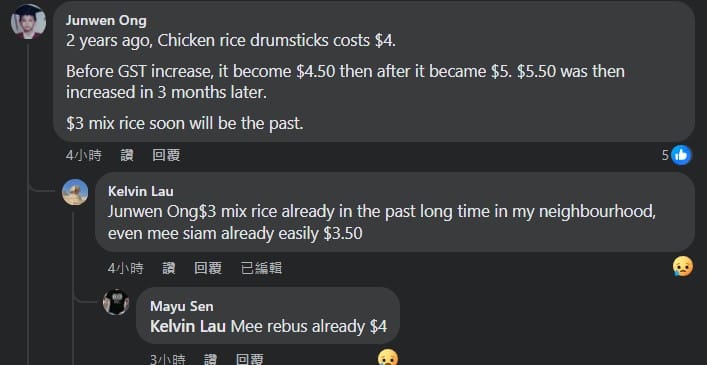
There are also comments discussing rising food prices. For example, a netizen noted that chicken drumsticks and rice, which were S$4 two years ago, increased to S$4.50 before the GST hike and then to S$5, with further increases to S$5.50 within three months.
Another netizen mentioned that mixed rice has been S$3 in their neighborhood for a long time, and mee siam now costs around S$3.50.
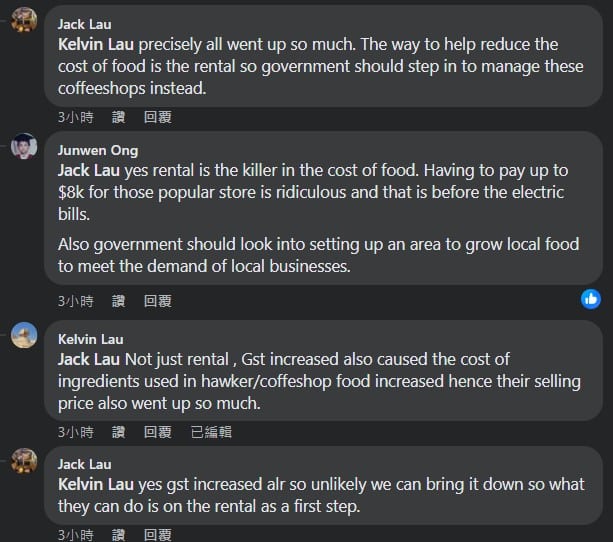
There are also netizens pointed out that high rental fees significantly impact food prices and called for government intervention in managing coffee shop rentals.
Additionally, they acknowledged that the GST increase has raised ingredient costs, further driving up food prices. However, they believe that addressing rental costs could provide a more immediate solution.
Earlier, Shin Min Daily News reported that a hawker at Marine Parade Central Market and Food Centre set a new island-wide record by bidding S$10,158 monthly rental for a vacant stall, heightening concerns about rising food prices and inflation.