Doubt cast on PAP Govt's payouts to ease ordinary Singaporean pressures
The Ministry of Finance recently announced cash payouts for 1.5 million eligible adult Singaporeans in August to aid daily expenses. Skepticism arose as netizens questioned their impact amidst economic challenges. Amid early election speculation, concerns grew that these payouts might foster dependency without ensuring long-term economic stability.


SINGAPORE: On Thursday (4 July), The Ministry of Finance (MOF) announced that approximately 1.5 million eligible adult Singaporeans will receive cash payouts in August to assist with their daily expenses.
However, scepticism has surfaced, as seen in the online comments on Singapore's mainstream media social media pages, where there is a notable expression of anxiety over economic pressures within the Singaporean community.
Some highlighted the overall economic situation, with observations that many businesses are struggling due to high operational costs, casting doubts on the effectiveness of these handouts in stimulating economic recovery.
Amid early election speculation, comparisons have been made between the ruling party's handouts and welfare programs like food stamps in other countries.
Some suggest that these handouts foster dependency without addressing long-term economic sustainability.
MOF: Increased cash payouts for Singaporeans amid economic challenges
In the Thursday statement, MOF noted that eligible recipients living in homes with annual values up to S$21,000 will receive S$850, while those in homes valued between S$21,000 and S$25,000 will get S$450, reflecting an increase of S$150 or S$100 from last year.
The payouts are for Singaporeans aged 21 and above with an assessable income of up to S$34,000 for the year of assessment 2023, excluding those owning multiple properties.
Additionally, about 650,000 citizens aged 65 and above will receive up to S$450 in their MediSave accounts as part of the GST Voucher scheme to alleviate GST expenses for lower- to middle-income Singaporeans.
These disbursements are part of the GST Voucher (GSTV) scheme, aimed at permanently alleviating GST expenses for lower- to middle-income Singaporeans amidst the recent increases in goods and services tax.
The GST rate rose from 7% to 8% in January 2023 and further to 9% at the start of 2024.
According to MOF, the 2024 GSTV disbursements, initially announced by Prime Minister Lawrence Wong in February 2023, will total $1.4 billion, an increase of about $200 million from 2023.
Netizens call for prioritizing core issues over payouts to alleviate the rising cost of living
Observing comments on Singapore state media such as The Straits Times and CNA's Facebook posts, it is evident that there is a sentiment urging the government to prioritize core issues that could alleviate the rising cost of living, rather than focusing solely on payouts, especially amidst anticipated early election speculation.
Some express pessimism, noting uncertainty about whether the payout will effectively mitigate the challenges faced by Singaporeans amidst increases in GST, property taxes, and water tariffs.

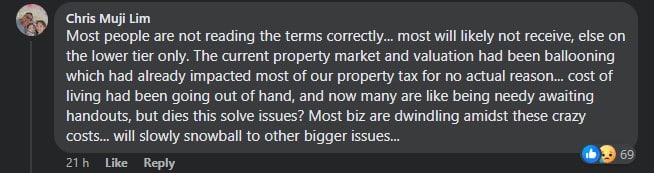
While MOF noted that eligible recipients will receive S$850 for homes up to S$21,000 annual values, S$450 for S$21,000 to S$25,000 annual values, a netizen argued that the escalating property market has disproportionately inflated property taxes without clear justification.
The netizen further criticised that the rising cost of living has left many dependent on handouts, questioning whether this effectively addresses underlying economic challenges.
Moreover, he expressed concerns that these costs could lead to broader economic issues as businesses struggle.
Middle-class struggles amid economic challenges highlighted by netizens
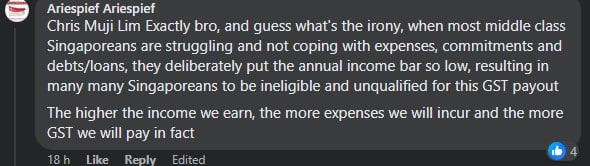
There are concerns about the eligibility criteria for the payout. For instance, one comment pointed out that the low annual income bar excludes many middle-class Singaporeans who are struggling with expenses, commitments, and debts.
This results in a significant number of Singaporeans being ineligible for the GST payout.
Some lamented that the middle class suffers from the impact of GST increases without adequate solutions to ease their burden.

Vouchers inadequate for addressing economic challenges
Some expressed scepticism towards vouchers, implying that they are not effective in addressing the broader economic issues being faced.
A netizen expressed their frustration, pointing out that it only provides cash payouts for two categories of the Annual Value of Home, up to S$25,000.
He expressed disbelief that those earning above this threshold are not considered for assistance, despite facing increased living expenses.


Another netizen suggests that an annual income of $S34,000 is insufficient, especially for larger families with four or more members.
The comment argues for an increase in the income ceiling for eligibility, indicating that current thresholds do not adequately support households facing higher expenses.

Meanwhile, a sarcastic comment suggests that when the ruling party provides handouts, it's acceptable; but if opposition parties propose similar measures, it's criticized as depleting national reserves.

PSP's Hazel Poa calls for fundamental changes to address the cost of living
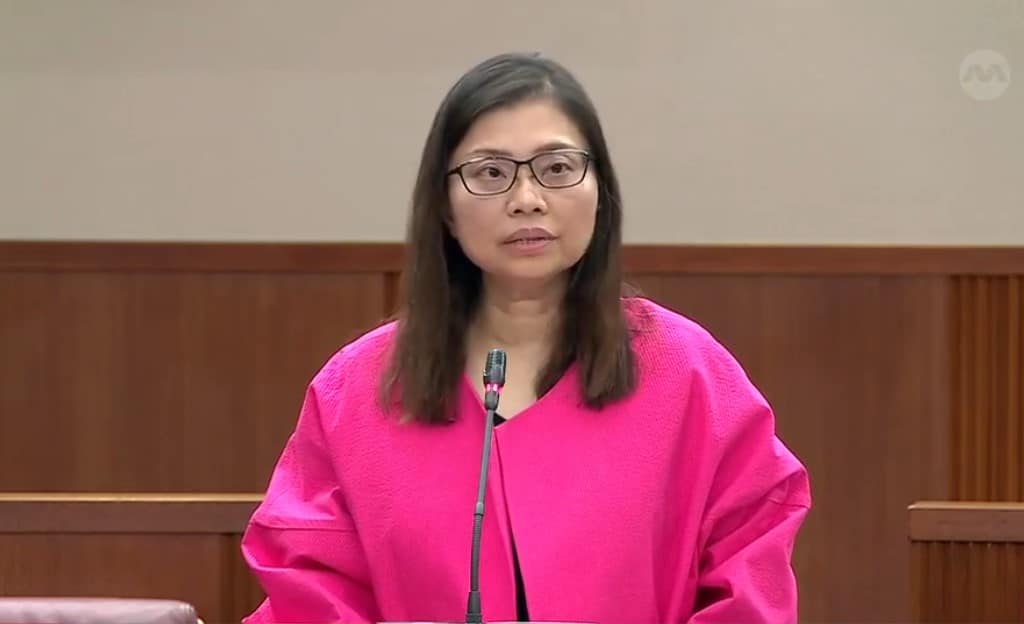
During an interview in February, Hazel Poa, Non-Constituency Member of Parliament (NCMP) from the Progress Singapore Party (PSP), remarked on the Singapore Budget 2024, suggesting that it appears to be tailored as an “election budget with no additional taxes.”
She expressed appreciation for the S$1.9 billion Assurance Package announced by then-Deputy Prime Minister Lawrence Wong which aimed at assisting Singaporeans in managing the cost of living.
However, she cautioned that these measures are short-term and expressed hope that the government’s focus would shift towards implementing fundamental changes to enable Singaporeans to increase their real wages, reducing the dependence on handouts for a significant portion of the population.
When prompted to elaborate on the fundamental changes she proposed, Ms Poa reiterated the essential need to raise Singaporeans’ wages to cope with the cost of living.
She outlined various approaches to achieve this, one of which aligns with the PSP’s previous proposal—the implementation of a living wage, which establishes a minimum wage for all individuals.
In addition, she stressed the importance of empowering employees to negotiate better wages, citing the comparatively lower percentage of Singaporeans’ wage component in GDP compared to other OECD countries.
“This is something that we can work on to improve the percentage of wages and therefore improve the lives of Singaporeans.”