Singapore oil spill raises concerns over safety protocols and emergency response
Netizens express concerns over safety protocols following Singapore oil spill. Questions arise over the spread of oil from the spillage point and the effectiveness of emergency protocols. Calls for investigations and preventive measures highlight public scrutiny amid environmental impact concerns.

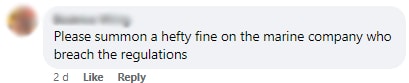
SINGAPORE: Netizens are questioning the safety protocols at the terminal regarding the oil spill and are hoping that the marine company responsible for breaching regulations will be issued a hefty fine.
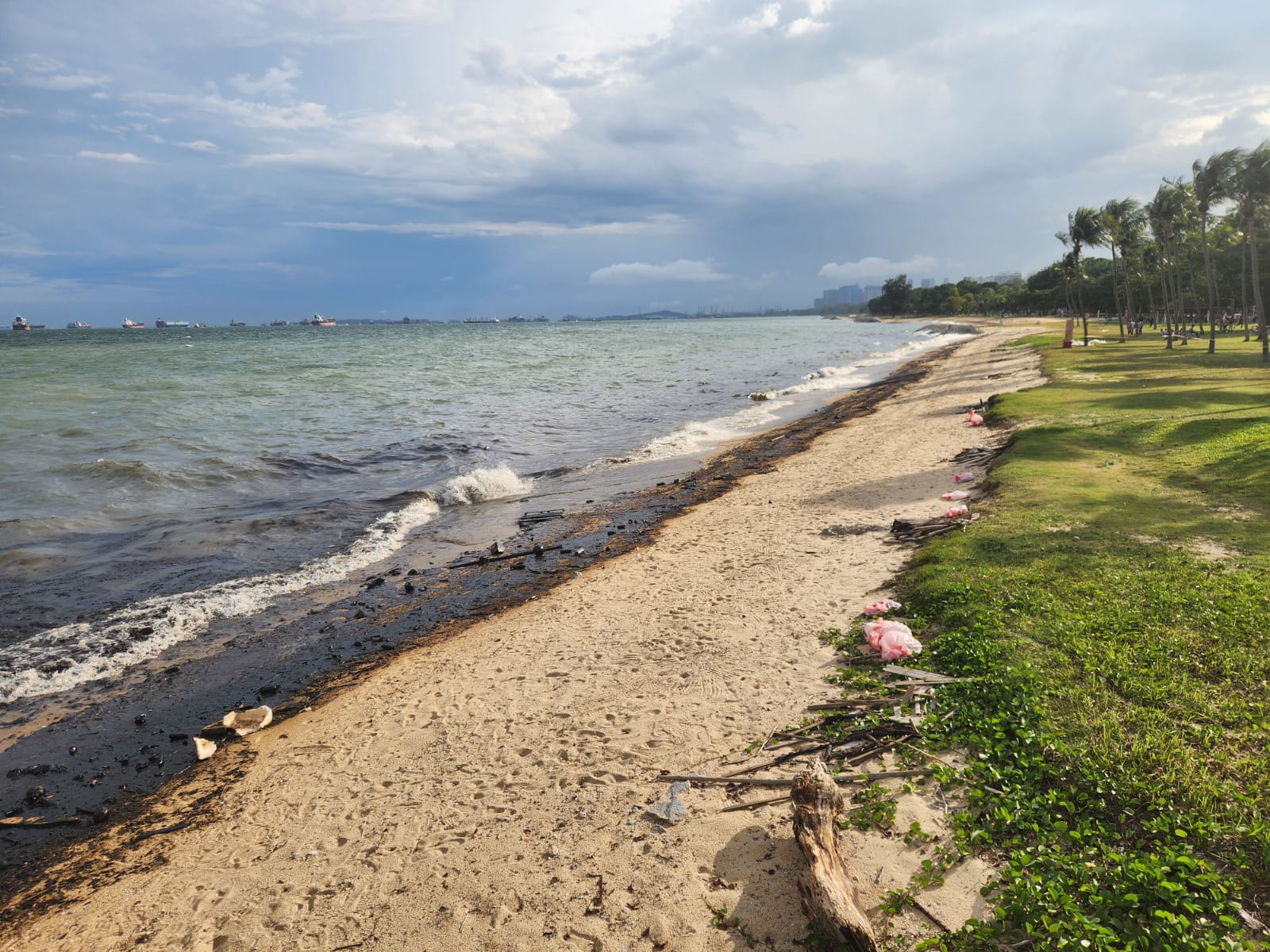
Oil has washed up along several beaches in Singapore, including Sentosa Island and East Coast Park, following a collision between a dredger and a bunker vessel at Pasir Panjang Terminal on Friday (14 June).
The incident resulted in a spillage after a Netherlands-flagged dredger struck a stationary Singapore-flagged bunker vessel around 2:20 pm the same day, causing oil to leak from the damaged cargo tank.
Authorities swiftly responded with closures and clean-up operations.
Eighteen response craft have been deployed, deploying approximately 1,500 meters of containment booms, with plans for more to prevent further spread of the oil spill.
East Coast Park's beachfront, spanning from areas B to H, has been closed until further notice to facilitate these operations, as announced by authorities on Saturday evening (15 June).
Additionally, closures include the jetty and rocky shore at Labrador Nature Reserve.
While Sentosa's Palawan, Siloso, and Tanjong beaches remain open, swimming and sea activities are currently prohibited.
These measures were detailed in a joint statement by the Maritime and Port Authority of Singapore (MPA), the National Environment Agency (NEA), the National Parks Board (NParks), and Sentosa Development Corporation (SDC).
The joint statement confirmed that treated oil had reached several shorelines, including those at Sentosa, Labrador Nature Reserve, the Southern Islands, Marina South Pier, and East Coast Park.
Although Sister’s Islands Marine Park showed no signs of oil slick, an oil sheen was observed in surrounding waters.
National Development Minister Desmond Lee took to Facebook to caution the public against visiting Labrador Nature Reserve due to strong fumes resulting from the oil spill.
He stated, "NParks colleagues are deploying booms to protect the rocky shores from further contamination. We are closely monitoring the situation to ensure swift containment and cleanup efforts."
He also provided an update on precautionary measures at West Coast Park, where booms have been strategically placed in canals feeding the mangrove, despite the area not being directly affected by the spill.
Meanwhile, closer to Sentosa, the spillage affected the Caribbean at Keppel Bay condominium, with residents noting an oil sheen and petrol smell.
Surfactant spraying in nearby waters appears to have mitigated the impact.
Environmental impact
Local conservation group Marine Stewards reported to CNA sightings of dead fish and oil-covered otters, primarily around the Southern Islands.
Founder Sue Ye noted that it is too early to determine the full extent of the damage.
A kingfisher has been rescued from Marina at Keppel Bay, while another was seen covered in oil at Lazarus Island.
An MPA-led Emergency Operation Centre has been established to coordinate the response, with key agencies involved.
The joint statement confirmed that the oil spill from the vessel has been contained, with no further leakage since Friday evening.
Dispersants treated the escaped oil, and drones and satellite imagery are assisting mitigation efforts.
MPA stated on Saturday afternoon that navigational traffic remains unaffected, and berthing operations at Pasir Panjang Terminal continue as usual.
People encountering oil-slicked animals can contact the Animal Response Centre at 1800 476 1600 for assistance.
Netizens raise concerns over safety protocols following Singapore oil spill
In response to CNA's Facebook post about the recent oil spill in Singapore, numerous netizens have voiced their concerns regarding the safety protocols at the terminal and the handling of the incident.
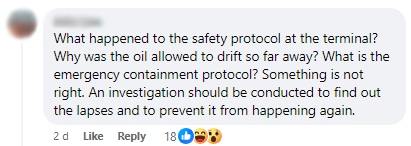
One netizen questioned the efficiency of the safety measures, asking why the oil was allowed to drift so far from the spillage point and what the emergency containment protocol is.
They emphasized the need for an investigation to identify lapses and prevent future occurrences.
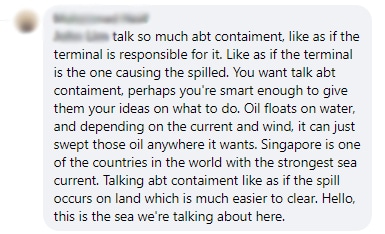
However, in response to the comments, one netizen highlighted the influence of sea currents and wind conditions on the effectiveness of cleanup efforts.
They pointed out, "Oil floats on water, and depending on the current and wind, it can be swept anywhere."
They emphasized that Singapore's strong sea currents could pose challenges to containment and cleanup operations.
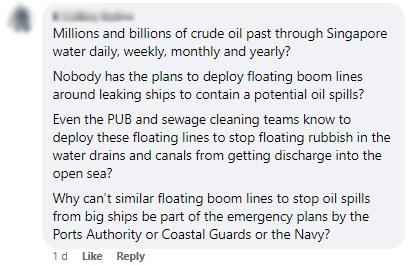
Another user highlighted the lack of preventive measures, questioning why floating boom lines were not deployed immediately to contain the spill.
They pointed out that millions of barrels of crude oil pass through Singapore waters regularly, and even sewage cleaning teams use floating lines to stop rubbish from reaching the sea.
They suggested that similar measures should be part of emergency plans by the Ports Authority, Coastal Guards, or the Navy.
Netizens question the delayed response
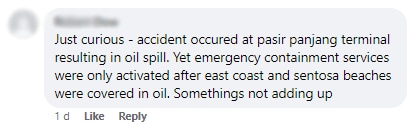
One netizen questioned the delayed activation of emergency containment services, highlighting that despite the oil spill occurring at Pasir Panjang Terminal, the emergency response was only initiated after East Coast and Sentosa beaches were already affected.
Calls for investigation and accountability
Several netizens called for a criminal investigation into potential negligence or sabotage, emphasizing the importance of accountability.

Others suggested imposing hefty fines on the marine company responsible for breaching regulations, stressing that strict penalties are necessary to ensure compliance and prevent future incidents.