Rafah assault ‘unacceptable’: UN Chief calls for ceasefire amid escalating Gaza vonflict
UN Secretary-General Antonio Guterres described the Israeli offensive in Gaza as an "open wound that threatens to infect the entire region," emphasizing the need for an immediate humanitarian ceasefire and unimpeded aid access. He labeled the assault on Rafah as unacceptable, causing unnecessary suffering when aid is critically needed.
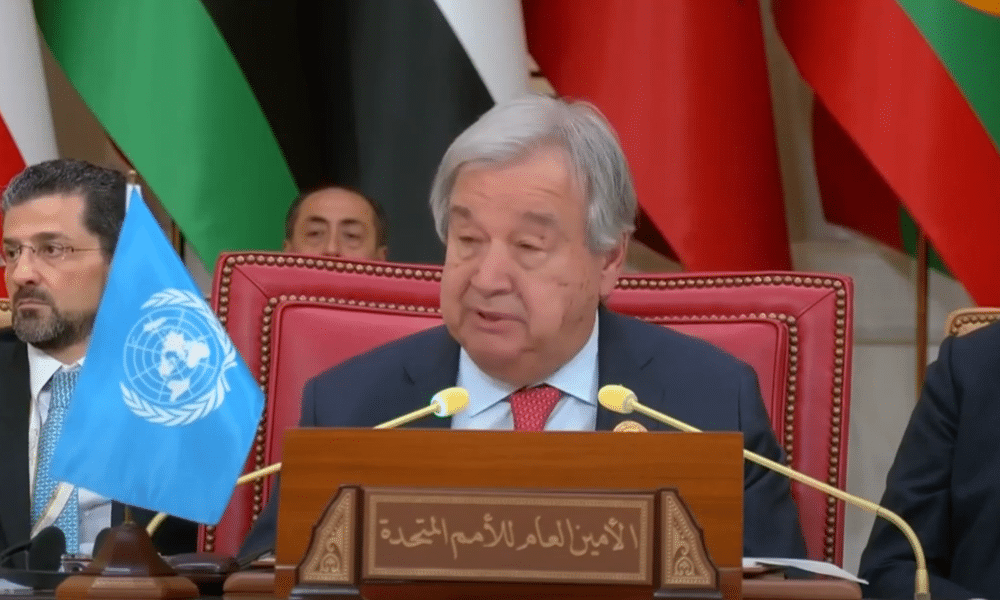

In a stark address delivered at the annual Arab summit in Bahrain, UN Secretary-General Antonio Guterres labelled the ongoing Israeli offensive in the Gaza Strip as an "open wound that threatens to infect the entire region," calling for an immediate humanitarian ceasefire and emphasizing the need for unimpeded access for aid throughout Gaza.
"The scenes we are witnessing in Gaza are nothing short of a catastrophe. This is the deadliest conflict in my tenure as Secretary-General, affecting civilians, aid workers, journalists, and our own UN colleagues," Guterres articulated.
He added that the assault on Rafah is particularly egregious, stating, "Any assault on Rafah is unacceptable. It would only bring another surge of pain and misery at a time when what is desperately needed is a surge in life-saving aid."
Highlighting the broader regional instability, Guterres expressed his deep concern about escalating tensions in the occupied West Bank, characterized by an increase in illegal settlements, settler violence, excessive use of force by the Israeli army, and forced evictions.
"The only permanent solution to end this cycle of violence and instability is through a two-state solution, where Israel and Palestine live side-by-side in peace and security, with Jerusalem as the capital of both states," he asserted.
Despite a UN Security Council resolution demanding an immediate halt, Israel has intensified its operations in Gaza. Reports indicate that more than 35,200 Palestinians, mostly women and children, have been killed. About 600,000 of Gaza’s residents have been forced to flee their homes, seeking refuge in increasingly congested and bombed-out areas of the territory.
"The toll on civilians is escalating daily. Nothing can justify the collective punishment of the Palestinian people," Guterres remarked, condemning the widespread destruction and loss of life.
The conflict has drawn severe international criticism, with Israel accused of genocide at the International Court of Justice (ICJ).
South Africa has been vocal at the ICJ, demanding that Israel end its assault on Rafah and its broader military campaign, and allow international investigators and journalists into Gaza to document the situation and gather evidence of potential war crimes.
In a call at the court to issue an emergency order to stop the offensive into Rafah, Professor Vaughan Lowe KC highlighted the dire consequences of the conflict: "The campaign in Rafah, the last corner of Gaza yet to face a ground invasion, threatens to destroy the very foundation of Palestinian life here. If the court does not intervene now, the prospects for rebuilding a viable Palestinian society will be decimated."
Israel’s Ministry of Foreign Affairs has responded to these allegations by defending its military actions as compliant with international law. "These biased and false claims rely on unreliable sources and fail to recognize our efforts to minimize harm to civilians," the ministry stated in a press release.
The Israeli government, which claims to be committed to dismantling Hamas and preventing a repeat of the attack on October 7, 2023, asserts that the military action in Rafah is crucial because militants are hiding among civilians who were instructed to evacuate to that area.
However, this military strategy has faced criticism even from Israel's principal ally, the United States.
Last week, US President Biden threatened to withhold weapons and munitions from Israel if they proceeded with their plan to enter Rafah.
Secretary of State Antony Blinken noted earlier this week that he had not been presented with a "credible plan" to ensure civilian safety. Additionally, Blinken expressed concerns that the ongoing military actions by Israel might lead to the rise of an insurgency or plunge Gaza into violent turmoil.
As the ICJ deliberates on new provisional measures, the international community remains gripped by the unfolding humanitarian crisis, with many calling for immediate and decisive action to prevent further loss of life and to facilitate the delivery of essential humanitarian aid to the beleaguered population of Gaza.