China unleashes coordinated media campaign after record 5.2 billion yuan fine on Trip.com
China's market regulator fined Trip.com 5.2 billion yuan for monopolistic practices, triggering an unusually coordinated wave of commentary across state media outlets on the same day.

China's market regulator has fined and confiscated a combined 5.2 billion yuan (US$770 million) from Trip.com Group, the country's largest online travel platform, in what state media have described as the most severe antitrust penalty yet imposed on a Chinese internet platform.
The State Administration for Market Regulation (SAMR) announced the decision on Saturday, 25 July 2026, following an investigation opened on 14 January 2026.
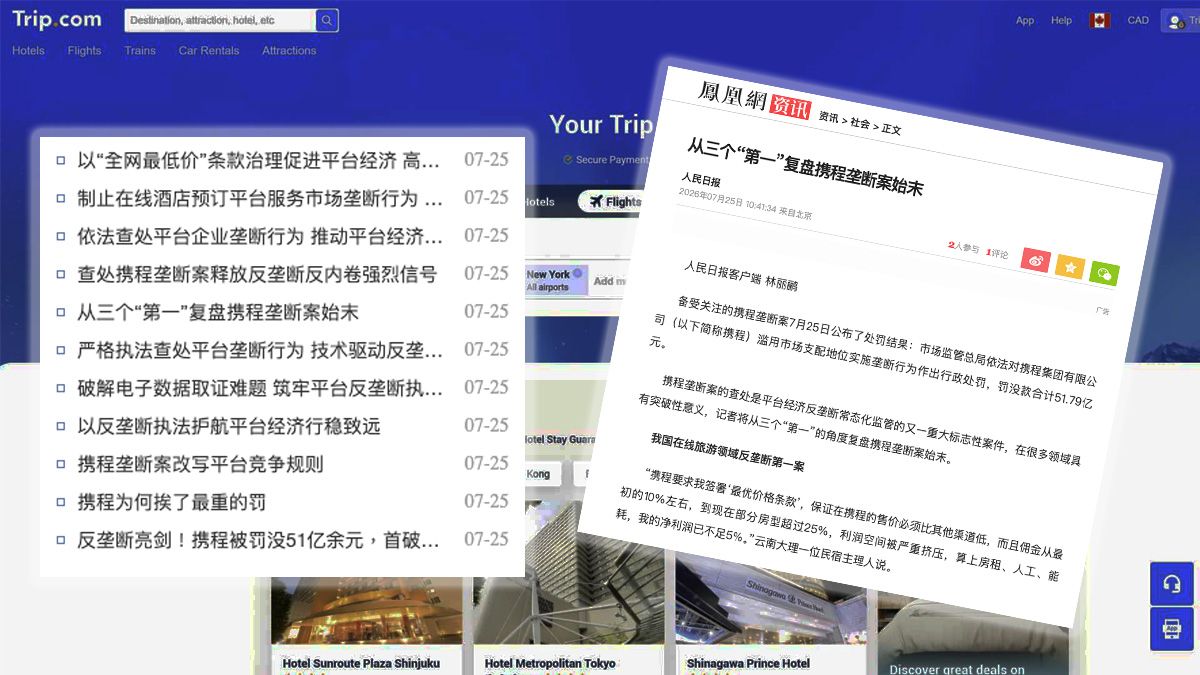
What followed the announcement was notable in itself: at least ten separate commentary and reporting pieces, from People's Daily, Economic Daily and China Economic Net, were published within the same hour.
Scale and coordination of the coverage
The volume and simultaneity of this output points to centralised messaging rather than organic, independent coverage. Contributors included two SAMR-affiliated officials writing under their own names, several members of the State Council's Anti-Monopoly and Anti-Unfair Competition Commission's expert advisory group, and law professors from Renmin University, Wuhan University and the China University of Political Science and Law.
The consistency of framing across outlets, and the repeated use of identical phrases such as "three firsts" and "involutionary competition" (内卷式竞争), suggests a deliberate effort to shape public understanding of the case as a landmark moment in platform-economy governance, rather than an isolated punitive action.
Nature of the violations
According to SAMR's findings, Trip.com had, since 2020, abused its dominant position in China's online hotel-booking market, where its share has exceeded 50 per cent throughout that period. The regulator identified two distinct practices.
First, hotels granted "exclusive" tier status were induced, through preferential traffic allocation, into agreements barring them from listing on rival platforms. SAMR said exclusivity compliance among this tier exceeded 90 per cent, and several state-media reports described the arrangements as communicated verbally by account managers rather than stated explicitly in written contracts.
Second, "gold" and "unbranded" tier hotels were required to guarantee prices matching or undercutting competitors, enforced through automated tools SAMR named as a "price adjustment assistant" and "listing pass" system, which could alter listed prices without hotel confirmation.
Hotelier accounts published alongside the ruling
People's Daily's investigative account, published as part of the same coverage wave, included on-record testimony from hotel operators across several provinces. A Yunnan guesthouse operator said commission rates rose from around 10 per cent to over 25 per cent, leaving margins below 5 per cent once other costs were included.
A Sichuan hotelier said Trip.com accounted for 80 to 90 per cent of the property's online bookings, describing the relationship as one in which the business "cannot survive without Trip.com, cannot thrive with it." A Jiangsu operator, cited separately in an Economic Daily account, said a holiday-period rate of 480 yuan was automatically altered to 130 yuan by the platform's repricing tool.
Fang Jie, deputy director of SAMR's Competition Policy and Evaluation Centre, said investigators analysed tens of thousands of gigabytes of electronic data over more than five months, developing new forensic methods to trace algorithmic decision-making across cloud servers and terminal devices.
Penalty structure and stated rationale
The 5.2 billion yuan total comprised 1.66 billion yuan in confiscated illegal gains and a 3.52 billion yuan fine, equivalent to 7.5 per cent of Trip.com's 2025 domestic sales revenue. State media noted this exceeded the fine ratios imposed on Alibaba (4 per cent) and Meituan (3 per cent) in earlier platform-exclusivity cases, and marked the first confiscation of illegal gains in a Chinese platform antitrust case.
Commentators linked the ruling explicitly to Beijing's "anti-involution" policy campaign, referencing the December 2025 Central Economic Work Conference and an April 2026 Politburo meeting, both of which called for curbing wasteful low-price competition among platforms. One People's Daily piece stated that the pattern of "platform profit, thin merchant margins, and worker strain" was not unique to Trip.com and existed "to some extent" in food delivery and freight platforms, suggesting further enforcement action in adjacent sectors may follow.
An Economic Daily commentary tied the penalty's severity to broader economic conditions, noting that China's second-quarter 2026 GDP growth slowed to 4.3 per cent from 5.0 per cent in the first quarter, with services consumption, particularly travel, cited as a key growth driver requiring protection from anti-competitive distortion.
Company response
Trip.com said it would "sincerely accept and fully comply" with the ruling and had already removed the automated repricing tool identified in the investigation, with further rectification measures to be published for public scrutiny.
Wider significance
Legal scholars quoted across the coverage, including Jiao Haitao of the China University of Political Science and Law, characterised the case as the first in China to penalise a "lowest price across the network" clause as an independent abuse of dominance, distinct from earlier most-favoured-nation clause disputes. Comparisons were drawn to similar scrutiny faced by Booking.com, Expedia and HRS in other jurisdictions.
Whether the coordinated volume of commentary reflects a broader signal about the direction of platform-economy regulation in China, beyond this single case, remains to be seen in how enforcement unfolds across the sector in coming months.