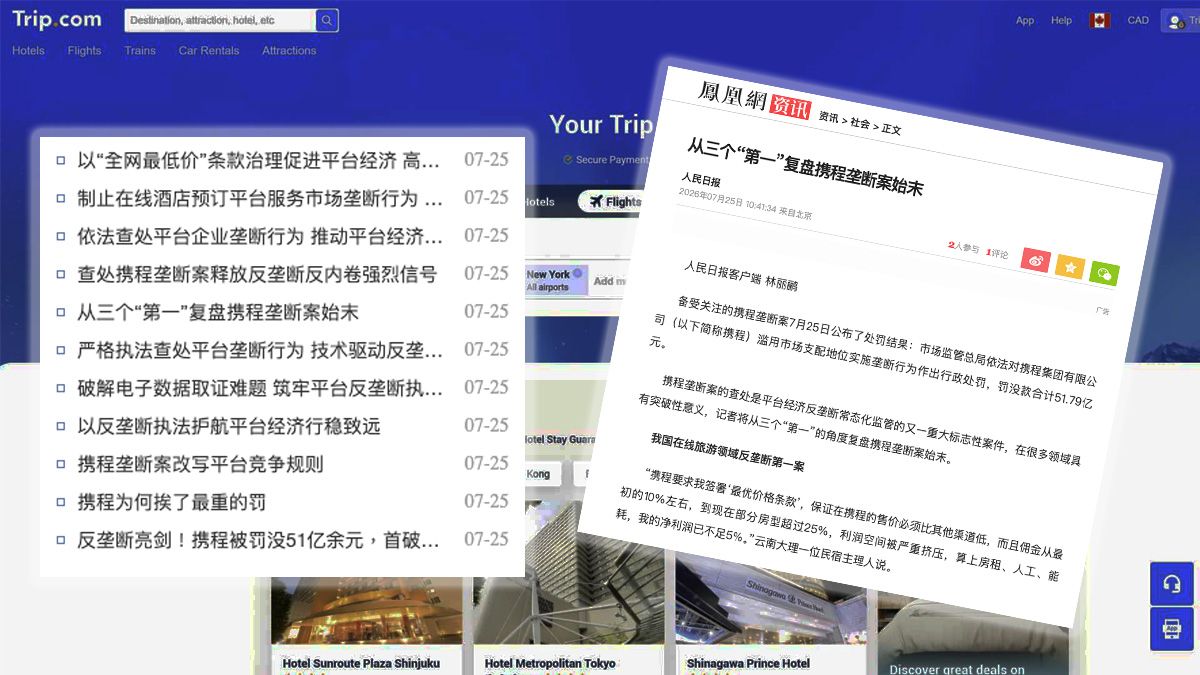
China fines Trip.com 5.2 billion yuan for abusing dominant market position
China's market regulator has fined and confiscated 5.2 billion yuan (US$770 million) from Trip.com Group for monopolistic practices in the domestic online hotel-booking market, marking the first such confiscation under the country's competition law.

- SAMR fined and confiscated 5.2 billion yuan from Trip.com over monopolistic practices.
- Regulator found exclusive-dealing and forced lowest-price schemes dating back to 2020.
- Trip.com ordered to refund 122 million yuan in withheld hotel deposits.

China's top market regulator has imposed fines and confiscated illegal gains totalling 5.2 billion yuan (US$770 million, approximately NT$24.75 billion at prevailing exchange rates) on Trip.com Group, the country's largest online travel platform, for abusing its dominant position in the domestic hotel-booking market.
The State Administration for Market Regulation (SAMR) announced the penalty on Saturday, 25 July 2026, following an investigation launched in January this year. The probe was prompted by complaints that Trip.com had imposed unfair terms on hotel operators and manipulated pricing.
Nature of the anti-competitive practices
According to SAMR's ruling, Trip.com had since 2020 abused its dominant position in China's online hotel-booking platform market, where its market share has remained above 50 per cent throughout that period. The regulator said the company built its scheme around a traffic-allocation mechanism, reinforced by platform rules and technical measures.
Hotels listed on the platform were sorted into three tiers, described as "exclusive", "gold" and "unbranded". Operators granted exclusive status were required to deal solely with Trip.com, in exchange for greater traffic allocation and other incentives, according to the regulator's findings.
SAMR said exclusive-tier compliance ran above 90 per cent, which it said had effectively locked up supply of higher-quality hotel inventory. The regulator noted that exclusivity terms were often not written into contracts but communicated verbally by account managers, complicating detection.
Gold and unbranded hotel operators, meanwhile, were compelled to offer the lowest prices available anywhere online. Gold-tier hotels were specifically required to price at least 20 yuan or 5 per cent below competing platforms, a threshold regulators described as a hard pricing constraint.
SAMR said Trip.com used tools it called a "price adjustment assistant" and a "listing pass" system, alongside a round-the-clock price-comparison monitoring system, to lower listed prices automatically whenever a cheaper rate was found on a rival platform, generally without requiring hotel confirmation.
Operators who did not comply faced penalties including reduced traffic allocation, removal of their listing status, and deductions from pre-paid "order reserve fund" deposits, the regulator said.
Legal basis for the finding
SAMR determined that the exclusive-dealing requirement violated Article 22(1)(4) of China's Anti-Monopoly Law, which prohibits dominant firms from restricting trading partners to a single counterparty without justification. The forced lowest-price requirement was found to violate Article 22(1)(5), covering the imposition of unreasonable trading conditions.
Investigation background and methodology
The investigation opened on 14 January 2026, following complaints submitted through 2025 by trade associations, individual hotel operators and rival travel platforms. Multiple local market regulators had separately summoned Trip.com representatives for questioning before the national-level probe began.
SAMR assembled a dedicated task force drawing antitrust enforcement staff from regulators nationwide, which conducted on-site investigations across more than ten provinces over a period exceeding five months. Fang Jie, deputy director of SAMR's Competition Policy and Evaluation Centre, said investigators analysed tens of thousands of gigabytes of electronic data spanning terminal devices, cloud servers and internal business systems.
Hotelier accounts cited in the investigation
State media reporting accompanying the ruling included accounts from hotel operators in several provinces. A Chongqing hotelier said their exclusive-tier agreement, signed in 2018, barred listings on other platforms and warned that violations would trigger delisting from those platforms.
A Beijing hotelier said their listing ranking rose from beyond 2,000th position to around 200th after adopting gold-tier status in June 2025, but said staff would contact them directly whenever prices on rival platforms fell below Trip.com's, demanding a price at least 20 yuan lower.
A Yunnan guesthouse worker said the automated repricing tool adjusted prices more than 100 times within a single month, typically checking competitor prices at fixed intervals throughout the day and continuing adjustments overnight.
A Jiangsu operator, cited in a separate account, said the repricing tool was activated without authorisation on nine occasions, cutting a 480 yuan holiday-period room rate to 130 yuan; the operator said the platform ceased responding to complaints and later penalised the hotel for order rejections.
A Yunnan guesthouse operator separately said commission rates had risen from around 10 per cent to more than 25 per cent on some room types, leaving net margins below 5 per cent once rent, labour and utility costs were factored in.
Consumer impact
Legal commentators cited in state media, including Jiao Haitao of the China University of Political Science and Law, said the forced lowest-price requirement harmed consumers in two ways: by preventing hotels from offering lower prices on competing platforms, and by compressing merchant margins to the point where operators reduced service quality to offset losses.
Terms of the penalty
Of the total penalty, SAMR confiscated 1.66 billion yuan in illegal gains and imposed a separate fine of 3.52 billion yuan, equivalent to 7.5 per cent of Trip.com's 2025 sales revenue in China. Chinese state media reported that this marks the first case in which illegal gains have been confiscated in a platform-economy antitrust matter, and the first case combining a cease-and-desist order, confiscation of illegal gains, and a fine.
State media noted that the 7.5 per cent fine ratio exceeded penalties imposed in earlier platform-exclusivity cases, including a 4 per cent ratio applied to Alibaba and a 3 per cent ratio applied to Meituan.
SAMR separately ordered Trip.com to fully refund 122 million yuan in booking deposits that regulators said had been withheld from hotel operators.
Company response
Trip.com said in a statement that it would "sincerely accept and fully comply" with the ruling, and would systematically carry out rectification measures in line with regulatory requirements. State media reports said the company had already removed the automated repricing tool identified in the investigation.
The company added it would treat the penalty as an opportunity for self-reflection and reform, and pledged to abandon what it termed low-efficiency "involutionary" competition in favour of higher-quality development. It said it would publish specific rectification measures for public scrutiny in due course.
Background and market position
Trip.com Group operates several travel brands, including Ctrip, Qunar, Skyscanner and the Trip.com platform itself, and holds a majority stake exceeding 90 per cent in Hong Kong-based Wing On Travel.
According to Chinese state media citing Global Times, the group accounted for 56 per cent of the gross transaction value of China's hotel and travel market in 2024, and ranks alongside Booking.com and Expedia among the world's three largest travel platforms.
The company reported net revenue of 62.4 billion yuan for the 2025 financial year, up 17 per cent year-on-year, while net profit surged 95 per cent to 33.4 billion yuan. Chinese media reports suggested this sharp rise in profitability was seen as a significant factor behind the regulatory scrutiny.
The penalty forms part of a broader effort by Beijing to rein in unfair competition among internet platforms. Authorities have said excessive price competition across the sector has damaged businesses and contributed to deflationary pressures within the wider economy.