Netizens demand review of high ministerial salaries post Iswaran's graft charges
Online community voices waning trust in “competitive ministerial pay” after Iswaran's court charges. Demands for a thorough review of high ministerial salaries intensify in the discourse.


On Thursday (18 January), former Transport Minister S Iswaran was charged in the State Courts with 27 offences, including corruption, receiving gratification as a public servant and obstructing justice.
The 61-year-old entered a plea of not guilty to all charges linked to his interactions with property tycoon Ong Beng Seng.
He had also tendered his resignation from Parliament and the People’s Action Party (PAP) on Tuesday.
The court heard that the charges included two counts of corruption under the Prevention of Corruption Act, 24 counts related to receiving items from individuals with whom he had business dealings in his capacity as a public servant, and one charge for obstructing the course of justice under the Penal Code.
According to charge sheets, between 2015 and 2022, Iswaran received “valuable things” exceeding S$384,000 (US$285,000) from Ong, the man who brought Formula One to Singapore.
These included tickets to shows, football matches, and multiple editions of the Singapore F1 Grand Prix.
S Iswaran pledges to clear name in face of allegations
Mr Iswaran is defended by his lawyers, including Senior Counsel Davinder Singh, Mr Navin Thevar, Ms Sheiffa Safi Shirbeeni and Mr Rajvinder Singh from Davinder Singh Chambers.
He expressed his focus on clearing his name in a statement published on his Facebook account on Thursday. He pledged to return all salary and allowances received since the start of the CPIB’s investigations in July 2023.
Iswaran explained that returning the funds was a decision made by him and his family based on their belief in doing what is morally right.
“We cannot in all good conscience keep the monies when I was unable, on account of the investigations, to discharge my duties as a Minister and Member of Parliament in that period. ”
The pre-trial conference for Iswaran’s case is scheduled for 1 March and he is currently released on S$800,000 bail.
Netizens express 'trust shaken' as PAP Minister faces corruption charges in court
This case marks a historical first in Singapore, the first instance of a minister being charged with a criminal offence while in office.
Examining comments across Singaporean state media's social media platforms, it becomes evident that the online community is grappling with a loss of trust in the perceived integrity of Singapore's well-compensated Ministers, a group traditionally entrusted with averting corruption.
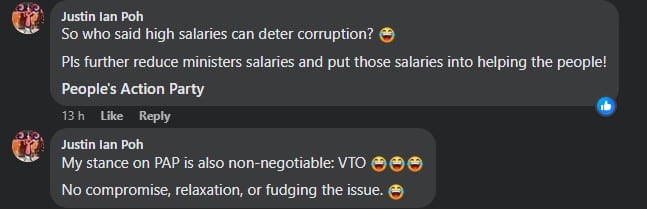
Calls for a comprehensive review of the current high ministerial salaries have gained momentum within these discussions.
Besides harsh punishment and a zero-tolerance toward corruption, the Singapore government has repeatedly justified its policy of awarding high wages to civil servants as a way to both prevent government corruption and attract talent from the private sector.
This high-wage structure was introduced in the early to mid-1990s where civil service salaries are pegged to the private sector.
The founding father Lee Kuan Yew even argued that competitive wages were crucial to retaining talented bureaucrats, as the private sector would otherwise lure them away.
Singapore’s political salaries are among the highest globally, with the Prime Minister reportedly earning US$1.6 million annually.
In the recent case of the PAP minister being charged with corruption charges, some Singaporeans have voiced apprehension regarding "trust shaken" to a system and principles that had hitherto been regarded as effective.
A notable comment in these discussions highlighted the stark contrast between the $384,000 worth of gifts, seemingly insignificant to a minister with a million-dollar salary.
"but for those who earn $1,800/month in e.g. F&B industry, or ComfortDelGro's taxi drivers pilot salary scheme, it's over 17 years worth of salary, " the comment wrote.

Some have posited that the once-prominent narrative of "million-dollar salaries ensuring no corruption" might now be approaching its conclusion, given the recent scandal.

Calls for reevaluation arise amidst the ineffectiveness of high ministerial salaries in preventing controversies
There is also a prevailing suggestion that the failure of high ministerial salaries to prevent such controversies prompts a reevaluation of their effectiveness.
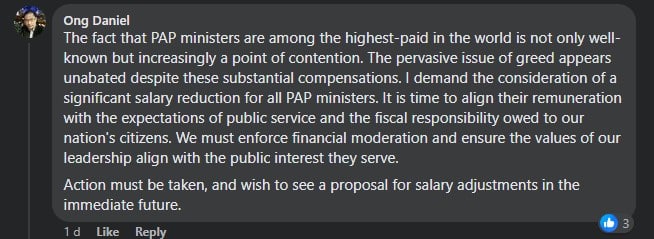
A netizen said The fact that PAP ministers are among the highest-paid in the world is not only well-known but increasingly a point of contention.
"The pervasive issue of greed appears unabated despite these substantial compensations, " the netizen remarked.
Consequently, he demands the consideration of a significant salary reduction for all PAP ministers, suggesting that it is time to align their remuneration with the expectations of public service and the fiscal responsibility owed to our nation's citizens.
"We must enforce financial moderation and ensure the values of our leadership align with the public interest they serve."
"Action must be taken, and wish to see a proposal for salary adjustments in the immediate future."
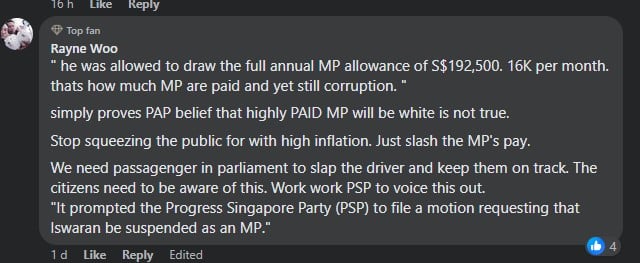
Echoing a similar sentiment, another comment argued that the recent case serves as evidence against the PAP's belief that highly paid MPs will inherently be incorruptible.
"Stop squeezing the public with high inflation. Just slash the MPs' pay," he emphasized.
He further urged the opposition in Parliament to scrutinize the incumbent government, ensuring they are on the right track.

Netizens' comments reflect diminished confidence in trusting the PAP Party
Following Iswaran's resignation, Deputy Prime Minister Lawrence Wong assured in an interview that the PAP's stance on corruption is "non-negotiable and part of its DNA."
He emphasized that the government would persist in upholding the highest standards of integrity, incorruptibility, and propriety.
Observing the online comments on the Straits Times' Facebook post, some netizens express concern that trust is something that requires time to build.
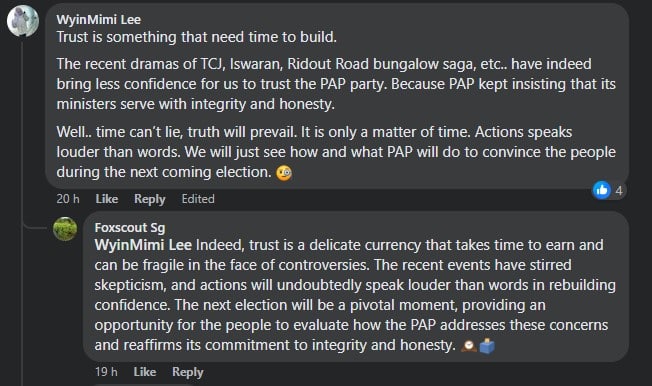
The recent scandals involving former Speaker Tan Chuan-Jin, Iswaran, the Ridout Road bungalow saga, and the like have indeed diminished confidence in trusting the PAP party, as PAP kept insisting that its ministers serve with integrity and honesty.
A comment noted, "Well.. time can’t lie, truth will prevail. It is only a matter of time. Actions speaks louder than words. "
The netizen expressed that people will closely observe how and what the PAP will do to convince the public during the upcoming election.
Another comment response, highlighted that trust is akin to a delicate currency, requiring time to earn and easily becoming fragile in the face of controversies.
"The recent events have stirred skepticism, and actions will undoubtedly speak louder than words in rebuilding confidence."
The upcoming election is viewed as a pivotal moment, offering an opportunity for the people to evaluate how the PAP addresses these concerns and reaffirms its commitment to integrity and honesty.
Another comment pointed out that proof alone does not create trust, as trust is a crucial factor between parties or members and cannot be easily developed within a month.

Singapore Govt defers 2023 political salary review
Recently, the Singapore Government has announced a deferral in the review of political salaries that was due in 2023.
Education Minister Chan Chun Sing, who also oversees Public Services, addressed this development in response to Parliamentary questions filed by Members of Parliament.
Minister Chan Chun Sing, representing the Prime Minister, stated: “The recommendations from the last political salaries review were announced in 2018. "
"The salary review Committee recommended a review of the political salaries framework about every five years, or when necessary. The Government did not make any changes to political salaries following the 2018 review as the salary structure remained valid and there were economic uncertainties in the previous few years.”
Mr Chan added, “A review of the political salaries was due in 2023. However, the Government decided to defer the review as we have other pressing issues to deal with.’
“In 2023, the global geopolitical situation has become more uncertain, with conflicts in the Middle East and Ukraine, and continuing heightened geopolitical contestation. On the economic front, significant uncertainties and downside risks in the global economy remain, impacting our local economy and our wages and inflation outlooks.”
Given the mentioned circumstances, Mr Chan announced that the Singapore government has decided to focus on dealing with these key challenges at hand and defer the review of political salaries for now.
“The Government will review the political salaries framework and benchmark in due course to ensure that they remain relevant and up to date.”
Earlier in January last year, in response to a question by Ms Poa, Minister Chan had confirmed the government’s intention to review political salaries for 2023.
This development is a continuation of the discourse on political salaries in Singapore, which gained significant attention following the 2012 White Paper on ministerial salaries.
This paper was introduced after the 2011 General Election, which saw a decrease in support for the incumbent PAP government and the party losing Aljunied GRC to the Workers’ Party.