More than 70 dogs rescued from South Korean farm ahead of 2027 ban
More than 70 dogs have been rescued from a former dog meat farm in Gangjin County, South Korea, as the country prepares to fully enforce a ban on the dog meat industry in February 2027.
- More than 70 dogs were rescued from a Gangjin farm that once bred up to 1,000 dogs annually.
- South Korea’s dog meat ban is due to take full effect on 7 February 2027.
- Animal welfare groups say most dogs from farms that have closed have not been rescued.

More than 70 dogs have been rescued from a dog meat farm in South Korea's Gangjin County, about 363 km south of Seoul, in what international animal welfare group Humane World for Animals said was its final large-scale rescue operation in the country before a ban on the dog meat industry takes full effect in February 2027.
The rescue, carried out this week, marks the latest stage in a decade-long campaign by the organisation, formerly known as Humane Society International, which says it has rescued almost 3,000 dogs from South Korean dog meat farms since 2015.
Final survivors leave a closing farm
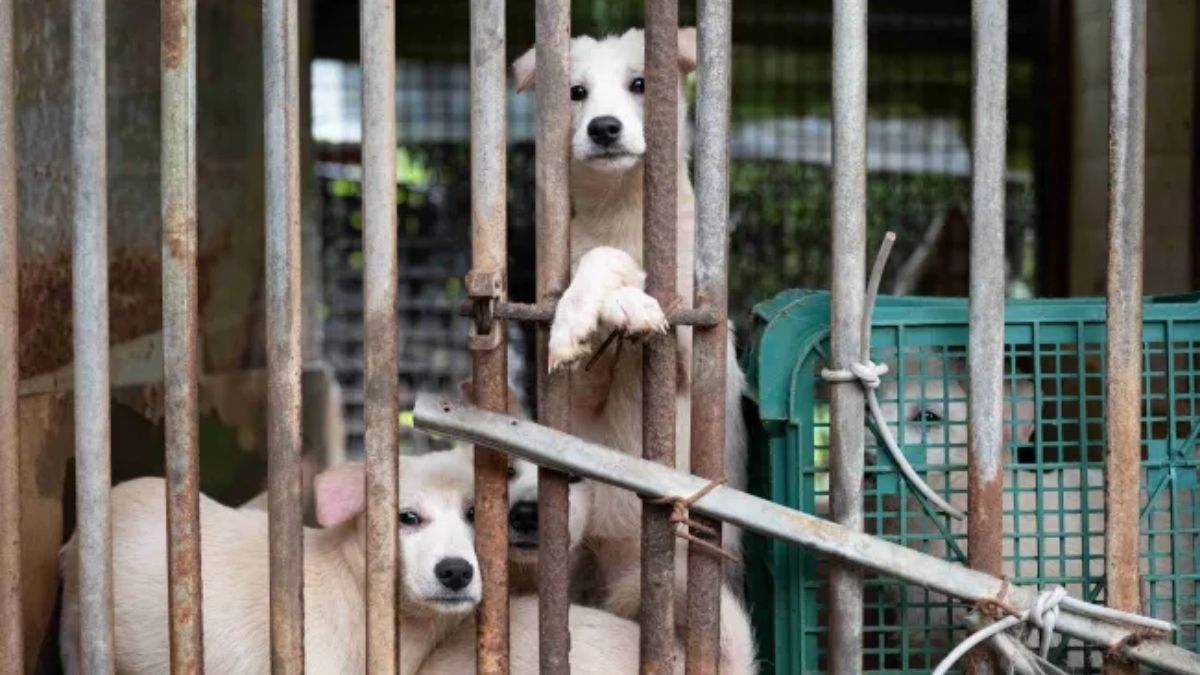
The Gangjin farm once bred and slaughtered as many as 1,000 dogs a year. By the time of the rescue, only about 70 dogs remained, including Jindos, a German shepherd, a Corgi mix, a husky mix, several Spitz mixes and other small and medium-sized dogs.
Yonhap News Agency reported that 46 dogs were removed during a two-hour operation on Tuesday, with rescuers taking the animals one by one from elevated wire cages and placing them in crates labelled with their names.
The farm was marked by rusting cages, piles of abandoned collars, old faeces and skeletal remains. Some of the dogs were wearing collars, suggesting that they may previously have been kept as companion animals.
Some of the rescued dogs required veterinary attention for conditions including malnutrition and skin infections. About half have been sent to rehabilitation facilities in the United States and Canada, including centres in Washington, D.C., and Montreal. Mother dogs and puppies that are too young to fly will travel later, with the remaining dogs expected to follow in early 2027.
Sangkyung Lee, campaign manager at Humane World for Animals Korea, said the operation marked a significant moment for the organisation.
"For more than a decade, our rescue teams have shone a spotlight inside these dog meat farms and faced the heartbreak of witnessing the suffering involved in this industry while saving the lives of thousands of dogs."
Lee added that sending the rescued dogs to the United States and Canada to begin new lives with families was "the perfect closing chapter" to the group's decade-long mission.
Farm owner agrees to surrender dogs
The rescue followed a report from a member of the public earlier this year to a local animal protection group. The group and Humane World for Animals subsequently alerted local authorities, who identified violations of South Korea's Animal Protection Act relating to animal husbandry and management.
The farm's 80-year-old owner agreed to relinquish ownership of the remaining dogs and signed a written commitment not to participate in the dog meat industry again. This allowed the animals to be rescued and rehomed rather than slaughtered.
Preparations for the operation took several months, including health checks, vaccinations, quarantine procedures and arrangements for international transport.
Humane World for Animals said the dogs were among the final survivors of a farm that had once housed far larger numbers of animals. The organisation described the empty cages and abandoned collars found on the property as evidence of the scale of the operation before its decline.
Industry shrinks ahead of February 2027 deadline
South Korea's National Assembly unanimously passed legislation in January 2024 to end the breeding, slaughtering and distribution of dogs for human consumption. The law, enacted in February 2024, provided a transition period of roughly three years for farms, slaughterhouses, distributors and restaurants to wind down their operations.
The ban's relevant provisions are due to take full effect on 7 February 2027.
Ministry of Agriculture, Food and Rural Affairs figures showed that South Korea had 1,537 registered dog farms when the legislation was passed, with about 466,000 dogs being raised for consumption. By May 2026, 1,265 farms, or about 82%, had closed, leaving 272 still operating.
The broader dog meat sector comprised 5,898 registered businesses at the time of the legislation, including 1,537 farms, 221 slaughterhouses, 1,788 traders and 2,352 restaurants, according to agriculture ministry figures.
Government measures have included financial support for farm owners who close their operations, with higher compensation available for earlier closures, as well as efforts to prevent new breeding and monitor farms that have shut.
Rescue gap remains as farms close
Despite the sharp decline in operating farms, animal welfare groups have raised concerns about the fate of dogs from farms that have closed.
Of 346,313 dogs kept at 1,072 farms that had closed by August 2025, 334,648, or 96.6%, were slaughtered, according to data released by National Assembly lawmaker Seo Cheon-ho based on agriculture ministry figures. Another 9,308 were transferred to other farms and 1,806 died during breeding. Only 166 were converted to pets or guard dogs, while 385 were adopted or placed through pre-sale arrangements.
Humane World for Animals estimates that only about 0.3% of dogs on meat farms were rescued between the ban's passage in 2024 and May 2026.
Under South Korean law, animals are classified as property, meaning farm owners generally must consent before dogs can be taken for rescue. The agriculture ministry has also acknowledged that shelters lack capacity, with about 100,000 dogs rescued annually but space for only around 20,000 at a time.
Recent cases have highlighted the issue. KARA reported finding 29 unreported dogs at a slaughterhouse in Pyeongtaek in May, while WEACT rescued seven dogs from an illegal slaughterhouse in Suncheon. At the Gangjin farm, the owner initially reported 20 dogs, but 60 were later found, Lee said.
"I don't think the situation will dramatically change after the ban comes into full effect. Small-scale farming, breeding, slaughtering and trading could be happening," Lee told Yonhap.
Monitoring to continue
South Korea's agriculture ministry plans to continue inspections, encourage early closures and crack down on illegal breeding ahead of the February 2027 deadline. It reported 272 registered dog farms remained as of May.
Humane World for Animals said the Gangjin rescue was its final large-scale farm operation in South Korea, but it would continue monitoring enforcement of the ban and working to end the dog and cat meat trade in Viet Nam, Indonesia, India and China.