Ceremonial reception for Japanese troops deployed to fight Kalimantan fires draws criticism
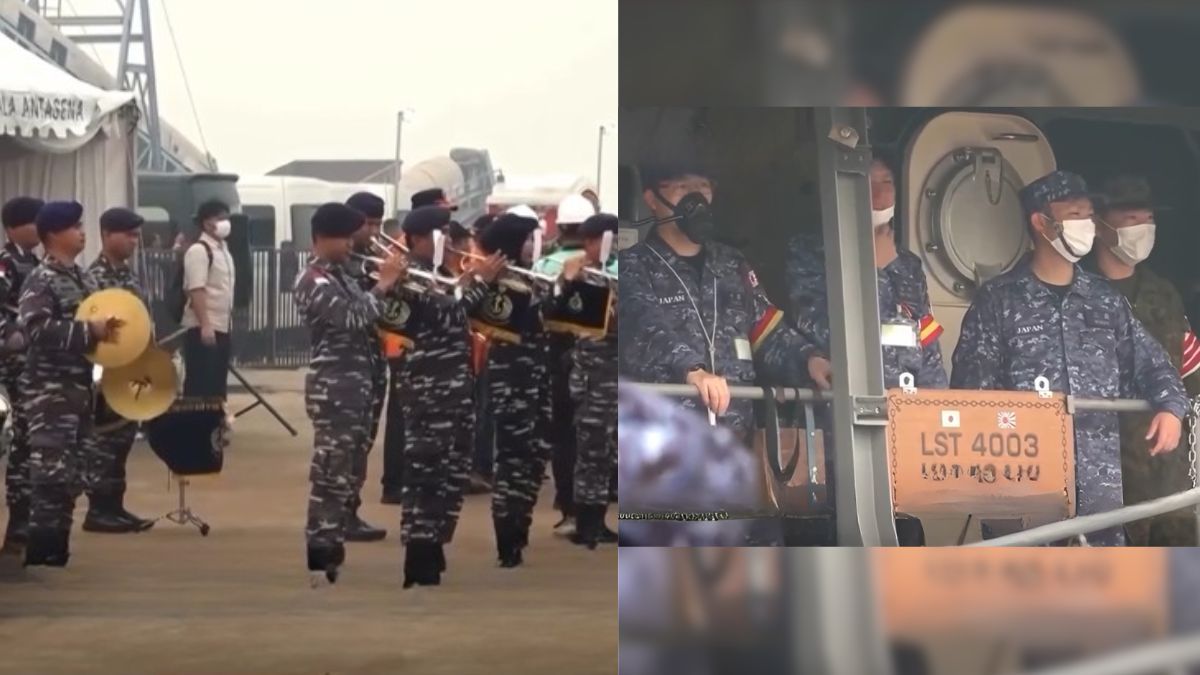
An Indonesian Threads post criticising a ceremonial welcome for Japanese troops sent to help fight forest fires in Kalimantan has gone viral, with commenters questioning whether such a reception was appropriate amid the ongoing emergency.
- A viral Indonesian Threads post criticised the ceremonial welcome for Japanese personnel deployed to help fight forest fires in Kalimantan.
- The post attracted more than 38,700 likes and 3,800 reposts, with many commenters questioning the timing of the reception amid the ongoing fires.
- Japan deployed about 300 personnel, JS Kunisaki and three CH-47 Chinook helicopters in what the Japan Self-Defense Forces described as their first known overseas firefighting operation.

INDONESIA: An Indonesian Threads post criticising the ceremonial reception given to Japanese personnel deployed to help fight forest fires in Kalimantan has attracted widespread attention online, with many Indonesians questioning whether such formalities were appropriate during an ongoing emergency.
The post, written by an Indonesian user, said Japanese troops had arrived to provide emergency assistance but appeared to be held up temporarily by a ceremonial welcome from Indonesian authorities.
The post had received more than 38,700 likes and 3,800 reposts at the time of the writing, with commenters largely agreeing with its criticism of the reception.
The discussion came after Japan deployed disaster-relief personnel and firefighting equipment to Indonesia as forest and land fires continued to cause severe haze across parts of the region.
View on Threads
Japan deploys personnel and Chinook helicopters
According to the Associated Press (AP), the Japanese military transport ship JS Kunisaki docked in Kalimantan on Thursday (10 September 2026) as part of a disaster-relief mission to help Indonesian authorities fight wildfires on the island of Borneo.
Japan deployed about 300 personnel, the JS Kunisaki and three CH-47 Chinook helicopters for the operation.
The Japan Self-Defense Forces (JSDF) said the helicopters would begin firefighting operations once preparations were complete.
The aircraft are intended to assist Indonesian authorities in reaching areas that are difficult for ground teams to access.
The operation is also significant for Japan, as AP reported that it marked the first known overseas firefighting operation conducted by the JSDF.
Col. Syunji Nakahara, commander of the disaster-relief activities, said at a port in Mempawah district that Japanese personnel would learn from the Indonesian military’s operational experience while working with Indonesian authorities.
The JSDF said the operation was intended to support people affected by the fires and prevent further damage.
The deployment comes as Indonesia faces a major forest and land fire crisis, with the country having experienced recurring fires for decades.
According to Indonesia’s Forestry Ministry, more than 202,000 hectares of land were burned between January and July 2026, an area almost three times the size of Singapore.
Regional haze adds pressure
The fires have also generated toxic haze affecting Indonesia and neighbouring countries.
According to AP, smoke had travelled as far as the Philippines, more than 800 kilometres away, while Malaysia’s air pollution levels exceeded its emergency threshold in parts of Sarawak.
Authorities in Sarawak had declared an emergency in a town affected by the pollution, while haze also affected parts of Sumatra.
The pollution had disrupted education in several areas, with schools suspending classes. AP reported that more than 1.4 million students across Indonesia had been affected by the toxic haze.
Indonesia has intensified firefighting operations in several provinces, with assistance from aircraft provided by countries including Japan, the United States, Russia, Australia, Canada and Ukraine.
Public criticism centres on timing
The viral Threads discussion focused less on Japan’s assistance itself and more on the perceived timing of the ceremonial reception.
Several commenters argued that formalities should have been kept to a minimum while fires remained active.
Their reactions reflected frustration that an emergency response appeared to be accompanied by ceremonies and photo opportunities.
One commenter joked that the reception might have been deliberately prolonged so that more forest could be planted, while another imagined Japanese personnel questioning whether the situation was truly an emergency.

“Seems like they’re deliberately making it longer so there’ll be more area to plant [on].”

"🇯🇵: Is this even an emergency?"
The post author joined in with the humour, replying with an imagined exchange along the lines of asking Japan about the weather during its journey before suggesting that photographs should be taken first.

“Helo Japan, hows the weather on the way here? Eh let's take pictures first”
Other commenters expressed embarrassment and frustration, arguing that Indonesia’s focus should have been on fighting the fires rather than holding ceremonies.

“So embarrassed seeing the stupidity of our people…”
Another commenter sarcastically suggested that a prolonged ceremony, luxury hotel accommodation and even a parade would be acceptable only after the fires had been extinguished.

“Ceremonies are fine once everything has been extinguished. They could even put the Japanese troops up in a five-star hotel with all-you-can-eat meals for a month and have a clown parade on top of a vehicle, that would be fine too. But this is an emergency and they’re holding an unnecessary ceremony.”
A separate commenter described ceremonial receptions as something Indonesia frequently does, suggesting that the practice was inappropriate given the scale of the forest fires.

“Indonesia loves ceremonies… we must be getting laughed at… the forest land is almost gone and they still have time to hold welcomes.”
Further comments included:

“It’s really not important at all!”

"But the situation is critical right now, isn’t it?"

“Indonesians are funny… even in an emergency there’s a welcome ceremony, and even when putting out a fire there’s an opening ceremony.”

“Even the Japanese people must be confused seeing this.”

“We use ceremonies for everything, even though this isn’t a formal event.”
A contrasting view defends protocol
Not all reactions criticised the reception.
One commenter argued that protocol and a brief ceremonial welcome were normal when receiving foreign military personnel. The commenter said the key issue was whether the Japanese assistance had arrived and was ready to be deployed to areas affected by the fires.

“Protocol and a brief welcome are normal when receiving foreign military personnel. The most important thing is that the technical assistance has arrived and is ready to be deployed to the fire hotspots.”
Japan-Indonesia cooperation
The firefighting deployment also comes as Japan and Indonesia continue to strengthen military cooperation.
AP reported that the two countries have discussed the potential sale of used Japanese destroyers to Indonesia, adding to broader defence ties between the two countries.
For the firefighting mission, however, the immediate focus is on supporting Indonesian authorities in containing the fires and limiting further damage from the resulting haze.
While the viral post has prompted criticism of the ceremonial reception, Japan’s deployment involves a substantial disaster-relief operation, with hundreds of personnel and three heavy-lift helicopters being prepared to support firefighting efforts across Kalimantan.