South Korea deploys 200 fire trucks as drought grips South Gyeongsang
South Korea has mobilised about 200 fire trucks and 400 firefighters to drought-hit South Gyeongsang, where reservoir storage has fallen to less than half the national average.
- South Gyeongsang's reservoir storage rate has fallen to about half the national average.
- About 200 fire trucks and 400 firefighters have been mobilised from 16 fire departments.
- Miryang, Geoje and Haman are under the highest-level agricultural drought classification.

South Korea has deployed hundreds of firefighters and fire trucks to drought-hit areas of South Gyeongsang Province after water storage levels fell sharply amid months of below-average rainfall.
The National Fire Agency said about 200 fire trucks and 400 firefighters from 16 fire departments across the country had been mobilised to help supply water to communities and agricultural areas affected by the worsening drought.
The deployment followed a national firefighting mobilisation order issued for South Gyeongsang Province on Tuesday.
The province has recorded the lowest average reservoir storage rate in the country. According to the Agricultural Drought Management System, its average reservoir storage rate stood at 33.5 per cent, less than half the national average of 72 per cent.
All but one of South Gyeongsang's 18 cities and counties are currently under an agricultural drought alert. Miryang, Geoje and Haman have been placed under the highest-level classification, described as “severe”.
Firefighters have been tasked with supplying household water to areas facing urgent shortages, as well as delivering water to agricultural water sources and other locations affected by the drought.
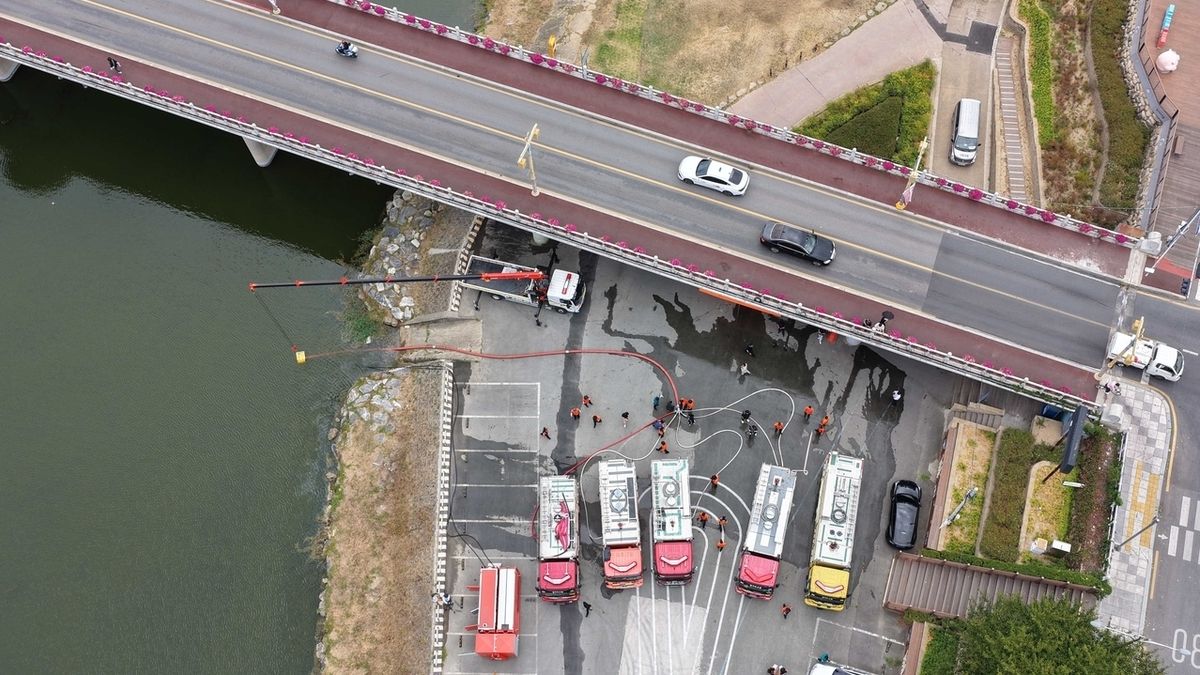
Fire trucks dispatched from across the country have been stationed at the Miryang Sports Complex in Miryang, where they are being used to support water supplies in drought-affected areas.
Firefighters have also been collecting water from the Miryang River before transporting it to areas in need.
In Miryang's Bubuk-myeon area, firefighters used fire hoses to spray water onto rice fields as part of efforts to support agricultural water supplies.
Southern regions receive only a quarter of average rainfall
The mobilisation comes as southern parts of South Korea have experienced a prolonged period of low precipitation, causing water storage levels to decline.
Between 12 July and 11 August, southern parts of the country received an average of 58.5 millimetres of rainfall, according to data reported by Yonhap.
That was roughly one-quarter of the long-term average of 241.9 mm for the same period.
The situation has been particularly severe in South Gyeongsang and the southeastern cities of Busan and Ulsan.
The three areas recorded a combined 16.6 mm of rainfall during the period, the lowest total for the timeframe since 1973, when South Korea established a nationwide weather observation network.
South Gyeongsang's reservoir storage rate stood at 32.3 per cent on Thursday, according to the Rural Agricultural Water Resource Information System. The figure was well below the long-term average of 70.8 per cent.
The declining reservoir levels have affected water supplies for agriculture and households in areas experiencing the drought.
Drought damage visible in agricultural areas
The impact of the dry conditions has also been visible in agricultural areas beyond South Gyeongsang.
A rice field in Gokseong County, South Jeolla Province, showed extensive cracks in the soil as drought conditions affected the region.
The bed of Bangsong Reservoir in Gokseong was also exposed as water levels fell.
South Jeolla is among the southern areas affected by the prolonged shortage of rainfall, although South Gyeongsang has recorded particularly low reservoir storage levels.
Authorities have responded by deploying firefighting equipment normally used for emergency response to support water distribution.
The National Fire Agency said the firefighters and vehicles would work with local governments to provide water to drought-stricken communities and agricultural areas.
The national mobilisation comes as reservoir levels in South Gyeongsang remain substantially below their long-term average, with several cities and counties under severe agricultural drought alerts.
The firefighting resources from 16 departments are being used to transport and distribute water while authorities monitor conditions across the drought-affected areas.