Japan records over 10,000 heatstroke hospital transports in a single week
More than 10,857 people were taken to hospital across Japan for suspected heatstroke between 13 and 19 July 2026, the first weekly total above 10,000 this year and more than double the same period in 2025. Fourteen people died.
- 10,857 people transported for heatstroke in Japan from 13 to 19 July 2026.
- Fourteen deaths confirmed across 12 prefectures; 321 people in serious condition.
- Those aged 65 and above made up 62 per cent of all cases.

More than 10,000 people across Japan were taken to hospital by ambulance for heatstroke or suspected heatstroke in a single week, as dangerously high temperatures gripped much of the country.
According to preliminary figures released by the Fire and Disaster Management Agency on Wednesday, 22 July 2026, some 10,857 people were transported between 13 and 19 July 2026.
It was the first weekly total above 10,000 since this year's monitoring period began on 1 May 2026. The figure was about 2.4 times the 4,580 cases recorded in the preceding week, from 6 to 12 July, an increase of 6,277 people.
The total was also more than double the 4,958 people transported during the corresponding week in 2025.
Deaths and severity
Fourteen deaths were confirmed, spread across 12 prefectures including Tochigi, Aichi and Osaka. A further 321 people were classified as being in a serious condition, meaning they were expected to require at least three weeks of hospitalisation.
Some 4,061 people, or roughly 37 per cent of the total, were assessed as moderately ill and requiring shorter hospital stays. Nearly 59 per cent had mild symptoms.
People aged 65 or older accounted for 6,734 cases, or 62 per cent of all transports, underlining the disproportionate burden of extreme heat on older residents.
Where people fell ill
Homes were the most common location for heatstroke, accounting for 4,523 cases. Roads followed with 2,326 cases, while outdoor public spaces accounted for 1,095.
The pattern indicates that a substantial share of cases occurred indoors rather than during outdoor activity, a recurring feature of heat-related illness among older people living alone.
Regional distribution
Osaka recorded the largest number of transports among Japan's 47 prefectures, with 1,041. Aichi followed with 797 and Tokyo with 783.
Tokyo's total was more than double the 379 cases recorded during the equivalent week in 2025. According to the Tokyo Fire Department, 453 people were taken to hospital for heatstroke in the capital on Wednesday alone.
The Japan Meteorological Agency (JMA) reported that on 14 July 2026, 170 of the country's 914 observation points recorded maximum temperatures of 35 degrees Celsius or above, classified in Japan as extremely hot days.
Little relief in sight
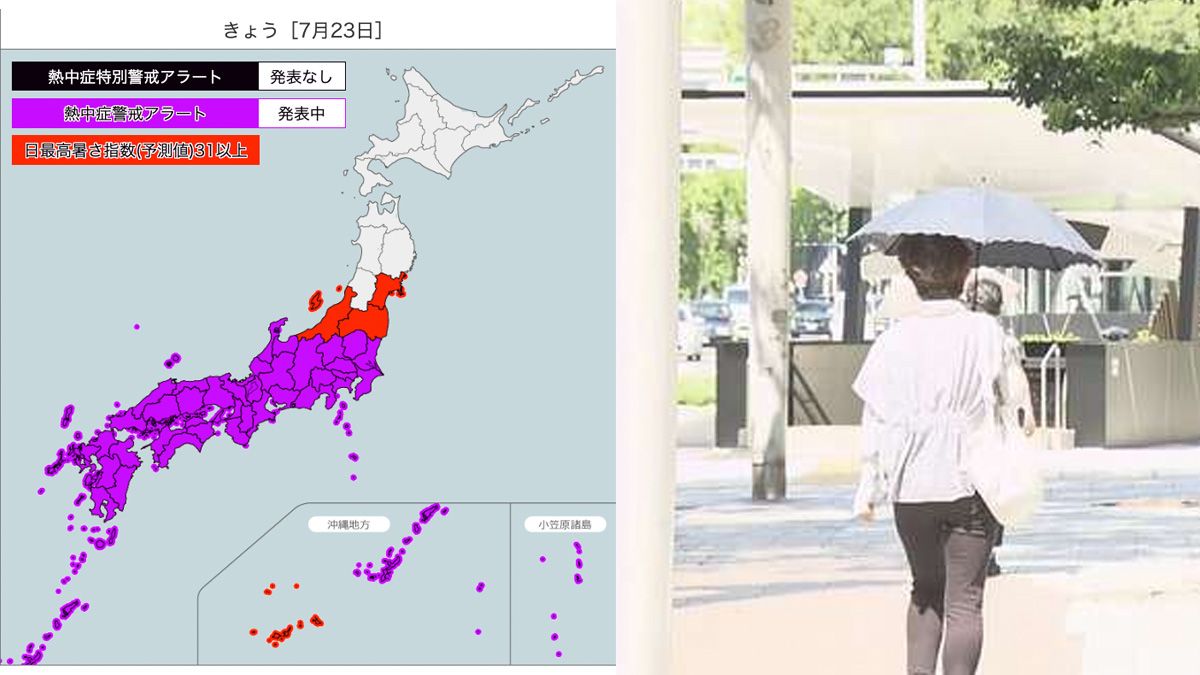
The heat showed little sign of easing on Thursday, 23 July 2026. Heatstroke alerts were issued for 39 prefectures, covering an area extending from the Kanto region through to Okinawa, according to the environment ministry and the JMA.
Temperatures were forecast to reach 40 degrees Celsius in Nagoya, in Gifu and Kyoto prefectures, and in the Kofu region. Readings above 40 degrees Celsius in Gifu and Kyoto would be the first recorded in either location.
Some areas were expected to remain above 30 degrees Celsius overnight, raising the risk of heatstroke after sunset and disrupting sleep.
Authorities urged the public to remain in air-conditioned spaces, avoid unnecessary outings and drink water before feeling thirsty. Older people and young children were said to require particular attention, as both groups are more vulnerable to heat-related illness.
Wider context
Heat stress is rising worldwide as human-induced climate change makes heat waves more frequent and more severe. Japan experienced record-breaking summer heat for a third consecutive year in 2025.
Heat waves and wildfires are also sweeping across parts of Europe. A fire in Spain's Guadalajara province has burned about 32,000 hectares, while more than 100,000 hectares have been scorched nationwide this year.
France has lost about 44,000 hectares to fires in 2026. Blazes have also affected Italy, Greece and Cyprus, as temperatures across parts of southern Europe surpassed 40 degrees Celsius.
The figures released this week are preliminary and may be revised once final data is compiled.