Philippines condemns China Daily cartoon depicting Filipinos as monkeys amid South China Sea tensions
The Philippines has condemned an AI-generated China Daily video depicting Filipinos as monkeys as racist and dehumanising, demanding its removal. The row further escalates already strained relations between Manila and Beijing over the South China Sea dispute.
- The Philippines denounced a China Daily video portraying Filipinos as monkeys as racist and offensive.
- Manila demanded the video's removal, saying it undermined dignity and worsened tensions with China.
- The dispute comes amid continuing disagreements over the South China Sea and the 2016 arbitral ruling.

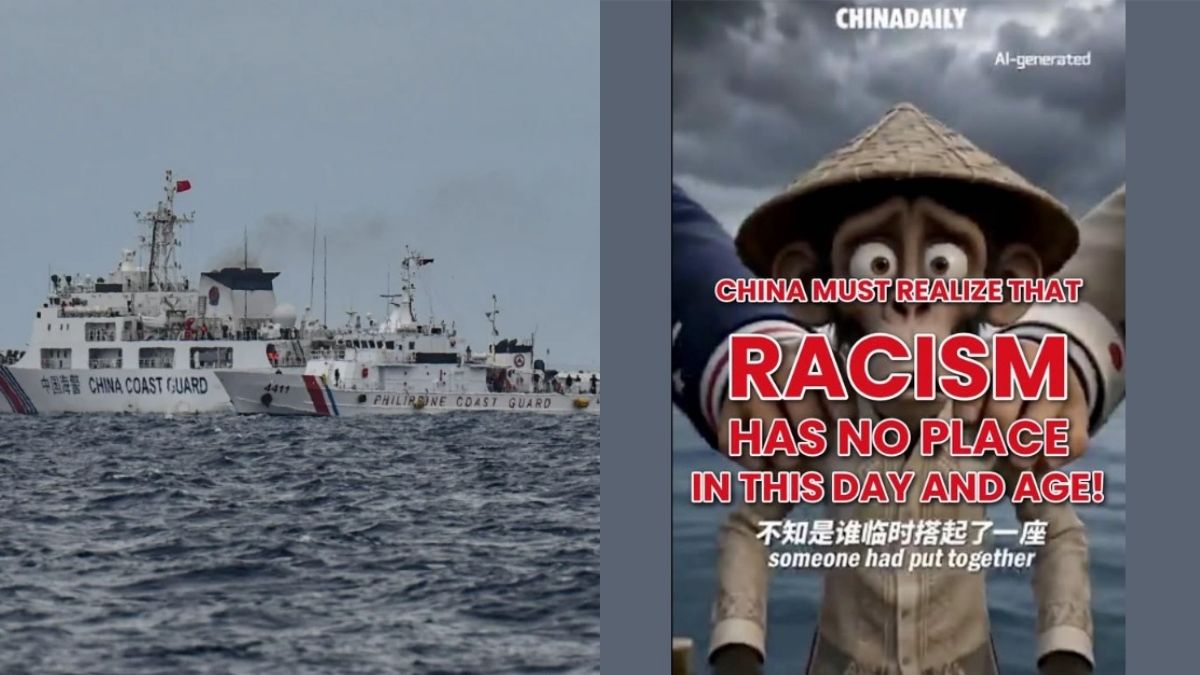
The Philippine government has condemned an AI-generated video published by Chinese state-run media outlet China Daily, describing it as racist, dehumanising and an affront to Filipinos amid continuing tensions over the South China Sea.
Officials said the video, which appeared on China Daily's Facebook page, depicted a Filipino character as a monkey manipulated by the United States and Japan, prompting strong criticism from multiple government agencies and senior officials.
Government condemns 'racist' depiction
The minute-long animation shows a timid monkey wearing a traditional Filipino barong being pushed onto a karaoke stage aboard a boat. As the character sings lyrics appearing to support China's position on recent maritime delimitation discussions between Manila and Tokyo, a voice interrupts with the words "wrong song!" before handing it a sheet labelled "South China Sea Arbitration Award".
The monkey is then launched by arms bearing United States and Japanese flags into a water cannon, a device previously used by the Chinese Coast Guard during confrontations with Philippine vessels in disputed waters.
Philippine Coast Guard spokesperson Rear-Admiral Jay Tarriela condemned the video on social media, describing it as "outright racism".
"Racism has no place in this day and age – and racism meant to belittle another race deserves nothing but condemnation. Filipinos are not monkeys!" Tarriela wrote.
Speaking separately to local media, Tarriela questioned China's actions.
"Isn't it infuriating that the very country infringing on our rights in the West Philippine Sea has the audacity to produce a video portraying Filipinos as monkeys who simply follow Japan and the United States?" he said.
He added: "Here, in this video that runs for more than a minute, what is being insulted and belittled is our very identity as Filipinos."
Tarriela further described the cartoon as "an outright racism and mockery of international law".
Defence and foreign affairs officials respond
Defence Secretary Gilberto Teodoro Jr. said the China Daily publication offered "a revealing insight into what the Chinese communist apparatus thinks of the Filipino people".
He said the video's mockery of the 2016 South China Sea Arbitral Award and its depiction of violence against Filipinos demonstrated "the moral and intellectual bankruptcy of China's propaganda machine".
"Such contemptible propaganda is a disgrace to any State that claims to exercise responsible regional leadership," Teodoro said.
He added that the incident justified the Philippines' policy of suspending ministerial and Armed Forces of the Philippines defence engagements and contacts with the Chinese Communist Party and its agencies.
In a separate statement, the Department of Foreign Affairs (DFA) strongly condemned China Daily's publication of AI-generated videos and editorial cartoons concerning the 2016 South China Sea Arbitral Award, including the video uploaded on 10 July 2026.
The department said China Daily had gone beyond legitimate political debate by employing "blatantly demeaning, dehumanising, and racist depictions of Filipinos".
"The Philippines has consistently rejected false narratives and distortions regarding the Arbitral Award and the Philippines' lawful positions in the South China Sea," the DFA said.
"But we draw a firm line at the depiction of Filipinos as monkeys... Disagreement over legal and political issues does not justify resorting to disturbing imagery."
The department demanded that the content be removed immediately and urged China to uphold "dignity, respect, and truth in public discourse".
Dispute rooted in South China Sea tensions
The latest diplomatic row comes against the backdrop of longstanding disputes over the South China Sea, where China claims almost the entire strategic waterway despite a 2016 arbitral ruling concluding that its expansive claims have no legal basis.
On 12 July 2026, marking the 10th anniversary of the Hague arbitration ruling, the Philippines issued a joint statement with 13 other countries, including Japan and the United States, reaffirming that the decision is legally binding.
Beijing has repeatedly rejected the ruling, describing it as invalid, and characterised the joint statement as a "distortion of the facts" intended to vilify China.
Relations remain strained
The controversy adds to already tense relations between Manila and Beijing.
In June, China imposed sanctions on Defence Secretary Teodoro after he criticised Beijing's activities in the South China Sea, barring him from entering mainland China, Hong Kong and Macau.
Earlier, in January, the Chinese Embassy in Manila lodged a diplomatic protest after Tarriela delivered a public speech with caricatures of Chinese President Xi Jinping displayed behind him. The incident drew mixed reactions from Philippine lawmakers, some of whom urged Tarriela to apologise to Beijing, although he declined to do so.