Netizens support Joscelin Yeo’s call for financial stability for Singaporean athletes
In a CNA commentary on 7 August, Joscelin Yeo, former national swimmer and four-time Olympian, highlighted the financial struggles of Singaporean athletes, noting that current support is inadequate. She cited examples of athletes relying on family or crowdfunding. Netizens echoed these concerns, emphasizing the need for long-term financial security.


SINGAPORE: In a commentary published on CNA on Wednesday (7 August), Joscelin Yeo, former national swimmer and four-time Olympian, highlighted the financial challenges faced by Singaporean athletes.
Netizens resonated with these concerns, acknowledging the dedication of Singaporean athletes in their pursuit of medals and national glory, while also stressing the importance of providing long-term financial security for them.
Joscelin Yeo: Financial hardships persist for Singaporean athletes
In her commentary, Ms. Yeo, who won 40 gold medals at the SEA Games during her 17-year swimming career, addressed the financial difficulties faced by Singaporean athletes.
She highlighted that despite a long career on the national team, she experienced significant financial hardships.
Ms Yeo noted that, even with a sponsor and a scholarship, these resources were insufficient to sustain a full-time athletic career.
She pointed out that the only professional sports league in Singapore is football, where there is a significant pay disparity between local and international players.
Other sports, including swimming, rely on government programs like spexScholarship and spexGLOW for support, but these programs do not fully cover the costs associated with a professional sports career.
Ms. Yeo highlighted the limitations of existing programs. While spexScholarship offers stipends and allowances, it does not cover all expenses.
She stressed that current efforts are insufficient for athletes to truly thrive and suggested that greater corporate involvement and sponsorships are necessary for a sustainable professional sports career in Singapore.
She also provided examples of how Singaporean athletes often rely on family support or crowdfunding. For instance, Joseph Schooling’s parents invested over S$1 million in his career, even selling property to fund it.
"Apart from the scholarship money I received to support my sporting expenses, my parents spent upwards of S$50,000 a year to bolster my journey," Ms Yeo revealed.
Ms Yeo emphasized that the costs associated with being a professional athlete include training, coaching, sports medicine, equipment, overseas competitions, and regular living expenses.
She concluded that while existing government support programs are beneficial, they do not fully cover the costs or sustain a professional athletic career.
Ms Yeo argued that government efforts alone are insufficient and that more substantial corporate support is needed.
"As the second week of the Paris Olympics gets underway, I can’t help but think of my ex-teammates from Australia and the United States who have become professional athletes. "
"I’ve watched how they are able to focus all their energy on training, finding the best resources for their athletic needs and meeting sponsor requirements. "
"Our local athletes, on the other hand, fight to survive while trying to be the best athletes they can be. "
She advocates for organizations to allocate budgets for athlete support, suggesting that this would help create a more viable and sustainable professional sports career path in Singapore.
Netizens call for comprehensive, long-term support for local athletes competing internationally
A netizen criticized that some officials are quick to take photos with medalists but tend to ignore athletes who do not win medals, viewing this as a lack of genuine support and recognition for all athletes.

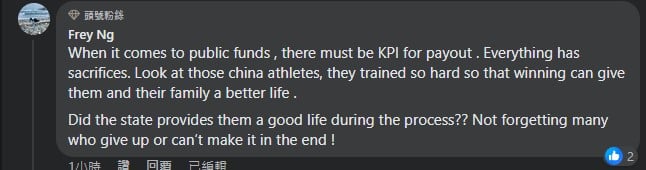
Meanwhile, some proposed the need for accountability in public funding for athletes, suggesting that public funds should be allocated with clear Key Performance Indicators (KPIs) to ensure their effective use.
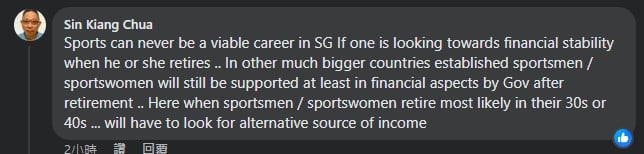
 A netizen lamented that in Singapore, a career in sports is not financially viable if one seeks long-term financial stability.
The netizen pointed hard truth that in larger countries, established athletes often receive ongoing financial support from the government even after they retire.
In contrast, Singaporean athletes typically retire in their 30s or 40s and are likely to face financial instability, needing to find alternative sources of income.
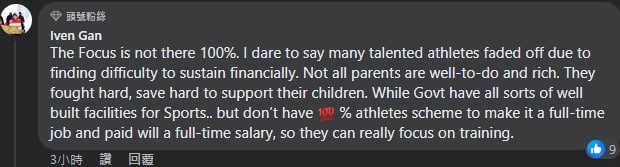
 Some pointed out that without systematic support, it is unreasonable to expect athletes—or others in similar situations—to succeed.