Unaware of her Olympic potential: 14-yr-old Japanese skateboarder wins gold
14-year-old Japanese skater Yoshizawa Coco made waves at the Paris Olympics by winning gold in women’s street skateboarding in an all-teen final. Unaware of her Olympic potential until 2020, she had been practicing her winning trick at a local park, where she had skated as a hobby since age 7.


JAPAN: A 14-year-old Japanese teen recently caused a sensation at the Paris Olympics by winning the gold medal in women’s street skateboarding during an all-teenage final.
On 28 July, over 20 teenagers competed in the Women’s Street Skateboarding Final at Place de la Concorde, one of Paris’s major public squares, where Yoshizawa Coco clinched the gold with a score of 272.75.
Yoshizawa's fellow compatriot, 15-year-old Liz Akama, grabbed silver with a score of 265.95, while 16-year-old Brazilian Rayssa Leal secured bronze with a score of 253.37.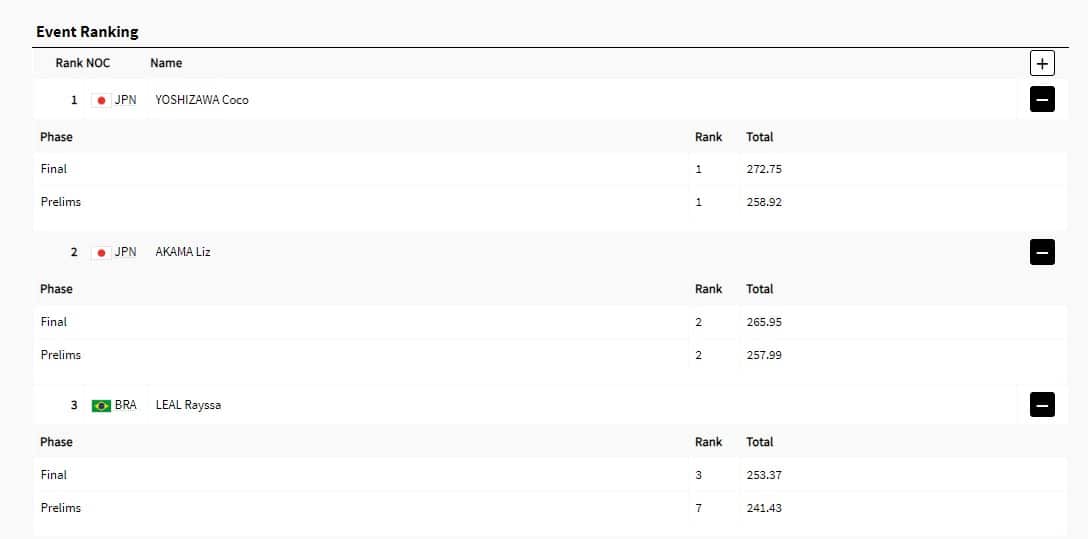
Despite her age, Yoshizawa exhibited remarkable poise and composure throughout her performance.
She landed a near-perfect big spin flip frontside boardslide on her fourth trick, which scored 96.46 points and propelled her to the top of the leaderboard.
This trick involves the skateboard rotating and flipping both vertically and horizontally before the skater lands on a rail and slides down backwards.
Yoshizawa practising Olympic-winning trick at local skatepark, unaware of her potential
What makes Yoshizawa's achievement even more remarkable is that she had been practising this trick at her local skatepark in Sagamihara (相模原市, a city in Kanagawa Prefecture) for years, unaware that it was an Olympic-caliber move.
According to the Japanese media Yomiuri Shimbun, she began skateboarding at age 7, inspired by her older brother.
Initially, she viewed skateboarding as just a hobby. She revealed to the media that she learned her winning tricks from a local skateboarding instructor and bought her equipment from a small, local skateboard shop.
Due to her parents' educational policy, Yoshizawa did not have a smartphone until junior high, leaving her unaware of how skaters showcased their tricks and interacted on social media.
It wasn’t until Yoshizawa watched the 2020 Tokyo Summer Olympics and saw fellow Japanese skateboarder Momiji Nishiya, then 13, win the first Olympic gold medal in skateboarding with the same big spin flip frontside boardslide Yoshizawa had mastered.
"It was a shock, and for the first time I thought maybe I had a chance," Yoshizawa told NHK.
In the 2020 Tokyo Olympics, skateboarding was first admitted as an official sport.
Motivated by this revelation, Yoshizawa began competing in tournaments.
She finished fifth at the 2023 World Championships in Tokyo and won a bronze medal in street skateboarding at the 2024 World Skateboarding Tour in Dubai.
In the first round of the Paris Olympic Qualifier Series in May, held in Shanghai, she placed third.
Last month, she secured her first victory at the Olympic Qualifier Series in Budapest.
Yoshizawa attributes her rapid improvement to focusing on her own performance rather than comparing herself to her competitors.
"When the skater before me succeeds in a trick and gets a high score, I feel pressured and anxious, which leads to mistakes," she told NHK.
"So I try to congratulate others on their success and focus on doing my best."
This approach proved successful for her on Sunday. In the women's street skateboarding final, competitors performed two 45-second runs followed by a phase of five tricks.
The best run and the best two tricks each earn scores between 0 and 100, resulting in a total score ranging from 0 to 300.
Entering the trick phase in sixth place, Yoshizawa’s fourth trick—the big spin flip frontside boardslide—secured her gold medal.
"I was more relieved than happy that I made it," she said afterwards.
"Completing the big spin flip felt fantastic because I hadn't been able to land it in practice, so nailing it here meant a lot."
Yoshizawa already has set her sights on the street course at the Los Angeles Olympics in 2028 and beyond.
Parental support
However, the cost of competing in international events is a major concern.
In a recent interview, Yoshizawa Isamu, the 14-year-old teen's father revealed that they cover half of the expenses for overseas competitions out of pocket.
Rising costs and the Japanese Yen depreciation have become a considerable burden.
Despite being a top-10 skateboarder globally, Yoshizawa remains a middle school student.
To support his daughter’s training after school, Yoshizawa Isamu transitioned from his job as a childcare worker to a more flexible nursing position.
He accompanies her for three hours of practice on weekdays, and on weekends, she sometimes trains for up to eight hours.
As Yoshizawa reaches the peak of the global stage with her family’s support, she reflects, "Honestly, I’m very happy, but it feels surreal. I’m just glad that all the hard work has paid off."
Redditors highlight the extraordinary aspects of Yoshizawa's journey to Olympic gold
Commenting on social media Reddit, some netizens pointed out the extraordinary aspects of Yoshizawa's journey to Olympic gold: she achieved success without sponsors or a management agency, was affiliated with a local skate shop, and realized her potential only after watching the Tokyo Olympics.
Additionally, she was unaware of the interaction among athletes on social media because smartphones were banned until middle school.
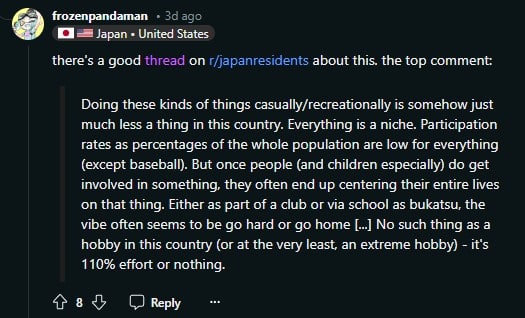
 A comment analyzes how casual or recreational activities are rare in Japan, with low participation rates for most activities except baseball.
The netizen highlights that when people, especially children, do get involved, they often commit fully through clubs or school programs, reflecting a culture of extreme dedication and a "go hard or go home" mentality.