Singapore's inflation rates hit three-year low in June
Singapore's headline inflation hit a three-year low of 2.4% in June, down from 3.1% in May, due to lower private transport costs. Core inflation fell to 2.9%. The full-year inflation forecast remains at 2.5-3.5%. This marks a 16.5% rise in inflation from June 2020 to June 2024, partly due to GST hikes.


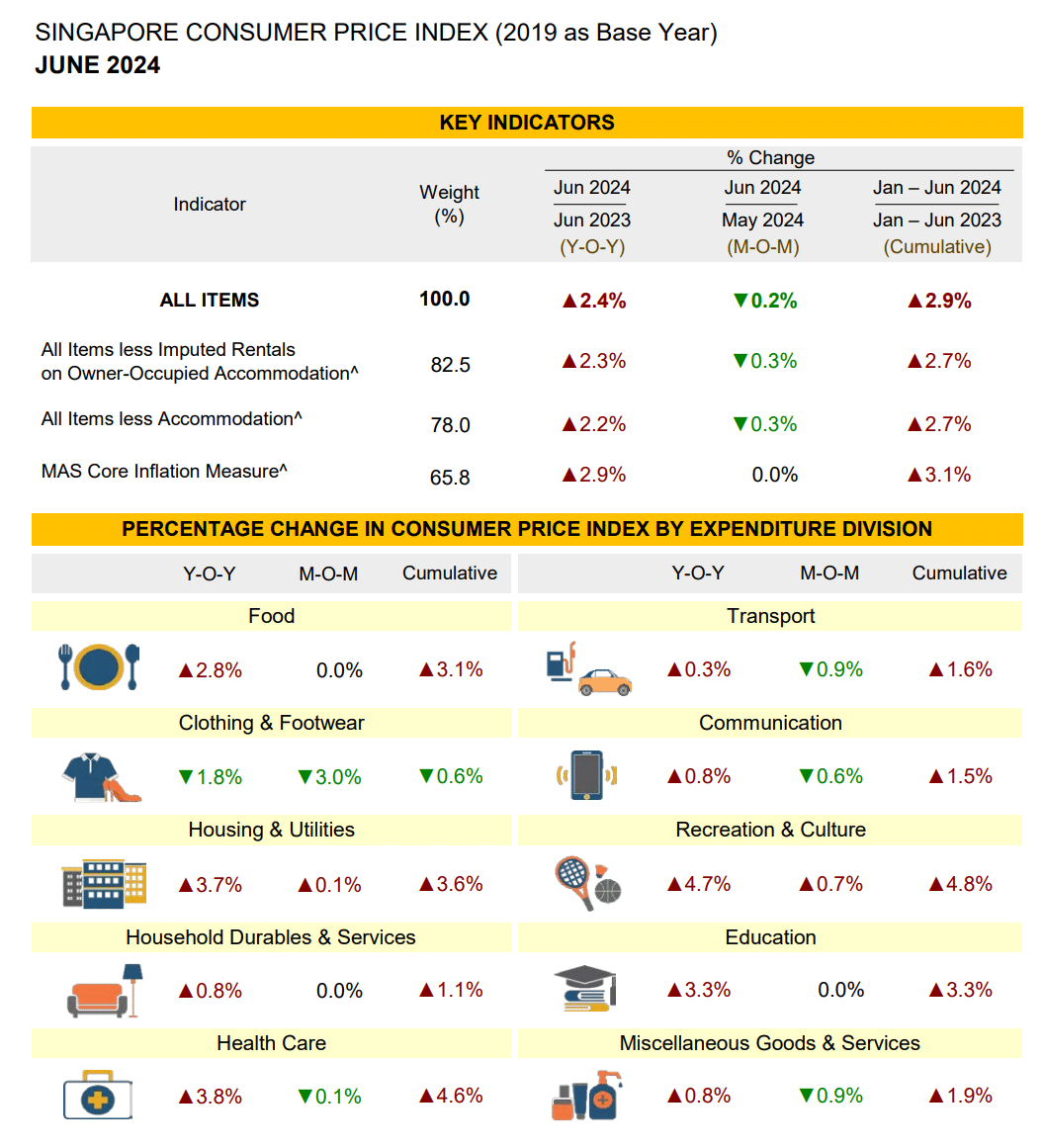
Singapore's headline and core inflation rates have slowed more than expected in June, marking the lowest level in three years, according to data released by the Department of Statistics on Tuesday (23 July).
The headline inflation rate in June was recorded at 2.4 per cent, down significantly from 3.1 per cent in May and below the median forecast of 2.7 per cent by private-sector economists polled by Bloomberg. This is the lowest rate since August 2021, when it also stood at 2.4 per cent. The decline is attributed primarily to a reduction in private transport costs and a decrease in core inflation.
Core inflation, which excludes accommodation and private transport, was 2.9 per cent in June, a slight decrease from 3.1 per cent in May and lower than the median estimate of 3 per cent by economists.
On a month-on-month basis, the overall consumer price index (CPI) fell by 0.2 per cent in June, while the core CPI remained unchanged.
The Monetary Authority of Singapore (MAS) and the Ministry of Trade and Industry (MTI) announced in a separate release that the official full-year forecast range for headline inflation is under review and will be updated in MAS's next monetary policy statement, expected by 31 July.
For now, both MAS and MTI have maintained their full-year inflation forecasts, predicting that both headline and core inflation will average between 2.5 and 3.5 per cent. Excluding the transitory effects of the goods and services tax (GST) hike, both headline and core inflation are expected to be between 1.5 and 2.5 per cent.
In June, most broad CPI categories experienced lower inflation or remained flat. Private transport costs fell by 0.7 per cent due to declining prices of cars and motorcycles, along with a slower rise in petrol prices.
Among core inflation components, retail and other goods saw the most significant easing, dropping to 0.5 per cent from 1.5 per cent previously. Services inflation also moderated to 3.4 per cent from 3.6 per cent, primarily due to a slower increase in hospital services and holiday expenses costs. Food costs remained unchanged at 2.8 per cent, indicating stable food services inflation. Electricity and gas inflation stayed flat at 6.9 per cent, with both electricity and gas prices rising at a steady pace.
Despite the recent dip in June, inflation has increased by 16.5 per cent from June 2020 (CPI 99.818) to June 2024 (CPI 116.3). The two GST increases during this period may have contributed to the overall rise in prices.