Singapore’s trade export decline in June 2024: Electronics and non-electronics impact
Singapore’s non-oil domestic export fell by 8.7% in June 2024, driven by declines in electronics and non-electronics, according to Enterprise Singapore. This contrasts with the 2.9% GDP growth reported by the Ministry of Trade and Industry for Q2 2024, highlighting the mixed performance of the economy.

The latest trade report released by Enterprise Singapore today reveals a continued decline in non-oil domestic exports (NODX) for June 2024, highlighting a significant drop in both the electronics and non-electronics sectors.
This comes in stark contrast to the recent economic growth figures reported by the Ministry of Trade and Industry (MTI), which showed a year-on-year GDP growth of 2.9% for the second quarter of 2024.
According to Enterprise Singapore, NODX fell by 8.7% in June 2024, following a modest decline of 0.7% in May. The reduction in NODX was primarily driven by a sharp decline in non-electronic products such as non-monetary gold, specialised machinery, and food preparations. The electronics sector also suffered, with significant decreases in telecommunications equipment, disk media products, and integrated circuits.
On a seasonally adjusted basis, NODX decreased by 0.4% month-on-month, reaching S$13.8 billion in June 2024, a figure comparable to the previous month but notably lower than the levels seen a year ago.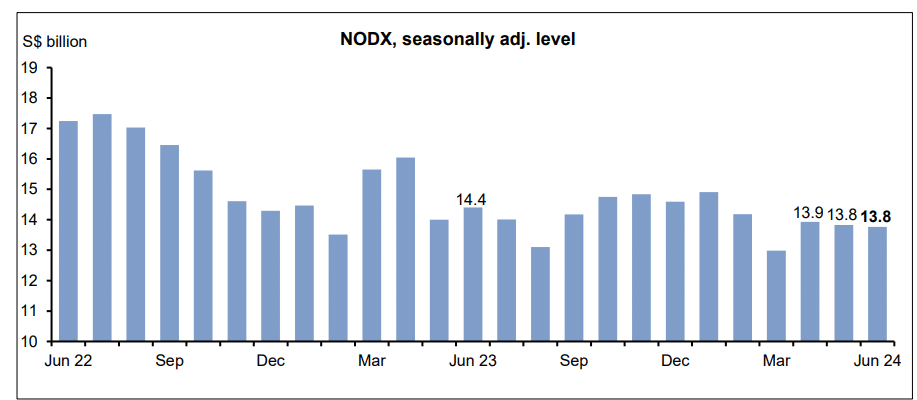
The overall trade performance showed a mixed picture. Total trade rose by 1.2% year-on-year in June 2024, a significant slowdown from the 13.9% expansion recorded in May. This increase was primarily driven by a 4.7% rise in imports, while exports decreased by 1.9%.
Non-oil re-exports (NORX) also experienced a downturn, declining by 1.0% year-on-year in June 2024 after a robust 13.3% expansion in May. While electronic re-exports grew slightly, non-electronic re-exports saw a substantial decline, particularly in copper, electrical machinery, and alcoholic beverages.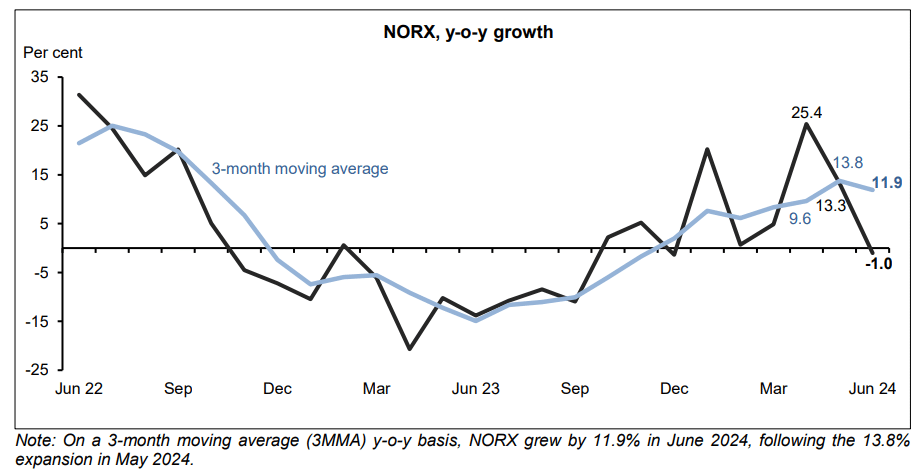
The trade report's findings stand in contrast to the optimistic economic growth reported by MTI. Based on advance estimates, Singapore's economy grew by 2.9% on a year-on-year basis in the second quarter of 2024. This growth was driven by strong performance in the services and construction sectors, which managed to offset the contractions observed in the manufacturing sector.
Enterprise Singapore's report also provided insights into the performance of Singapore’s trade with its key markets. NODX to major markets such as the US, Hong Kong, and China saw significant declines. Exports to the US contracted by 21.3% due to decreased shipments of disk media products, food preparations, and telecommunications equipment. NODX to Hong Kong plummeted by 41.9%, driven by a sharp fall in non-monetary gold, integrated circuits, and measuring instruments. Similarly, exports to China dropped by 11.2%, impacted by declines in non-monetary gold, electrical circuit apparatus, and diodes & transistors.
Conversely, NODX to Malaysia, Thailand, the EU 27, and Indonesia experienced growth, showcasing a more nuanced trade landscape. Oil domestic exports grew by 9.2% year-on-year, bolstered by higher exports to Indonesia, Australia, and the Marshall Islands. However, in volume terms, oil domestic exports decreased by 3.2%.
The juxtaposition of the trade report with the MTI's economic growth figures underscores the complexity of Singapore's economic landscape. While the overall economy shows signs of robust growth, driven by certain sectors, the trade sector faces significant challenges, particularly in exports. This dual narrative highlights the need for targeted strategies to bolster trade performance and ensure balanced economic growth.
For more detailed data and insights, the full trade report is available on the Enterprise Singapore website.