Chan Chun Sing warns against Singapore being "used as proxies for other people's quarrels"
Addressing a query at a conference about the de-conflicting mechanisms in place in the Singapore system, Education Minister Chan Chun Sing stressed the need to understand its interests and global stance, warning against being drawn into proxy roles in external conflicts.
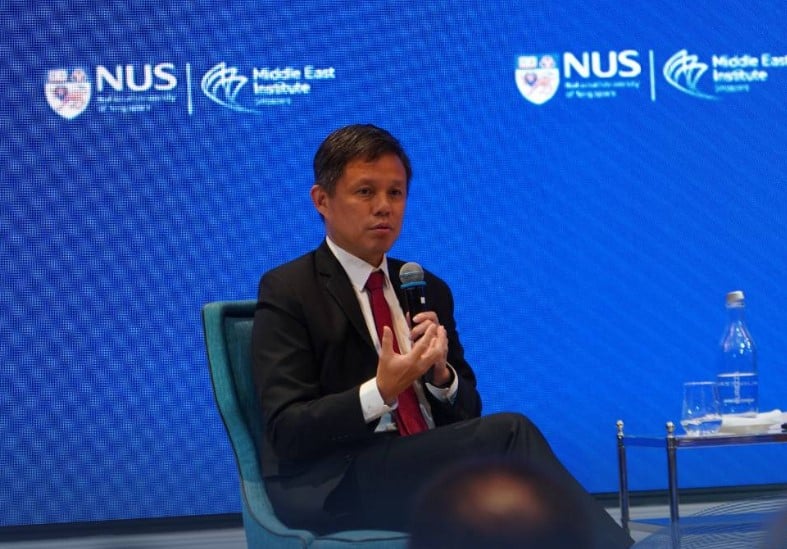

SINGAPORE: Chan Chun Sing, Singapore's Education Minister suggested that when addressing conflict or discourse, Singaporeans should prioritize understanding the root causes of conflicts and disagreements instead of taking sides.
He also emphasized the importance of Singapore understanding its own interests and global stance, cautioning against the nation being drawn into acting as a proxy in disputes or conflicts involving other parties.
"We are not instruments of other people's quarrels or contests, " he said. "We need to understand why they are doing what they are doing and have bring our own perspective understand our own interests."
"Then we won’t get caught up in this thing whereby we are used as proxies for other people's quarrels."
"People don't need Singaporeans to be another proxy for them. They can disagree, they can quarrel very well on their own, they don't need our help."
"If we can value it is to deeply understand, why it is so, and more importantly what constructive role we can play."
Minister Chan envisions that these instincts and dispositions—focused on deep understanding and constructive engagement in global affairs—will become integral to the identity of Singaporeans, persisting across generations.
Minister Chan was addressing an audience question during the closing session of the NUS Middle East Institute’s annual conference on 25 June.
The SMU student asked the Minister about how Singapore's education system handles conflicts or clashes of narratives, whether they arise from local or foreign events.
He also sought insights into the "de-conflicting "mechanisms and measures in place in the Singapore education system to facilitate discourse and resolve such conflicts effectively.
In response, Minister Chan acknowledged the complexity and multitude of global issues, noting that Singapore cannot solve all problems nor act as a universal judge of global events.
However, he stressed the importance of understanding the root causes of conflicts and disagreements, both locally and internationally.
"and that comes with a deep respect for the diversity of perspective out there. That is not just about the Singapore perspective, it's about the diverse perspective out there."
He emphasized that solutions should not be about choosing sides but about understanding the different viewpoints involved.
"I'm saying that different parties have different perspective and for us to earn our keep, we better understand deeply why people think how they think."
"Then only can we be “creative” and come up with solutions that transcend that overcome, " he added.
Minister Chan also underscored the importance of Singapore understanding its own interests, stance on issues, and approach to global affairs, cautioning against being drawn into conflicts or taking sides without thoughtful consideration.
"It is not about just listening to the diverse perspective and then choosing one side, and then defending the side come what may."
"We are not instruments of other people's quarrels or contests. We need to understand why they are doing what they are doing and have to bring our perspective understand our own interests."
Minister Chan expressed hope that Singaporean students will develop instincts and dispositions characterized by deep understanding, independence in thought, and a commitment to constructive engagement.
MOE criticised for allegedly ‘cherry-picking’ facts in CCE lesson saga
While Minister Chan advocates for a deep understanding of conflicts, whether local or global, his ministry's approach to handling content related to the Israel-Palestinian conflict within the Character and Citizenship Education (CCE) curriculum appears contradictory.
In February this year, MOE faced criticism for perceived failures in addressing the prolonged suffering of Palestinians, accused of presenting a biased perspective on the prolonged conflicts to students.
Despite the one-hour time limit and the preparation required for resources, the curriculum only spans developments from October 7 to December 2023.
The teaching has been criticized for lacking accurate historical narration of events related to the Israeli-Palestinian conflict.
There are accusations that students attempting to correct misinformation are allegedly being disregarded, silenced, or, in some cases, met with punishment.
Lesson slides include a summary of key events in the Israel-Palestine conflict since 1948 and a summary of Hamas, highlighting its non-recognition of Israel’s right to exist.
Notably absent were mentions of Israel’s non-recognition of a Palestinian state and recent accusations against Israel of committing acts of genocide against Palestinians.
MOE initially defended its "balanced teaching" on the conflict, emphasizing empathy and critical thinking in lessons.
However, criticism continued, with the community advocating for MOE to ensure a balanced and bias-free teaching approach regarding the Gaza conflict in CCE lessons. This prompted Minister Chan to personally address the matter during the budget debate for MOE on 4 March.
Addressing public concern, Minister Chan announced adjustments to the CCE lesson on the Gaza conflict to cater to different age groups: younger students will receive simplified content focusing on empathy and emotional management, while older and more mature students will get additional guidance and updated materials to understand Singapore’s national interest in the context of the conflict.
When MPs, including Non-Constituency Member of Parliament (NCMP) Leong Mun Wai and Hazel Poa from the Progress Singapore Party, asked for transparency by requesting the release of the lesson materials and slides, Minister Chan stated that MOE had decided against making them public after extensive discussions.
He justified that the slides alone might not accurately represent how the lesson is taught by teachers and could lead to misinterpretations if viewed without context.
He encouraged concerned parents to visit the teachers who could explain how the lesson is conducted, emphasizing that this is better than merely looking at slides without context.
NCMP Leong had also expressed concern about complex and controversial issues like the Israel-Hamas conflict being taught to children and questioned how the content is tailored based on students’ maturity levels.