Serious questions that need to be raised about China football fans swarming Hassan Sunny's stall
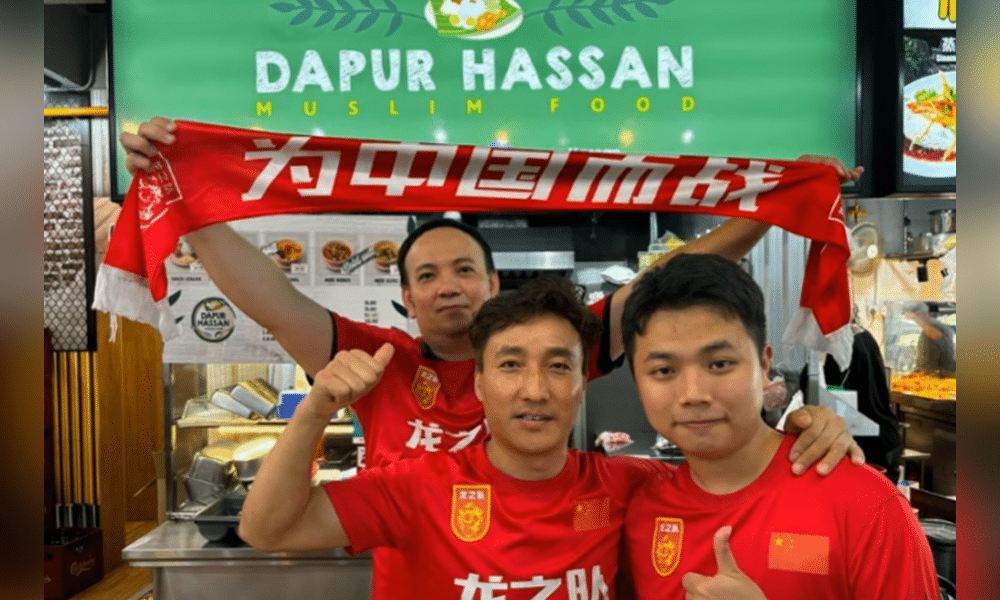
Swarms of China nationals heading to Hassan Sunny's Nasi Padang stall to thank him for helping China get into the next round of World Cup qualifiers raises serious questions beyond football. This situation highlights concerns about potential political loyalties and foreign interference, echoing recent CCP statements urging overseas Chinese to act as a "united front." Such matters demand deeper reflection on their national security implications.

by Alexander
We have certainly been aware of the news that Singapore goalkeeper Hassan Sunny's Nasi Padang stall is being thanked by fans of the Chinese football team in light of his crucial save in the Thailand match that sent China through to the next round of the World Cup qualifiers.
Firstly, Hassan Sunny having to double off as a Nasi Padang stall owner reflects badly on the state of affairs of the Football Association of Singapore (FAS).
It shows that Singapore football players are underpaid, and underpaid football players reflect a national football team that is under-resourced.
If Singapore's football team remains under-resourced, how can it remain competitive on the global or even regional footballing stage?
Do we see Japanese or South Korean footballers, even those playing in their domestic leagues, having to work other jobs on the sidelines?
The above paragraph's point aside, the swarms of Chinese people heading for Hassan Sunny's Nasi Padang store raise serious questions beyond football.
And the question is, what or where will the loyalties of these individuals who support China be, when push comes to shove, politically?
Could they even be a potential foreign interference fifth column here on Singapore soil?
These are questions that should not be taken lightly, and these are in view of statements made by senior CCP figures on overseas Chinese:
1. Li Xi, seventh-ranked member in the politburo standing committee, called on overseas Chinese to "protect reunification and take a clear-cut stand against talk that will split the country"
2. Xi Jinping, President of the People's Republic of China, talked about overseas Chinese forming a "united front" for purposes of national rejuvenation.
The points in 1) and 2) are not just expressions of benign patriotism or nationalism.
The CCP's one-China policy has seen it not eschewing from using coercive, arm-twisting approaches to have its way, case in point, the seizure of the SAF's terrex vehicles by China-controlled Hong Kong in 2016-17.
Although the incident was technically a customs affair, China's demand that Singapore adhere to the one-China policy (i.e., demands that Taiwan's independence drive be not recognised) reflects anything but.
Given how the CCP views overseas Chinese as extensions of its foreign policy, there are questions if China nationals in Singapore are just benign entities or how many of them will have little problem acting as Xi Jinping's fifth column and the extension of his (arm-twisting) arm should Xi Jinping want to wring stuff out of Singapore.
This issue should not be treated lightly, especially in view of how overseas Chinese acting as CCP influence ops has been an issue flagged out (as seen here and here).
Why this can be problematic is because we see a China under Xi that is not content with just soft power projection.
This is a China that flicked the middle-finger at the International Court of Justice's ruling on the South China Sea dispute, with Western countries not being able to do much about it.
This is also a China that was more than happy to impose sanctions on one of Norway's chief exports, salmon, after Liu Xiaobo was awarded the Nobel Prize for Peace. As such, we don't know how a potential pro-CCP fifth column here on Singapore soil will affect things here.
Also, their presence could have a bearing on Singapore's long-standing foreign policy stance of neutrality. Already, that is in question given Singapore's hostile response to Russia, in sanctioning her, following her (Russia's) 2022 invasion of Ukraine, and the recent welcoming of Zelensky with open arms.
This is already in contrast to Singapore's approach when the then-Soviet Union invaded Afghanistan in 1979. Singapore's Ministry of Foreign Affairs resisted calls to reduce the Soviet embassy's staff size, certainly a stance that best reflects neutrality in contrast to the current approach.
With this neutrality already in question, what more when potential CCP fifth columns of unknown size try to exert their influence?
What are the bearings this could have on Singapore-China relations, especially in view of the tendency for China to treat smaller states as quasi-vassals?
Also, if China has her way too far, could this throw Singapore deeper into the US-China cold war, and even be a pivotal tool for China to shape the global economy in her favour, via a stronger grip over the South China Sea?
These are serious questions that cannot be sat on, and swarms of Chinese nationals visiting Hassan Sunny's Nasi Padang stall should not just be the stuff of memes and jokes.
They reflect a wider social and geopolitical question at play.