Redditors challenge birth rate analysis, highlight rising costs and family challenges in Singapore
Reddit users contested an analysis by the Department of Statistics analysis linking Singapore's declining birth rate to the increase in single women. They shared anecdotes, underscoring the challenges women face balancing work and family. Additionally, some noted the hesitation to start families due to the rising cost of living and uncertain economic conditions.

Following the release of a Department of Statistics (DOS) analysis attributing Singapore’s longstanding baby drought to the growing share of women remaining single, the online community engaged in vigorous debate, contesting the assertion.
The DOS's findings sparked heated discussion on Reddit, with some Redditors criticizing the analysis for solely attributing blame to the increasing number of single women while overlooking the escalating costs and the mounting challenges of parenthood within a high-cost environment and under societal pressures.
Additionally, there is a prevalent critique of traditional gender roles, accompanied by calls for societal and policy reforms aimed at addressing these challenges and reshaping the societal perception of marriage and parenting.
In a May newsletter, DOS suggested that Singapore’s longstanding baby drought may be attributed to the increasing number of women remaining single, resulting in a decline in the resident total fertility rate (TFR) to below 1 in 2023, a historic low for Singapore.
The analysis of the factors behind the falling TFR found that the drop in the TFR between 2005 and 2023 was due to a decline in the proportion of married women, which offset slight increases in the fertility rate of married women.
The analysis comes after Singapore’s resident TFR fell to 0.97 in 2023 – which is among the lowest in the world. The TFR refers to the average number of babies each woman would have during her reproductive years.
The analysis also mentions various measures that Singapore has implemented over the past 20 years to boost the birth rate, such as Baby Bonus cash gifts, extended maternity and paternity leave, and government co-funding for in-vitro fertilization treatments. Despite these efforts, the resident TFR has been on a declining trend for the past 30 years.
However, population experts stress that Singapore cannot afford to see the baby drought as a lost cause and may need to explore additional strategies to address the issue.
Redditors highlight challenges faced by women: Juggling work, family, and societal expectations
The DOS's analysis, as reported by The Straits Times, sparked heated discussions on the Reddit platform.
Redditors shared personal experiences and observations regarding the challenges of balancing work and family life, particularly for women.
They highlight issues such as the expectation for women to manage household chores and childcare while also holding down full-time jobs, the financial strain of raising a family in a high-cost environment, and the societal pressure on women to marry and have children.
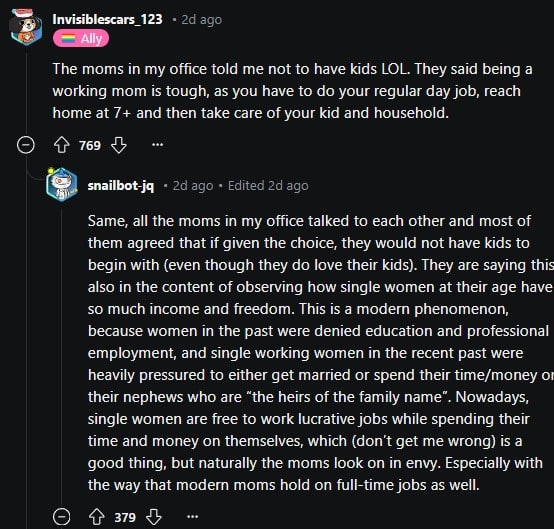
For instance, a Redditor shared that parents in his office expressed the difficulties of being working mothers and even advised against having children.
These mothers agreed that if given the choice, they would not have had kids, despite their love for them.
The Redditor attributes this sentiment to the observation that single women in their age group have more income and freedom. They contextualize this phenomenon as a modern development, contrasting it with past societal norms where women were denied education and professional opportunities, and single women were pressured to marry or focus on familial obligations.
The Redditor acknowledges the positive aspect of women now being free to pursue lucrative careers and self-development but notes that some working mothers may envy the freedom and financial independence of single women.
"As a parent, your job never ends"
Some highlighted the challenges of being a parent in Singapore, emphasizing the effort required to balance various responsibilities.
One Redditor noted that his female friends often work long hours in high-stress jobs but are still expected to manage all household chores, cooking, and childcare.
With both partners working, the imbalance in domestic duties becomes evident. The Redditor argued that until men and women share home and childcare responsibilities equally, fewer women will see the value in marriage.
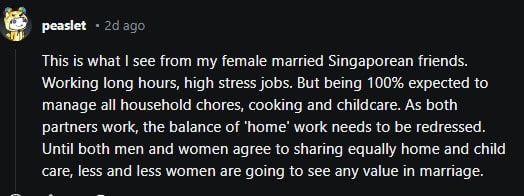
Some ridicule that being a parent means their job never ends:

Daunting challenges of starting a family
A Redditor, who introduced herself as a recent-divorcee with no kids, addressed the societal pressure and the suggestion from others that having children could have "kept their marriage together" or provided companionship in old age.
She criticized how getting married and having children has become a materialistic desire due to the increasing costs of living.
"To some, kids are their driving factor to want career advancements (and thus earn more income) but to others, it's not always possible to do the same and this ends up in many unseen sacrifices being made. "
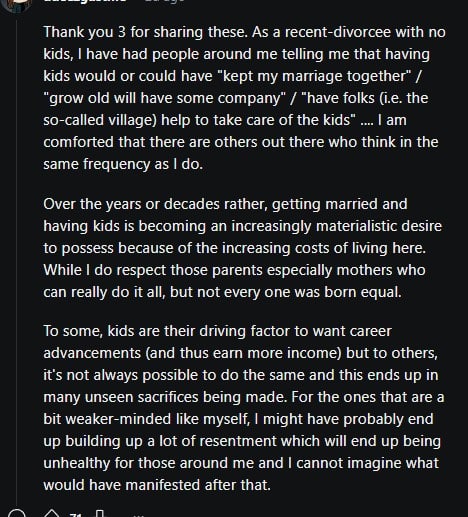
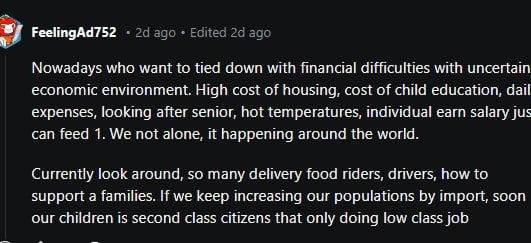
Another comment highlighted various economic and societal challenges that make starting a family daunting, including the high cost of living, housing, education, daily expenses, and caring for seniors, which can strain finances.
Additionally, with uncertain economic conditions, individuals may hesitate to commit to the financial responsibilities of starting a family.
Anticipated pressures on young women: Balancing careers, family, and elder care
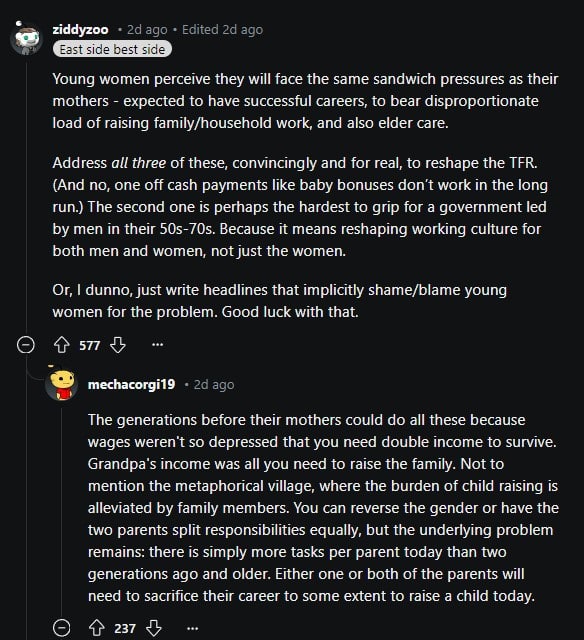
There are also comments highlighting that young women anticipate facing the same pressures as their mothers, which include managing successful careers, bearing the disproportionate load of family and household work, and taking care of elderly parents.
A Redditor emphasized that addressing all three of these pressures convincingly is essential to reshaping the Total Fertility Rate and that one-off solutions like cash payments (e.g., baby bonuses) are ineffective in the long run.
Another Redditor discussed the economic realities that differ from previous generations. In the past, a single income was sufficient to support a family, and there was more communal support for child-rearing.
Today, with wages depressed and the necessity for dual incomes, parents face more tasks and responsibilities. This economic pressure means that either one or both parents often need to sacrifice their careers to adequately raise their children.