PAP may lose more votes in upcoming election but will definitely remain in power
Deputy Prime Minister Lawrence Wong acknowledges the possibility of opposition gains, but historical trends and electoral structures suggest that the People's Action Party is likely to form the Singapore government again, despite a potential decrease in voter support in the upcoming election.
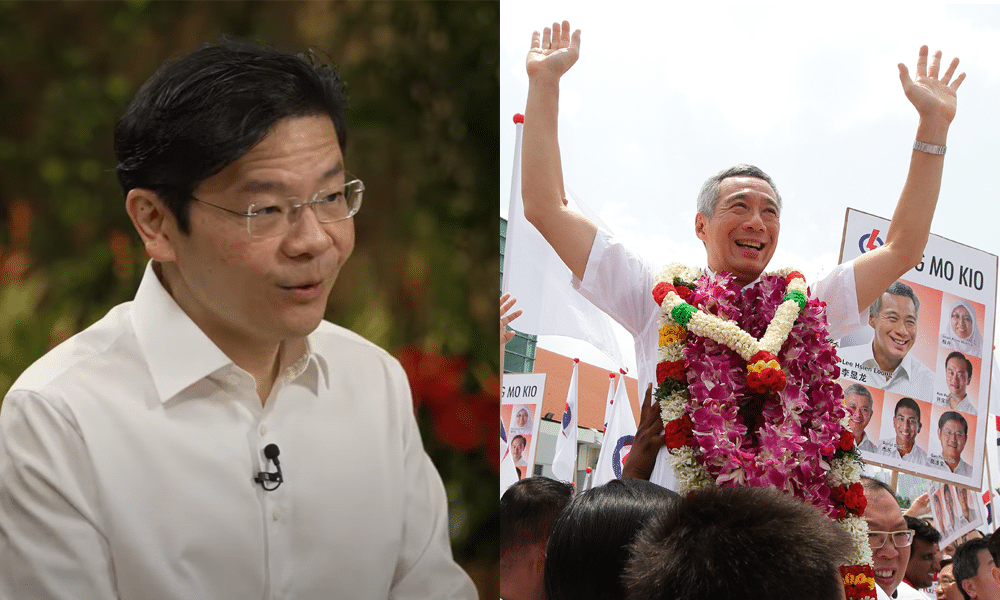

Speaking in an interview with local media prior to his appointment as Singapore's 4th Prime Minister on 15 May, Deputy Prime Minister Lawrence Wong suggested that if the Workers' Party and one or two other opposition parties intensify their efforts in the next election, a slight dip in PAP's votes could lead to a coalition government formed by two or three opposition parties, achieving over 50% of the vote.
"That's why I seriously say I do not assume PAP will automatically win the next election or that I will definitely be PM," Wong added, highlighting the evolving nature of Singapore's political landscape where diverse voices are now heard in Parliament.
Wong further stated that Singapore’s political system today is no longer a dominant one-party system but rather one where alternative voices and diverse views can be heard on any issue.
Wong further said that Singapore’s political system today is no longer a dominant one-party system but rather one where alternative voices in Parliament and diverse views on any issue can be heard.
Once again, we hear the same fear-mongering from PAP politicians about the possibility of a freak election, seeing a non-PAP government following the conclusion of polling day in the election.
While it is true that the PAP managed to garner only 61.23% of the total votes cast during the COVID-19 pandemic in July 2020, this was a significant decline from the 69.86% it managed in the previous election. However, the eventual outcome of the poll contrasts with Wong's statement about the possibility of the opposition forming the government.
One should note that although the PAP secured just over 60% of total votes in the most recent election, it still held 89.2% of the total parliamentary seats, or 83 out of 93 seats.
Even if we assume that the seats where the opposition managed to get over 40% during GE2020—from those contested by the Singapore Democratic Party, Progress Singapore Party, and Workers' Party—could be won in the next election, that would add only 22 seats to the existing 10, making it 32 seats. This is still far from the 47 seats needed for a majority to form a government.
Furthermore, we have not yet factored in the dissolution of wards that the PAP nearly lost in the upcoming election, similar to how Fengshan SMC and Joo Chiat SMC were wiped off from the map by the Electoral Boundary Review Committee, led by the secretary to the PM, without any explanations.
Many speculate that Bukit Batok SMC, which is contested by SDP's Dr Chee Soon Juan, might be absorbed into a GRC and that West Coast GRC, where former Transport Minister S Iswaran was situated and nearly won by PSP with its 48.32% of votes, could be broken up or redrawn.
Back in July 2020, following the conclusion of the General Election, Wong himself said that it is “unlikely” that the ruling PAP would be able to exceed 65% of the national vote in future elections, given voters’ desire for alternative voices in Parliament.
“Subsequent general elections will be much tougher than this one. The desire for diversity in Parliament, for checks and balances, is permanent. It is here to stay, and we must be prepared for this new reality,” Mr Wong said to PAP activists.
It should be noted that since 1984, the PAP has typically obtained around 65% of the votes, with outliers being the snap election in 2001 following the September 11 terror attacks in the United States and the 2015 election, which occurred after founding Prime Minister Lee Kuan Yew passed away in March of that year.
Based on past election trends, it is challenging to determine whether support for the ruling party is truly in decline despite the significant influx of new immigrants over the decades.
Nevertheless, it is clear that the prospect of the current batch of political parties contesting the election, winning over the majority of the electorate, and forming a government is far from certain, given the existing hurdles.
The results of past elections would, however, suggest that even if the PAP were to win below 50% of the total votes, it could still form a government due to the GRC system's strongholds across the island.
Wong's appointment as PM to be a challenge for PAP
In the same interview, Wong said, "...as Prime Minister and later Leader of the Party, I will do my very best to make sure that the PAP earns the confidence and trust of Singaporeans and we get the mandate to govern."
"But if along the way, who knows how long, but down the road – we hope not, this will not happen – but if it does happen, that the PAP is not able to deliver up to the standards that Singaporeans expect of us and an alternative party or parties emerge that can offer a better answer, then they deserve to get the mandate."
"But so long as it is under my watch, I will do everything I can to make sure that the PAP earns (the) confidence and trust of Singaporeans."
Wong's statement to the media seems to be aimed at lowering expectations for the upcoming election results, with him leading the party into the general election and LHL stepping out of the picture as Senior Minister.
Back in the day, it didn't matter to many who held the top seat as long as they believed Old Lee was there to ensure Singapore was run well as a country.
Since he is not named Lawrence Lee and does not share the same good fortune as Goh Chok Tong, who had the backing of the late founding Prime Minister Lee Kuan Yew when he first stepped up to the premiership, Wong faces a tough challenge in proving his ability to lead as the Prime Minister.
A survey conducted by YouGov in April this year, following the announcement of LHL stepping down for Wong to take over, revealed that while just over half considered him competent, three in five Singaporeans do not feel he is trustworthy. Furthermore, 72% do not think he is honest, and the same percentage do not see him as a strong leader.
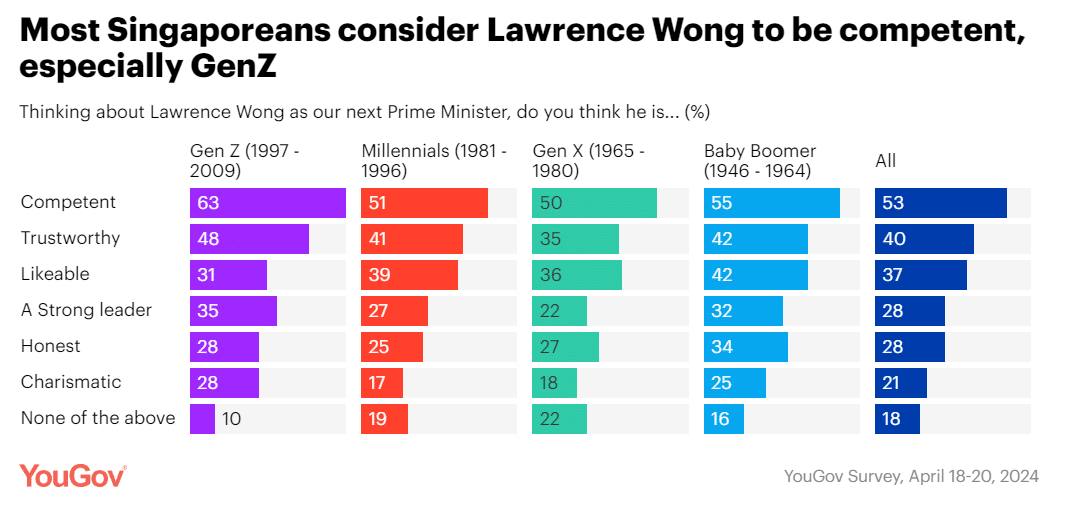
Perhaps that's why Wong has to go on social media and be promoted for his guitar skills instead of his leadership qualities, as people are simply not interested—according to YouGov's figures, 36% didn't care about the news of his being appointed as Prime Minister.
Frankly, given Wong's background in civil service for essentially his entire career, it is quite a tall order to expect him to be his own man instead of following instructions from higher-ups.
Since Lee Hsien Loong will remain as the Senior Minister in the cabinet, it is unlikely that Wong would make any significant changes to Singapore's policies, mainly since his fellow cabinet members are likely still eyeing the top seat.
If he is ousted for being his own man, it is doubtful any of his colleagues would lament the matter, just as MPs such as Tan Cheng Bock and others have been treated. On the other hand, the PAP has shown time and again that as long as a party member's loyalty and actions align with the leadership, he or she will be taken care of regardless of any supposed transgression.
Wong set up the stage nicely when asked if he would relook at policies by saying, "We are prepared to relook everything; it is not so much that we are going to slay a sacred cow for the sake of doing so, but we are prepared to re-examine all our assumptions and consider under different circumstances, different societal expectations and needs; how might we do things different?"
When the PAP forms the new government after the General Election—most likely to be held in September this year—Wong will likely maintain the course set by his predecessor and boss, promoting an economy reliant on a population of over 6 million for growth. The population can be expected to grow in the future under the leadership of Wong, with massive infrastructure spending being planned and no apparent U-turn on the controversial Population White Paper.
Reflecting on Wong's comment about the opposition forming a government, this is not the first time the PAP has remarked on the possibility of the opposition taking over.
One can recall 2015 when, for the first time since independence, all seats were contested. Former PAP chairman Khaw Boon Wan then told the press, "We cannot be sure of a PAP government on Sept 12." with the headline, "No guarantee PAP will be in govt after polls: Khaw" splashed on top of the Straits Times front page.
And what happened next? The PAP nearly wiped out all opposition representation as WP barely held onto Aljunied GRC with a mere 50.96% of total votes cast, and Hougang SMC remained its sole stronghold.
Many attribute the results of the election to the passing of LKY, where many voters wanted to give him a farewell gift at the polls.
However, voters surely did not expect his family to fall apart not so soon after his passing over issues related to his wish to have the 38 Oxley Road property demolished after his death.
Perhaps the PAP understands deeply that its legitimacy with voters is not due to its belief in Lee Hsien Loong, Lawrence Wong, or any of the 4G ministers, but rather the undying trust in LKY's foresight.
This might explain why they are so intent on vilifying Lee Hsien Yang, who has openly defied his elder brother and professes a desire to fulfil the final wish of the beloved statesman of the city-state.