"Is a one-hour lunch break sufficient for Singaporean workers?"
Redditors question the suitability of a one-hour lunch break, citing crowded food stalls and time constraints. Strategies like opting for a 'late lunch' and bringing homemade meals are discussed to navigate the challenges.
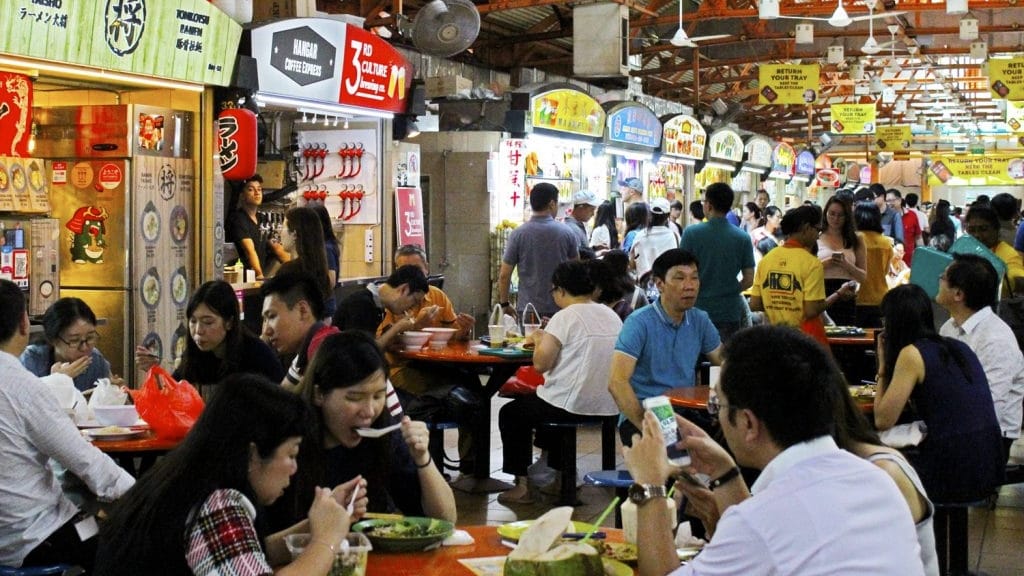

SINGAPORE: Lunch break holds significant importance for workers, providing a brief respite from the demands of work and an opportunity to replenish energy levels.
However, questions arise regarding the adequacy of the allotted lunch break time within companies.
On Tuesday (26 Mar), a Reddit user sparked a discussion by questioning the suitability of a one-hour lunch break for employees in Singapore.
"Do you think a one-hour lunch break is too short for those of us working in Singapore?" the user asked.
The user pointed out the challenges posed by the dense population of Singapore, highlighting the scarcity of space.
"The lunch crowd can be very scary," the user emphasized, shedding light on the congestion and time constraints faced during lunch hours.
The process of walking, queuing, waiting, eating, and attending to personal needs all demand considerable time.
Reflecting on their own experiences, the user recalled feeling rushed during school lunch breaks, where a mere 30 minutes often felt insufficient for eating, socializing, and attending to personal needs.
They acknowledged that it's theoretically possible to manage within the time frame, but it requires fast-paced actions and luck in encountering shorter queues or less crowded food stalls.
Under the user's post, numerous Redditors resonated with the sentiment that a one-hour lunch break is insufficient, particularly citing long queues at food stalls as a primary challenge.
Many emphasized the difficulties faced, especially in the Central Business District (CBD), where time constraints are exacerbated by the high demand for food during peak hours.
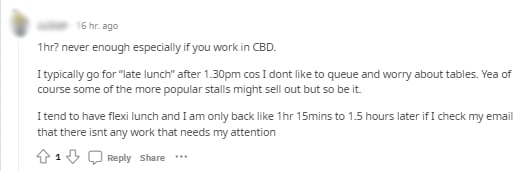
One user highlighted their strategy of opting for a "late lunch" at 1:30 pm to avoid queues and ensure access to seating.
They acknowledged the risk of popular stalls running out of food but deemed it a necessary trade-off for a more manageable dining experience.
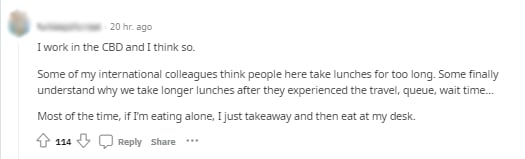
Another CBD worker shared similar sentiments, noting that international colleagues initially perceived lunch breaks in Singapore as excessively long until they experienced the realities of navigating queues and wait times.
The user admitted to often resorting to takeaway meals eaten at their desk to save time.
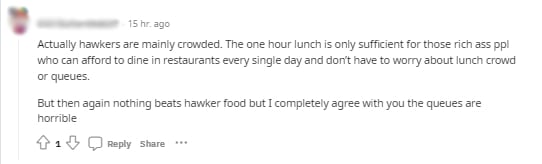
One user highlighted the contrast between dining at restaurants and hawker centers, asserting that a one-hour lunch break is only adequate for those who can afford restaurant meals regularly.
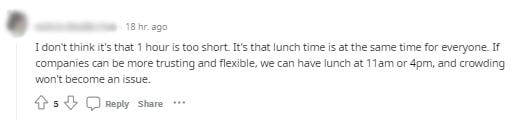
A different perspective emerged, suggesting that the issue lies not in the duration of the lunch break but rather in the synchronization of lunch times for the majority of workers.
This user proposed that if companies embraced more flexible schedules, employees could choose to have lunch at non-peak hours, thereby reducing congestion and queues at food stalls.
Lunch break hacks: Bringing homemade meals to save time and money
Several Redditors offered advice on streamlining lunch breaks by bringing food from home, thereby bypassing queues at food stalls. Some users even shared tips on meal prepping to optimize efficiency.
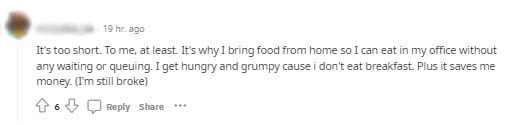
One commenter expressed dissatisfaction with the duration of the lunch break, deeming it too short for their needs.
To counteract this, they opted to bring food from home, allowing them to eat in their office without wasting time waiting in queues.
Another user detailed their approach, which involved purchasing a loaf of bread over the weekend and storing various toppings in the fridge.
By packing these items in a cooler bag each morning, they could quickly assemble sandwiches during their lunch break, accompanied by fruit and a beverage, thereby saving significant time.

In addition to time-saving benefits, one user emphasized the cost-effectiveness of bringing homemade meals.
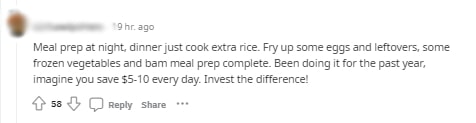
They advocated for meal prepping at night, suggesting utilizing leftovers and basic ingredients to create affordable yet satisfying meals.
By adopting this strategy, the user asserted that substantial savings could be accrued over time, encouraging others to invest the difference.