TWC2 exposes recruitment scam: S-Pass supervisor ended up with menial work, lower pay
TWC2 spotlights an alleged recruitment scam, where a Bangladeshi worker recruited under the S-Pass as a construction site supervisor, ended up doing menial labour and received significantly lower pay, sometimes less than S$600 per month.


SINGAPORE: Transient Workers Count Too (TWC2), an advocacy group for migrant workers, has shed light on an alleged recruitment scam in Singapore, wherein a migrant worker recruited under the S-Pass scheme found himself receiving salaries far below what was promised by his employer.
TWC2 stresses the urgent need for stringent actions against such recruitment scams and calls upon the Ministry of Manpower (MOM) to implement a robust system ensuring that migrant workers are assigned job roles and compensated exactly as advertised.
Furthermore, the group underscores the potential exploitation of S-Pass requirements and advocates for thorough verification processes to guarantee that job offers made by companies align with their claims and that the salaries provided are accurate.
In a February article, TWC2 shared the story of Mridha Hossein, a Bangladeshi migrant worker who fell victim to an alleged recruitment scam.
Despite being assured a construction site supervisor position with a monthly salary of S$3,050, Mridha was instead subjected to menial labour across various worksites and received significantly lower pay, sometimes less than S$600 per month.
According to TWC2, Mridha, who held a university degree and had prior work experience in Bangladesh, secured a job in Singapore through an agent under the S-Pass scheme, for which he paid S$12,000 in recruitment fees.
A screenshot of an In-principle Approval (IPA) issued to Mridha indicated that he was appointed as a construction site supervisor with a basic monthly salary of S$3,050 along with an S$800 allowance.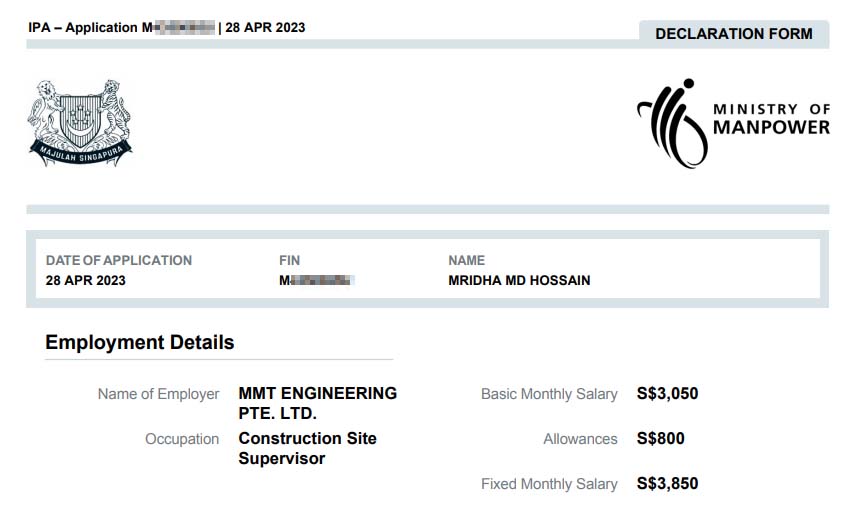
Discrepancies between promised and assigned job responsibilities
Mridha expressed his initial optimism upon receiving the In-principle Approval (IPA), envisioning a path to building his career, earning a stable income, and supporting his family.
However, upon his arrival in Singapore in August 2023 and the commencement of his employment, his expectations were shattered.
He soon discovered that the job he was assigned was entirely different from what had been promised to him.
Contrary to expectations, the company allegedly did not possess its own construction projects. Instead, Mridha was deployed as casual labour to various worksites daily.
"For a total of three months I was working here, I worked at different places and different types of work. Sometimes I worked as an electrician, sometimes I'm doing a glass fitting job, sometimes I'm doing construction," he told TWC2 volunteers in an interview.
"On first time I going for work, I did a painting work. After I finished work, I was really astonished and depressed," said Mridha.
According to the MOM website, Only eligible candidates will be considered for an S Pass. Criteria include earning a salary of at least S$3,150, which is benchmarked against the top one-third of the local associate professionals and technicians (APT) salaries by age.
Discrepancies in payslips
In October 2023, Mridha's plight caught the attention of a compassionate stranger who directed him to TWC2 for assistance.
TWC2 then filed a salary complaint with the Ministry of Manpower (MOM) on Mridha's behalf, recognizing the significant shortfall in his earnings.
Mridha's payslips revealed a stark disparity between what he was promised and what he actually received. His first paycheck amounted to S$668, with S$148 deducted, leaving him with only S$520 in cash.
Similarly, his second paycheck showed a gross amount of S$697, but after a deduction of S$150, he received just S$547. These figures were a far cry from the promised fixed monthly salary of S$3,850, before overtime.
TWC2 estimated that inclusive of overtime, Mridha was owed approximately S$15,000 in unpaid wages.
TWC2 highlighted Mridha's encounter with a Tripartite Alliance for Dispute Management (TADM) officer, who allegedly asserted that Mridha, with his S-Pass cancelled by the employer, was under a 30-day Social Visit Pass (SVP) and would need to leave Singapore once the 30-day period expired.
TWC2 criticized TADM for not assuring Mridha of MOM's policy, which states that workers are not to be repatriated while their claim is pending.
"Moreover, the TADM mediation stage is not the final opportunity for a worker to claim his rightful salary. If an employee finds the settlement offer unacceptably low, he has a right to take the case to the Employment Claims Tribunal (ECT), where he may seek a judgement in his favour."
Mridha eventually obtained a Special Pass after TWC2 wrote to MOM regarding the matter. Another MOM branch stepped in, possibly due to the severe nature of the employer's abuse of the In-principle Approval process.
During the ensuing months of November, December, and January (2024), Mridha faced financial hardship as his case lingered on. He was prohibited from seeking new employment due to the conditions of the Special Pass.
Ultimately, MOM succeeded in getting Mridha's employer to compensate him S$10,000, which he received in full at the beginning of February 2024.
However, Mridha had paid his recruiter around S$12,000 for the job, leaving him still in debt despite the settlement.
Call for stronger measures against recruitment scams
TWC2 emphasized the need for robust measures to prevent recruitment scams like the one experienced by Mridha Hossein.
They stress that while addressing such cases after the fact is important, it's only part of the solution.
They highlight that Mridha didn't receive full restitution and suffered significant setbacks to his career aspirations and confidence in Singapore.
TWC2 advocates for a focus on prevention, suggesting that more measures need to be implemented to deter such scams from occurring in the first place.
They propose that companies should be scrutinized more closely, particularly if they cannot demonstrate actual construction contracts but are applying for positions like "Construction Site Supervisor" with high salaries.
Ethan Guo, TWC2's General Manager, highlights an unusual aspect of S-Pass jobs: the requirement for employers to advertise vacancies locally before hiring foreigners.
He questioned whether the company adhered to the requirement of advertising job vacancies locally before hiring foreigners, pointing out potential gaps in the recruitment process.
"In particular with S-passes, because there's there the need to ensure that uh locals are protected, and therefore we want to check and ensure that these jobs that the company say they are offering and that they're paying for is exactly what they say they're offering."
"If the poor migrant worker can be cheated, does that mean Singaporeans might potentially be scammed as well?" Mr Guo asked.