Questioning PAP's green initiatives: more politics than sustainability?
Cloaked under the guise of environmental friendliness, PAP's green initiatives seem to offer a mere feel-good factor, leans more towards political campaigning than genuine sustainability efforts.

The People's Action Party's (PAP) professed commitment to green initiatives has raised doubts about the sincerity of their dedication to sustainability.
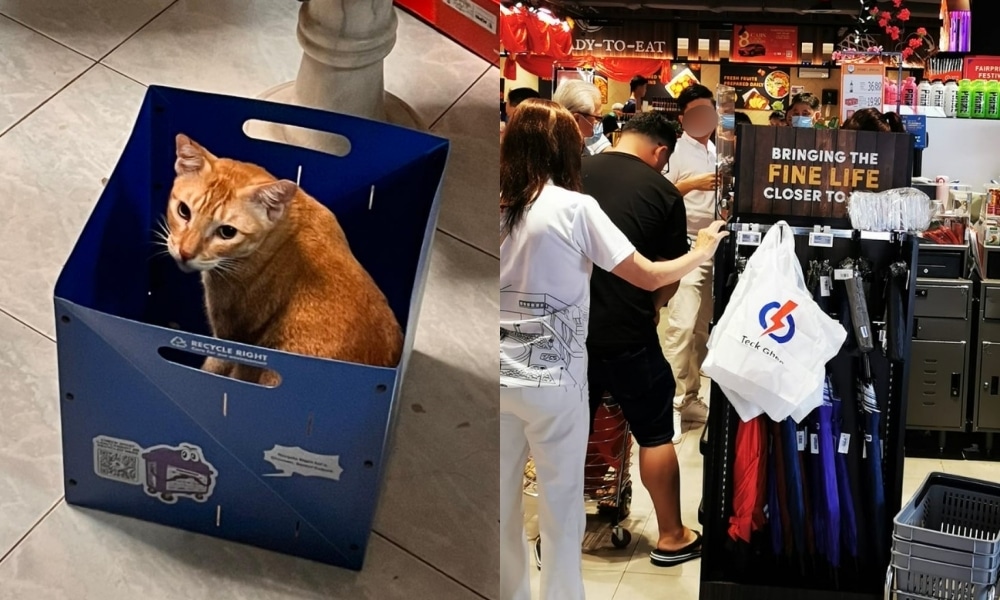
Disguised as environmentally friendly gestures, the recent distribution of reusable grocery bags bearing the PAP party logo, as well as a recycling box initiative last year, prompts a critical examination of their actual impact on sustainability.
PAP's reusable grocery bags distribution
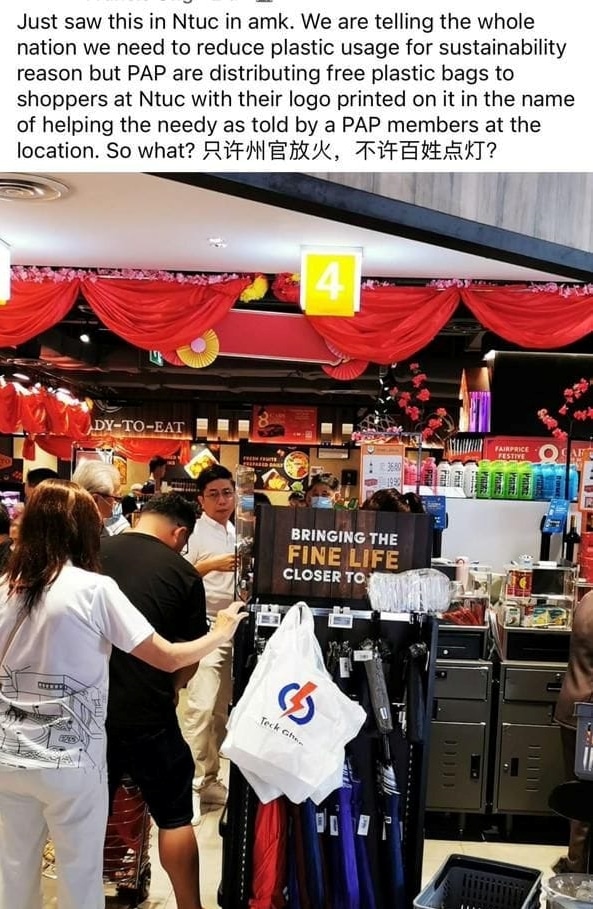
Recently, a photo emerged online, suggesting that members of the PAP were distributing free plastic bags to shoppers at NTUC, adorned with their party logo.
The post contended that despite the public being urged to reduce plastic usage for sustainability reasons, the party was accused of distributing free plastic bags to shoppers under the guise of assisting the needy.
The post then raised the question of whether this practice resembled the Chinese proverb: "Allowing the official to set fires but forbidding the common people from lighting lamps" (只许州官放火,不许百姓点灯).
Skepticism on PAP's so-called sustainability initiatives
While the bags are not disposable bags, one can't help but question the practicality of a grocery bag prominently displaying a large PAP logo, considering whether the public would willingly carry these bags as a form of free publicity for the party.
If these bags aren't reused as intended, akin to the concerns surrounding recycling boxes, does their production not contribute to waste?
In March 2023, Dr Amy Khor, Senior Minister of State for the Ministry of the Environment and Water Resources, launched the Bloobox initiative, an initiative that aims to encourage every household in Singapore to set up a home recycling corner and reduce the contamination rate in blue recycling bins.
The Bloobox initiative was launched in November 2022 as part of Singapore's national Recycle Right campaign.
The Blooboxes are foldable, washable, and reusable boxes that can be collected for free from vending machines at 140 locations, including community clubs and some bus interchanges, until 30 April 2023.
The boxes were designed in collaboration with a team of students from the Singapore Institute of Technology and can hold up to 5kg of paper, plastic, metal, or glass recyclables, as well as e-waste.
NEA’s deputy CEO Ram Bhaskar stressed the importance of encouraging every household to recycle to achieve Singapore’s national target of a 70% overall recycling rate by 2030.
“We must get everyone into the habit of recycling at home if we want to achieve our national target of a 70% overall recycling rate by 2030,” he said.
Unconventional uses of the recycle boxes
However, on 23 April 2023, the Straits Times reported that only slightly more than 300,000 households had collected the Bloobox, representing roughly 20% of the 1.39 million households, despite the impending deadline.
Many individuals cited scepticism about the efficacy of the box in boosting recycling as the reason for not collecting it.
Even among those who did collect the box, some repurposed it for unintended uses.
For example, one person mentioned that their father used the Bloobox to store his shoes.
SMS Baey claimed Bloobox initiatives received "strong and positive response"
Later on 9 May 2023, Senior Parliamentary Secretary for Sustainability and the Environment Baey Yam Keng in Parliament disclosed that a total of 93 per cent of Bloobox have been distributed by the end of the distribution period.
"The strong and positive response by the public reflects the community’s interest in recycling at home or offices, and their appreciation of the utility of the Blooboxes," said Mr Baey.
Addressing concerns about the necessity of a Bloobox for every household, Mr Baey stated that not all households required one, as many already had existing recycling corners with alternative containers.
PAP MP for Yio Chu Kang SMC Yip Hon Weng further asked if areas in Singapore which have a higher percentage of boxes collected have a higher recyclable collection rate, and how those who still wanted a Bloobox could collect one past the distribution date.
Mr Baey clarified that annual recyclables collection data is currently available. However, specific data for estates and neighbourhoods related to Bloobox collection and recycling rates would require further verification by the ministry.
Associate Professor Jamus Lim, Workers' Party MP for Sengkang GRC, sought details from Mr Baey on the total cost of the Bloobox initiative and the threshold for deeming the program cost-effective.
In response, Mr Baey indicated that he did not possess the exact cost of the campaign.
"As I mentioned in my reply, we estimated the number of Blooboxes required. We did not produce or procure Blooboxes to cover all households in Singapore because that would not be realistic and we know that not every household would require it. "
"We were quite close to our estimate – 93% of the Blooboxes were collected. The remaining will not be put to waste because they will be used in our efforts to promote recycling."
Promoting recycling habits or disguised political campaigning initiatives?
It remains unclear whether the distribution of the recycling boxes effectively translated into increased recycling efforts among residents, or if the boxes found alternative uses, or worse, were recycled themselves during the Chinese New Year festive house cleaning.
Nevertheless, these political campaigning initiatives, which are disguised as promoting environmental friendliness, are actually just greenwashing.
They provide a feel-good factor but hardly address the issue of conservation. In fact, they contribute to the problem of wastage.