SG$1 billion money laundering case: Unveiling the complex web of illicit wealth accumulation
Intricate methods of amassing illicit funds come to light as Singapore investigates a high-profile SG$1 billion money laundering case involving ten suspects. \n \nAn anonymous insider reveals four common strategies used by money launderers, shedding light on the complexities of their operations.

SINGAPORE: As authorities delve into a high-profile SG$1 billion (US$737 million) money laundering case involving ten suspects, questions arise regarding the methods employed to amass significant sums of illicit funds.
Insights from an insider shed light on four common strategies employed by money launderers.
Singapore Chinese media outlet 8world.com interviewed an anonymous person regarding commonly used money laundering methods.
Four key money laundering approaches
- Exploiting high exchange rates to entice foreign workers to remit money and launder fund
This challenge extends not only to legitimate entities like money changers but also to law enforcement authorities who concede the elusive nature of eradicating such illicit activities altogether.
One of the most familiar methods of accumulating black money involves facilitating foreign workers in sending money back to their hometowns.
Suspects possessing substantial amounts of black money readily offer attractive high exchange rates to incentivize foreign workers to funnel money through their channels.
"For instance, money launderers frequently hire agents to collect remittances from foreign workers. Subsequently, these agents locate recipients in the workers' hometowns to disburse funds to their families. This scheme allows money launderers to amass significant cash abroad," explained the anonymous insider.
"There are about 400,000 foreign workers here. When they receive their salary every month, they can't wait to remit money home. The money launderers will send agents to go to foreign workers’ dormitories and remittance centres."
There, they persuade these workers to use their services by offering favorable exchange rates.
"After the foreign workers hand over the cash they want to remit, they immediately find someone to transfer the money to their families in the foreign workers' hometowns."
“As long as hundreds or thousands of people ‘remit money’ through them, these behind-the-scenes bosses will naturally receive a lot of ‘cash’ from other places and other countries, right?” said the person familiar with the matter.
The exchange rates offered by these individuals are typically a few cents higher, or merely a cent or two higher, than those offered by legitimate money remitters or banks.
For migrant workers, this translates to more favourable conversion rates. However, the insider cautioned foreign workers against engaging with these operators for minor gains.
"Initially, these agents offer elevated exchange rates to cultivate trust among foreign workers. After assisting with remittances several times, they abscond with the workers' money, leaving them with no recourse. They end up losing everything," the insider cautioned.
2. Transfer money abroad through cryptocurrency transactions
In recent years, money launderers with a lot of black money have chosen to indirectly transfer large amounts of funds abroad by buying and selling cryptocurrencies.
Cryptocurrency is a virtual currency that is encrypted, without relying on banks to verify transactions.
“Anyone, anywhere can send and receive payments. Many people use cryptocurrency transactions to transfer funds to other countries,” he said.
3. Proxy payment for Chinese orders followed by overseas cash collection
China, as the world's largest exporter, receives daily orders worth millions or even tens of millions of dollars from across the globe.
"In cases where conventional bank transfers entail fees for both the buyer and seller, individuals seeking to transfer black money abroad approach merchants with an offer to pay for goods on the buyer's behalf."
“Then the buyer pays the agent of the money launderer in a foreign country, with this method, the black money is clean in a foreign country,” said the informant.
“China's financial system controls foreign currency strictly. In China, individuals who want to transfer money abroad must go through legitimate ways such as banks."
“The maximum amount that can be transferred abroad cannot exceed US$50,000 yearly. Therefore, many people will transfer money abroad via different methods,” he said.
4. Collusion among local importers and exporters to underreport prices and evade tariffs
Illegal money laundering might facilitated through import and export bills. Consequently, many countries impose tariffs on goods imported from China, aiming to discourage local importers from engaging in such transactions.
“The importer and exporter will decide a ‘legit’ lower payment amount, so the importer can avoid some taxes, and then pay the difference in cash in private.
“Through this way, Chinese exporters will not lose any profits, and foreign importers can save some taxes, and the black money involved will be transferred abroad. Of course, this practice is illegal,” he said.
Banks will not deposit unknown money
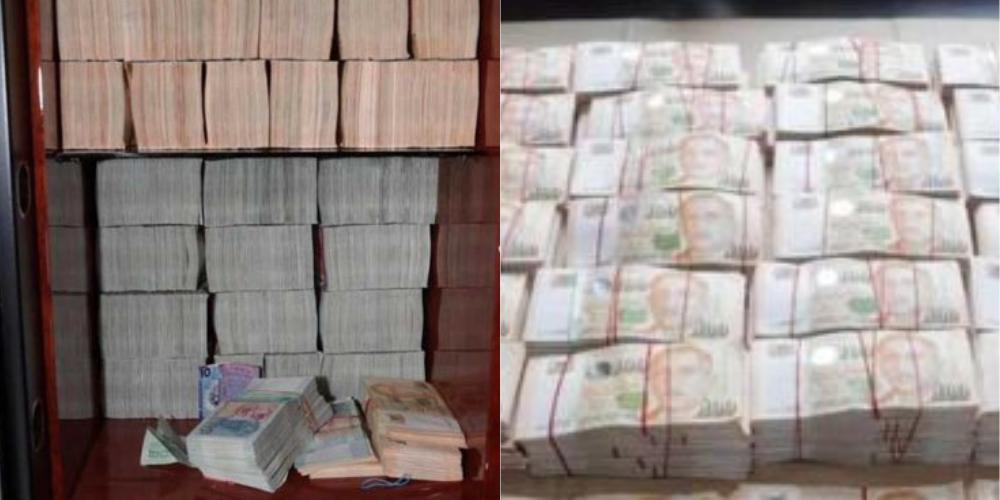
The suspects in the recent money laundering raid knew the source of their cash was not “clean”, so they would not deposit it in the bank, they just keep it at home.
“When you want to deposit a large amount of cash in the bank, you need to explain the source of the money. Bank will not let them deposit if can’t disclose how they got the cash. In addition, a huge amount of cash is required to launder money,” he said.
The suspects normally accumulate their initial “dirty” money through fraud, tax evasion, corruption, gambling, drug sales, and other illegal means, then they will start to launder money and transfer funds, and then the amount of cash grows bigger and bigger.
"The eradication of money laundering activities seems nearly impossible. While only ten individuals were apprehended this time, many more remain at large," the source concluded.
Historical crackdown on S$1 billion money laundering case
Last Wednesday (16 Aug), The Singapore Police Force (SPF) announced a significant crackdown on money laundering and forgery activities, resulting in the seizure of assets amounting to roughly S$1 billion (US$736 million).
This substantial haul includes properties, vehicles, luxury items, gold bars, and more.
In a news release, the police disclosed that ten individuals, aged between 31 and 44, were taken into custody.
They face charges related to the alleged crimes and for resisting arrest. These individuals are of diverse nationalities, including Cypriot, Turkish, Chinese, Cambodian, and Ni-Vanuatu.
Furthermore, twelve others are assisting with the ongoing investigations. An additional eight persons remain on the police’s wanted list.
“These persons are believed to have connections among themselves. All the persons involved are neither Singapore citizens nor permanent residents,” the police added.