Twelve killed, 309 injured in attack on Riyadh’s King Khalid International Airport
At least 12 people were killed and 309 injured in an attack on King Khalid International Airport in Riyadh on 10 October 2026. The Saudi-led coalition blamed Yemen’s Houthis and called it a war crime. Flights were suspended and condemnation came from the UN, Gulf states and the US.
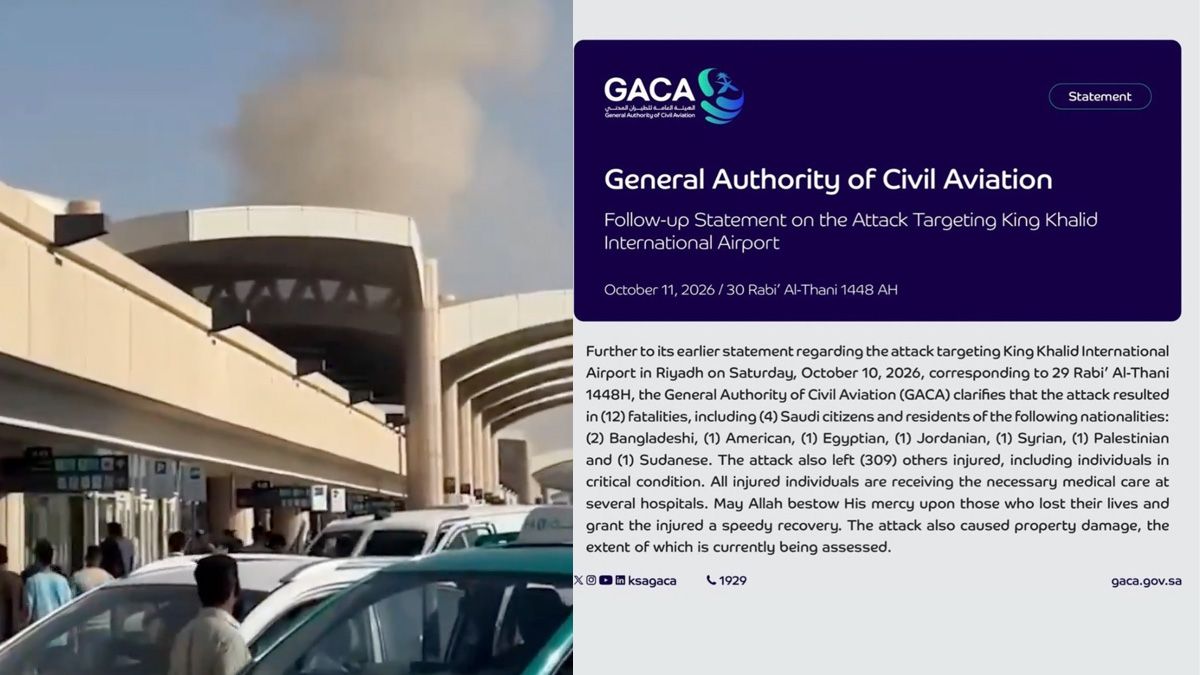
- Attack on Riyadh airport kills 12 and injures 309, the deadliest in Saudi Arabia since May 2015.
- Saudi-led coalition blames Houthis, who have not formally claimed Saturday’s strike.
- Trump says US “may” join strikes; UN, Gulf states, Pakistan and Canada condemn attack.

At least 12 people were killed and 309 injured in an attack on King Khalid International Airport in the Saudi capital, Riyadh, on Saturday, 10 October 2026, according to Saudi Arabia’s General Authority of Civil Aviation (GACA).
The Saudi-led military coalition fighting in Yemen has blamed the Iran-backed Houthi movement, also known as Ansar Allah, and described the strike as a war crime. The Houthis have not formally claimed responsibility.
According to the BBC, the attack was the deadliest in the kingdom since May 2015. CNN reported that it was the third strike on the airport in a week.
Airport operations have been suspended, and flights to Riyadh have been diverted or cancelled.
Victims from eight countries
GACA said the dead included four Saudi citizens, two people from Bangladesh, and one person each from the United States, Jordan, Palestine, Syria, Sudan and Egypt.
The authority said some of the injured were in critical condition and that damage to the airport was being assessed.
Coalition spokesman Maj Gen Turki al-Maliki said the strike hit one of the passenger terminals, killing and injuring civilian passengers and airport staff. He described it as a “full-fledged war crime”.
Wounded people, some in critical condition, were taken to hospital by ambulance and helicopter, people familiar with the matter told Reuters. An eyewitness cited by Reuters said more than a dozen ambulances rushed to the airport.
Scenes inside the terminal
One person who said they had been in the domestic terminal told a news agency they saw gate 401 hit and people injured in front of them. “Everyone was running,” the eyewitness said.
One traveller told Reuters they saw something fly across the sky before part of the ceiling near a departure gate collapsed. Another recalled hearing an explosion, then seeing several people lying wounded on the ground.
Video released by Reuters showed large boards and debris strewn across the terminal floor, with people moving through a dust-filled hall.
Al Jazeera reported that the airport was struck by a ballistic missile. Its correspondent in Riyadh, Jama Noor Ahmed, described the attack as a dangerous escalation.
Questions over responsibility
Saudi Arabia’s Coalition Joint Forces Command confirmed the Houthis were behind the attack, CNN reported.
According to the BBC and Al Jazeera, the Houthis have not commented on Saturday’s attack.
However, Reuters reported that the head of the Houthi media office said in a post on X that the group had “shut down” the airport.
The group has also warned airlines against using Saudi airspace, declaring it a zone of military operations after Yemeni government forces launched an offensive against it earlier this month.
The Houthis did claim strikes on the same airport on Thursday, 8 October, which the BBC said killed three people and damaged a plane. CNN, citing Reuters, put the toll from two earlier attacks on the airport this week at four.
The BBC also reported that three people were killed in separate Houthi attacks on two Saudi airports on 6 and 7 October.
The coalition said a projectile also fell near King Fahd International Airport in Dammam, in eastern Saudi Arabia, on Saturday.
What the Houthis say they are responding to
The Houthis have framed their recent strikes on Saudi airports as retaliation for the Saudi-led military campaign in Yemen and the kingdom’s continued blockade.
The latest escalation began after Rashad al-Alimi announced Operation Dawn of Yemen on 4 October, a Saudi-backed counteroffensive to retake all Houthi-held territory, including Sanaa.
Coalition spokesman Maj Gen Turki al-Maliki said on 5 October that the coalition had destroyed 324 high-value targets at the start of the operation, according to FDD’s Long War Journal.
On the same day, the Houthis claimed attacks on King Khalid International Airport. Their military spokesman, Yahya Saree, said these responded to 60 air strikes and a missile on Sanaa and five provinces in the preceding 24 hours.
According to FDD’s Long War Journal, the Houthis had launched an offensive around Taiz in the days before the government’s announcement, which government forces largely held off.
The wider escalation dates to July. On 13 July 2026, the Houthis declared an end to the de-escalation phase and vowed retaliation, alleging that Saudi Arabia had carried out air strikes on Sanaa International Airport.
FDD’s Long War Journal reported that the Sanaa strike was intended to prevent an Iranian aircraft from landing.
Trump says US “may” join strikes
Asked whether the US would join Saudi strikes on the Houthis, President Donald Trump told reporters: “We may. We’re going to look at it.”
He added: “We just found out about the recent attack, so we’ll make a decision. We move very quickly.”
Speaking at Joint Base Andrews, Trump said the attack was “not acceptable” and that he planned to speak with Saudi Crown Prince Mohammed bin Salman.
He said the US had communication with the Houthis, adding that “what they did was very bad”.
Asked whether Saudi Arabia could defend itself, Trump said: “They’re able to defend. The Saudis are good fighters. But I think the attack was a terrible thing.”
Secretary of State Marco Rubio confirmed that a US citizen was among the dead. In a post on X, he said the attacks showed “a blatant disregard for innocent civilian life”.
International condemnation
UN Secretary-General António Guterres said he was “deeply shocked” by the attack. In a post on X, he said attacks on civilians and civilian infrastructure violated international law and “must cease immediately”.
The UN special envoy for Yemen, Hans Grundberg, said Houthi attacks on civilian infrastructure in Saudi Arabia represented a “dangerous escalation” and posed “a grave threat to regional security”.
Grundberg said Saturday’s attack followed other deadly attacks on airports in Riyadh and Abha the previous week. He called on the Houthis to halt their attacks and respect international humanitarian law.
Kuwait’s Ministry of Foreign Affairs described the strike as a “heinous and cowardly attack” and a flagrant violation of international law. It expressed “absolute solidarity” with Saudi Arabia.
The ministry urged the international community to adopt a firm stance to protect civil aviation infrastructure and ensure that the perpetrators do not escape punishment.
Gulf Cooperation Council (GCC) Secretary-General Jasem al-Budaiwi called the strikes “treacherous terrorist attacks”. He said the repeated targeting of the airport reflected a criminal pattern of terrorising civilians.
Pakistani Prime Minister Shehbaz Sharif called the attack “heinous” and reaffirmed Pakistan’s commitment to Saudi Arabia’s sovereignty and security. Pakistan, Saudi Arabia and Turkiye signed the Mecca Joint Defence Agreement in August.
Canadian Prime Minister Mark Carney described the attacks on Saudi Arabia as “abhorrent”, saying: “No political or military objective can justify the deliberate targeting of innocent people.”
Egypt, Palestine and Qatar also condemned the attacks, according to the BBC.
Yemeni government vows to press offensive
Rashad al-Alimi, chairman of Yemen’s Saudi-backed Presidential Leadership Council, said the “criminal assault” reflected the nature of the Houthi militias. He described aggression against Saudi Arabia as aggression against Yemen’s own security and interests.
Al-Alimi said government forces would press ahead with the operation known as Dawn of Yemen to end the Houthi threat and restore state institutions, “whatever the sacrifices”.
Marwan Ali Noman, political adviser to Yemen’s foreign minister, told Al Jazeera that a decade of attempts to resolve the conflict peacefully had produced more threats and attacks. He said the current approach was the “antidote”.
Flights cancelled and travel warnings issued
CNN reported that around 580 flights had been cancelled on Sunday, according to Flightradar24. Al Jazeera reported no inbound flights to Riyadh as of shortly after 3am local time on Sunday.
Several Gulf airlines cancelled flights to and from the airport, with Kuwait Airways citing the security situation, the BBC reported.
The US, UK, Spain and Canada are among the countries that have warned their citizens against using the airport. The UK Foreign Office told British nationals to avoid the area “until the airport is secure”.
The US embassy said US government employees need special authorisation to use airports in Riyadh, Jeddah and Dammam, and must not travel within 20 miles (32km) of the Yemeni border.
Special authorisation is also required for travel to the provinces of Jazan, Asir and Najran and the cities of Qatif, Yanbu and Taif. The embassy urged extreme caution at all major Saudi airports.
Major Riyadh conferences to proceed
Organisers of the World Petroleum Congress, running from Sunday to Thursday, and the Future Investment Initiative (FII), from 26 to 29 October, said both events would go ahead, Al Jazeera reported.
An email to Congress delegates noted alternative routes to Riyadh, including a four-hour drive from Dammam. Executives from ExxonMobil, Shell and Woodside Energy are expected to attend.
JPMorgan chief executive Jamie Dimon and Citi chief executive Jane Fraser were among the expected attendees at the FII.
Analyst says attack aimed to portray Saudi Arabia as weak
Nawaf Obaid, a senior research fellow at King’s College London, told Al Jazeera that the Houthis were striking civilian targets in response to coalition air strikes on Yemen over the previous two weeks.
He said a ballistic missile was likely used, given the damage caused. Obaid said the attack aimed to portray Saudi Arabia as weak and had “to a large extent succeeded”.
He added, however, that the Houthis were “getting smashed” on the battlefield.
According to CNN, the incident has exposed vulnerabilities in Saudi defences as the kingdom conducts an air campaign supporting Yemen’s internationally recognised government.
Experts cited by CNN said a series of miscalculations had left Riyadh exposed. These included ending its partnership with the United Arab Emirates (UAE) late last year over the UAE’s backing of a rival force in Yemen.
Background to the conflict
The Houthis seized Sanaa in 2014. The Saudi-led coalition was formed in 2015 to stop them taking over Yemen from its internationally recognised government.
Years of air strikes and ground fighting led to the deaths of hundreds of thousands of people, triggering one of the world’s worst humanitarian crises, according to the BBC.
A temporary ceasefire brokered in 2022 began to unravel in July. The Houthis then announced a “maritime embargo” against Saudi Arabia and began missile and drone attacks on Saudi airports, oil facilities and Red Sea tankers.
The Houthis recently seized stretches of the Red Sea coast, including the port of Mokha on the Bab al-Mandab Strait, a chokepoint for global shipping. Pro-government forces have since said they “secured” the strait.
Separately, the World Food Programme (WFP) says Houthi authorities hold 72 UN personnel and five former UN personnel in custody.
Human Rights Watch (HRW) reported that since 18 August 2026, the Houthis have referred at least eight people involved in human rights and humanitarian work for prosecution on espionage-related charges punishable by death.