Bangkok halts new large data centre approvals amid diesel storage investigation
Bangkok has suspended approvals for new large-scale data centres while authorities investigate claims that a facility under construction in Bang Kapi district may store hundreds of thousands of litres of diesel for backup generators. Officials say the sector currently operates without dedicated legislation.
- Bangkok suspends new large data centre approvals pending safety, grid and zoning review
- Allegations centre on diesel storage at a Bang Kapi site near schools and homes
- Officials confirm no dedicated law governs data centres; operators licensed as warehouses

Bangkok has paused consideration of new large-scale data centre projects while authorities investigate claims that a facility under construction in Bang Kapi district may hold underground capacity to store close to 500,000 litres of diesel.
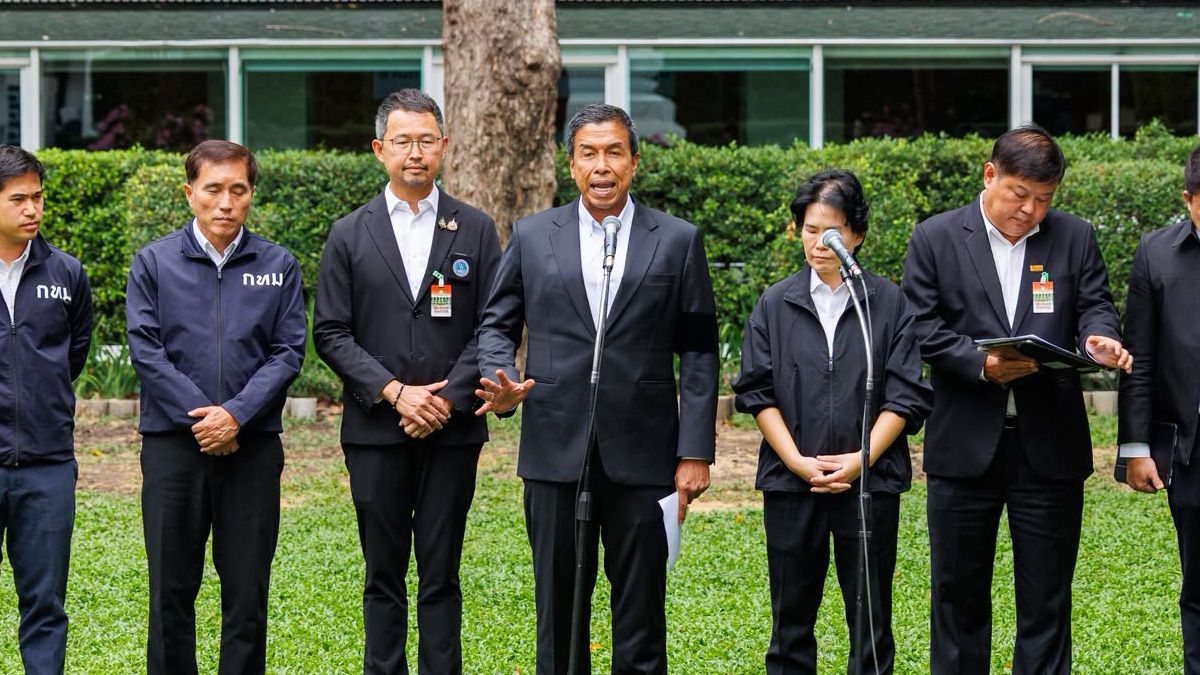
The decision was announced at a joint press conference in Bangkok on 2 September 2026, bringing together the Bangkok Metropolitan Administration (BMA), the Ministry of Energy, the Metropolitan Electricity Authority (MEA), the Metropolitan Waterworks Authority (MWA) and the Department of Energy Business.
Bangkok Governor Chadchart Sittipunt said existing data centres had not adversely affected public electricity supplies. However, he said approvals for future large-scale projects should be delayed while authorities review their suitability, particularly safety standards and connections to the electricity network.
Chadchart said the suspension had in practice already been in force for around two to three weeks.
Diesel storage claim prompts investigation
Scrutiny of the sector intensified after Suphanat Minchainant, a People's Party member of parliament for Bangkok, alleged in a public post that a data centre being built on Ramkhamhaeng Soi 28 in Bang Kapi district was storing 429,000 litres of diesel.
Suphanat described the volume as equivalent to the stock of three or four large petrol stations concentrated within a single building, and warned of the consequences for surrounding residents should an incident occur.
The fuel would be used to power large emergency generators, typically sized to sustain operations for around 48 hours during a grid failure. The site's proximity to schools and densely populated communities has driven concern over safety and environmental standards.
Thitipat Chotidechachainan, secretary to the energy minister, said neither the Department of Energy Business nor the BMA had authorised the Ramkhamhaeng facility to store the volume cited in reports.
A review of the facility's licence found no approval for diesel storage approaching 400,000 litres, she said. Officials will inspect the site and take legal action if the operator is found to be storing more fuel than permitted.
A separate complaint concerning a data centre near Praram 9 Hospital is also under examination. Thitipat said prosecution would follow immediately if either site was found to hold fuel beyond permitted limits.
Regulatory gap leaves centres licensed as warehouses
Chadchart said the central difficulty is that Thai law contains no provision dealing directly with data centres. Operators therefore apply for permits as warehouses.
That classification means the facilities do not fall within the definition of an industrial factory, and no clear city planning zone applies to them. He said the Office of the Prime Minister had begun formulating a definition as a step towards amending the law.
More than 40 data centres are already operating in Bangkok, with rapid expansion driven by rising demand for cloud services and artificial intelligence.
Thitipat said current criteria for the Bangkok area permit fuel storage of no more than 500,000 litres. Consideration of new applications to install backup fuel tanks has been suspended pending a data centre committee's review of the regulatory framework.
The suspension will remain until authorities establish clearer criteria covering water and electricity use, environmental effects and safety requirements.
Electricity authority reports no disruption
Kasem Srathonghug, assistant governor for planning and power system innovation at the MEA, said data centres currently operating in Bangkok are not considered large-scale facilities.
Their installed capacity does not exceed 20 megawatts, while actual consumption is no more than eight megawatts, he said. The MEA supplies these facilities through separate arrangements designed to prevent disruption to other consumers.
Kasem said their electricity use remained low relative to large shopping centres, which may draw more than 100 megawatts.
Water use below hospitals and shopping centres
MWA deputy governor Supichete Tavorntaveevong said large data centres in Bangkok consume no more than 7,000 to 8,000 cubic metres of water per month.
By comparison, a large hospital may use around 20,000 cubic metres monthly, while a major shopping centre may consume between 30,000 and 40,000 cubic metres.
Supichete said existing facilities had not affected water services in the capital. The MWA plans to strengthen screening of future projects and expand production capacity to accommodate growth.
Chadchart said water at these sites is used for cooling systems only, producing no hazardous wastewater, with much of it recirculated. The BMA would nonetheless continue monitoring, he said.
Officials also said complaints about night-time noise from generator testing had been addressed by moving tests to daytime hours.
Thailand has separately begun tightening screening of data centre projects nationally, amid concerns over electricity and water consumption, environmental effects, and the economic benefit delivered domestically.