Taiwan tests mobile network blackout in largest urban resilience drill yet
Taiwan held its largest urban resilience exercise to date on Thursday, testing a nationwide mobile network slowdown and air raid drills, as President Lai Ching-te inspected New Taipei preparations amid concerns over China's rising military pressure.
- Northern Taiwan held its first mobile network slowdown drill alongside air raid exercises on Thursday.
- President Lai Ching-te inspected New Taipei preparations, joined by foreign diplomats including AIT's Raymond Greene.
- Exercise follows real 2023 and 2025 Matsu submarine cable outages that cut islanders off for weeks.

Air raid sirens sounded and streets emptied across seven counties and cities in northern Taiwan on Thursday, 13 August 2026, as the government held its annual urban resilience exercise, combining civil defence drills with a mobile network slowdown for the first time in the region.
At Taipei Main Station, one of the capital's busiest transport hubs, staff pulled down shop shutters and stopped selling goods as members of the public were guided to shelter on the station's underground levels. High-speed rail and conventional rail services continued to run as normal throughout the drill.
The exercise, part of this year's "urban resilience" programme combining the former Wan An air defence drills and Min An disaster resilience drills, ran from 2.30pm to 3pm. Mobile internet speeds slowed dramatically for 30 minutes, though fixed-line internet and Wi-Fi were unaffected.
The drill formed part of the wider 10-day Han Kuang military exercises, during which the armed forces rehearsed responses to a Chinese invasion. A separate, smaller-scale mobile network throttling test was first held in central Taiwan on Monday, 10 August.
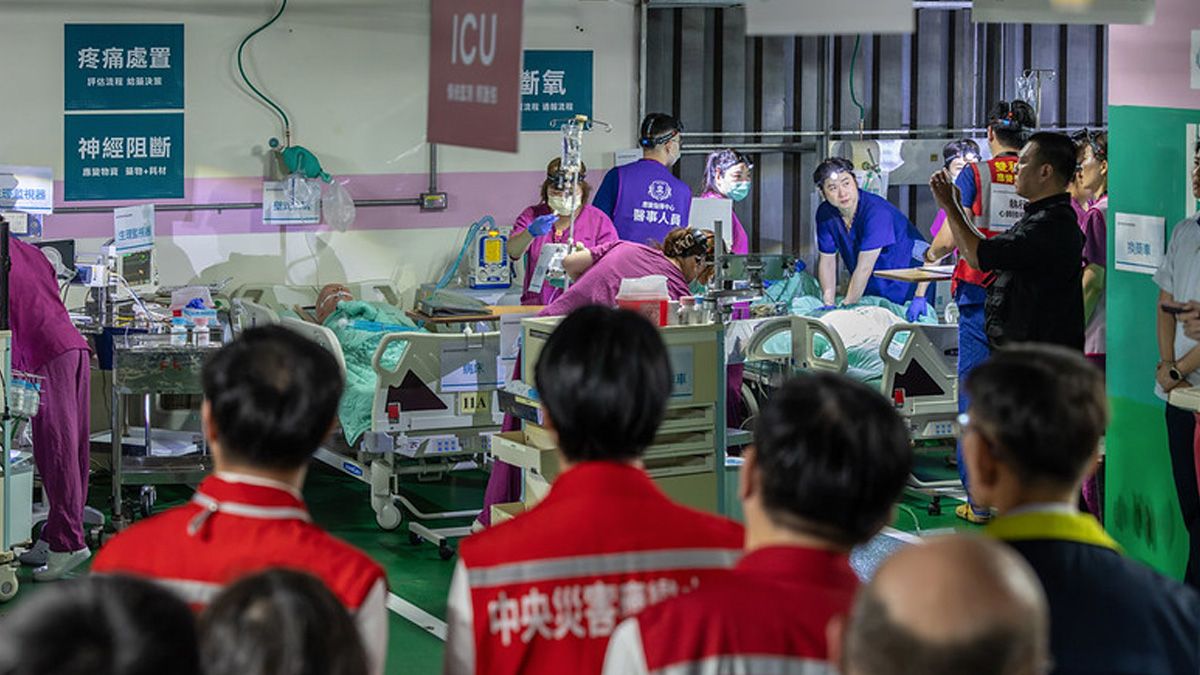
President Lai Ching-te visited New Taipei City on Thursday morning to inspect preparations. He toured an emergency medical ward set up in the underground car park of Shuang Ho Hospital, alongside a supply distribution station demonstrating how provisions would be delivered during a crisis.
The hospital's underground car park, covering 3,504 square metres, can be converted into a fully functioning underground medical centre within 48 hours, according to hospital staff cited by the Presidential Office.
Lai was accompanied by New Taipei Mayor Hou Yu-ih, National Security Council Secretary-General Joseph Wu, and senior representatives from the American Institute in Taiwan (AIT), Canada and Israel, including AIT Taipei director Raymond Greene, Canadian trade office representative Marie-Louise Hannan and Israeli office representative Israel Strulov.
Speaking at the site, Lai said Taiwan was not facing regional geopolitical changes alone, but alongside the concern and joint efforts of the international community, according to a statement from the Presidential Office.
Reactions in the capital and beyond
Members of the public interviewed at Taipei Main Station broadly supported the exercise. One resident said the drill helped people prepare to check on family members' safety in a real emergency, such as an earthquake, and would reduce panic if a genuine crisis occurred.
Others said drills were necessary regardless of whether the threat was natural or man-made, arguing that a lack of preparation would cause chaos and danger if an emergency struck without warning.
Foreign visitors caught up in the drill offered similar views. An Italian tourist said the exercise ran smoothly and that authorities had ensured visitors were informed, calling Taiwan a well-organised country. A Dutch visitor said holding such exercises was valuable so the public would know what to do if a real crisis occurred.
First test for network resilience
This year marked the first time the urban resilience exercise incorporated a mobile network slowdown, intended to simulate the effects of damage to undersea communications cables during a conflict. Taiwan relies on undersea cables for roughly 99 percent of its international internet bandwidth.
According to Taiwan Network Information Center (TWNIC) chairman Huang Sheng-hsiung, the country operates 15 international and 10 domestic undersea cables, with more than 90 percent of network capacity dependent on this infrastructure. He said multiple cables often converge at single landing stations, meaning damage in a conflict could cause disruption far beyond a single cable.
Huang said the drill's greatest value lay not in reproducing every disaster scenario, but in building public awareness of how disrupted networks would affect daily life, including communications, financial services and transport information.
Taiwan has recorded two real disruptions to the undersea cables serving the outlying Matsu Islands, which authorities have linked to Chinese vessels. In February 2023, two cables connecting Matsu to Taiwan proper were damaged within six days, cutting the islands off from stable internet access for around 50 days.
A further two-cable disruption occurred in January 2025, again restricting external network access on Matsu. China's Taiwan Affairs Office has said cable damage is a common maritime occurrence, dismissing suggestions of deliberate "grey zone" activity as political exaggeration by Taiwan's governing party.
Residents recall real blackout
Matsu resident Tsao, a civil servant, described the 2023 outage to BBC Chinese as frightening, recalling that he initially assumed his phone was faulty before realising the entire island had lost connectivity for what became more than a month.
Fellow Matsu resident Chou, who runs a guesthouse, said the outage disrupted bookings and daily communication, with many local businesses travelling to Taiwan proper to sustain operations during the disruption. Residents gathered outside Chunghwa Telecom's local office to access its stronger signal.
Following the outages, authorities strengthened backup microwave communications on Matsu and have begun incorporating low-orbit satellite services into digital resilience planning, alongside amendments easing restrictions on international satellite operators.
Political criticism
The exercise drew criticism from opposition lawmakers. Taiwan People's Party legislator Hung Yu-hsiang argued that if the drill was meant to simulate real wartime conditions, authorities should test whether backup communication systems could take over after a full network outage, rather than a partial slowdown.
Kuomintang legislator Ko Ju-chun said the government's decision to voluntarily reduce mobile network access for an estimated seven million people on Monday, absent an actual conflict, was unprecedented globally, and called on authorities to disclose any resulting economic losses.
Fellow Kuomintang legislator Lai Shyh-bao suggested the exercise's geographic concentration was linked to upcoming elections and served to manufacture a sense of wartime threat, a claim not substantiated with further evidence in available reporting.
According to BBC Chinese, the network slowdown affected an estimated 17 million people across 14 counties and cities in central and northern Taiwan over the course of this year's exercise period.
The Executive Yuan said it would review the results of this first phase of testing, with plans to gradually expand the exercise to additional counties and cities to strengthen communications and social resilience.