Lai urges Micron and unions to negotiate in good faith as strike threat looms
President Lai Ching-te urged Micron Technology and its Taiwan workers to negotiate sincerely, speaking at the opening of a new Taichung plant as unions prepare for a Taipei rally over profit-sharing and one union holds a legal right to strike.
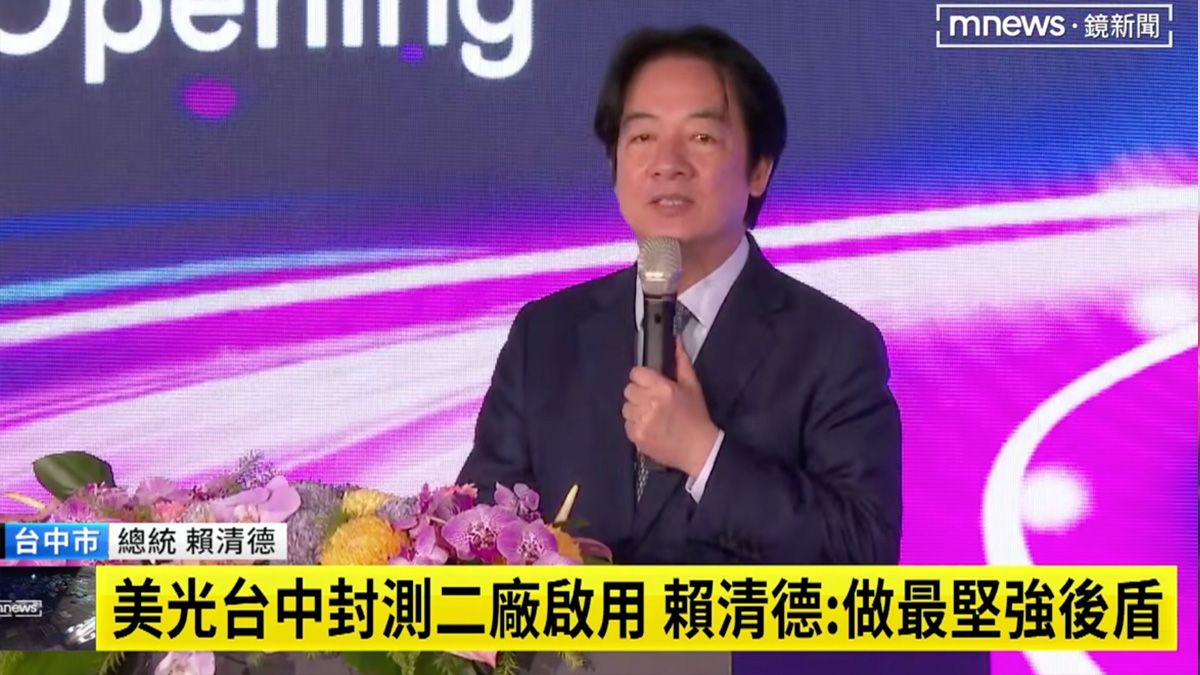
- Lai urged Micron and unions to negotiate sincerely while opening the company’s new Taichung plant.
- Micron’s Taoyuan union secured a legal right to strike on 7 October over profit-sharing.
- Unions plan a Taipei rally on 19 October; Taichung union’s second mediation is set for 22 October.

President Lai Ching-te on Thursday, 15 October 2026, called on US memory chipmaker Micron Technology and its workers in Taiwan to negotiate “sincerely and in good faith”, as a labour dispute over the company’s bonus and profit-sharing scheme continues to escalate.
Lai made the remarks in Taichung at the opening of Micron’s second advanced packaging and testing facility, located in Houli District. The ceremony took place a week after a union representing Micron workers secured authorisation from its members to strike.
“We also hope both labour and management will uphold the spirit that fish need water and water needs fish, continuing to negotiate sincerely and in good faith to build the broadest possible consensus,” Lai said, according to Reuters.
“Only by creating harmonious labour relations can both sides win, allowing employees to work with peace of mind and businesses to move steadily and go further,” he added.
Lai said a sound industrial environment was essential for businesses to grow. He called on central and local governments, as well as the public and private sectors, to work together to strengthen communication and build trust between labour and management.
Dispute over profit-sharing
According to NOWnews, the union representing workers at Micron’s Taoyuan operations formally obtained a legal right to strike on 7 October. Employees have long expressed dissatisfaction with the company’s existing bonus and profit-sharing arrangements.
Reuters reported that the two unions representing workers at Micron’s Taoyuan and Taichung operations said last week they hoped the company would put forward a concrete profit-sharing proposal for employees.
Mediation between Micron and the Taoyuan union ended without agreement in September. The Taichung union remains in negotiations with the company, and NOWnews reported that its second round of labour mediation is scheduled for 22 October.
The unions are encouraging members from both the Taoyuan and Taichung plants to take a day off on 19 October to join a rally on Ketagalan Boulevard in Taipei. According to Reuters, the unions said the rally would not constitute a strike.
Micron’s Taichung union told Reuters that it looked forward to the company engaging in “more substantive dialogue and negotiations” with workers.
Micron executive highlights demand
Manish Bhatia, Micron’s president and chief operating officer, spoke shortly before Lai and made no reference to the possibility of strike action.
“We have already sold out all the capacity for 2027 that this factory will build and we expect high-bandwidth memory to grow faster than the rest of the DRAM industry all the way through 2028,” Bhatia said, according to Reuters.
Micron employs about 15,000 people in Taiwan, one of its most important manufacturing hubs. The island is a crucial production base for the company’s DRAM and high-bandwidth memory (HBM) chips, which are used in AI servers.
New plant completed in just over a year
In his address, Lai noted that construction of the facility began in September last year and was completed in just over a year, which he said reflected the efficiency of the construction team and Micron’s determination to deepen its presence in Taiwan.
According to a statement of his remarks reported by United Daily News, Lai said the plant would strengthen Micron’s global competitiveness and serve as a significant boost to Taiwan’s wider semiconductor industry.
He said the new facility would further enhance advanced packaging and testing capabilities for HBM, helping to meet growing global demand for high-end memory from the AI industry.
Lai said Micron had operated in Taiwan for more than 30 years, with cumulative investment exceeding NT$1.6 trillion (about US$49.4 billion). He described this long-term commitment as a sign of the company’s confidence in Taiwan.
He recalled meeting Micron chief executive Sanjay Mehrotra at the Presidential Office in January, when he thanked the company for making Taiwan a key part of its global capacity expansion plans.
Lai said chips and memory were both indispensable to the AI era. He noted that Taiwan possessed both the world-leading advanced process and packaging technology of Taiwan Semiconductor Manufacturing Company (TSMC) and Micron’s high-end memory operations.
Government support for investment and research
Lai said that the more the world needs AI, the more it needs a trustworthy Taiwan with complete industrial capabilities.
He said the government had extended its three major “Invest in Taiwan” programmes to 2027. The programmes have been expanded to include overseas Taiwanese businesses and foreign companies, offering financing assistance and a single-window service to coordinate land, water and electricity needs.
On research and development, Lai cited tax credits for research investment under the Statute for Industrial Innovation and the Ministry of Economic Affairs’ A+ Industrial Innovative R&D Programme as tools to support international companies conducting advanced research in Taiwan.
He said Micron had secured funding under the latest phase of the A+ programme, which would accelerate HBM research and development in Taiwan and drive further investment and capacity expansion.
Lai added that such investment created new opportunities for local suppliers. He said the government was pursuing a “dual-engine” strategy to help traditional manufacturers with precision engineering capabilities upgrade their technology and enter high-tech supply chains.
He expressed hope that Micron would continue to expand its investment in Taiwan and work with local industry partners, combining high-end memory with advanced process technology to develop next-generation AI products.
“The government will continue to serve as a backbone for industry,” Lai said, pledging support for advanced technologies to be developed and manufactured in Taiwan.
Officials and executives in attendance
Officials attending the ceremony included Senior Adviser to the President Shen Jong-chin, Secretary-General to the President Pan Men-an, Minister of Economic Affairs Kung Ming-hsin, and National Science and Technology Council (NSTC) Deputy Minister Su Chen-kang.
Taichung City Government Secretary-General Huang Chung-tien also attended, alongside Micron Taiwan chairman Donghui Lu and Chang Yu-lin, Micron’s vice-president of advanced packaging and test operations.