At least eight dead and 34 missing after landslide crushes buildings in Chongqing
A mountain slope collapsed onto residential buildings along Hualang Road in Pengshui County, Chongqing, on 17 July 2026, killing at least eight people and leaving 34 unaccounted for. More than 800 rescuers have been deployed.
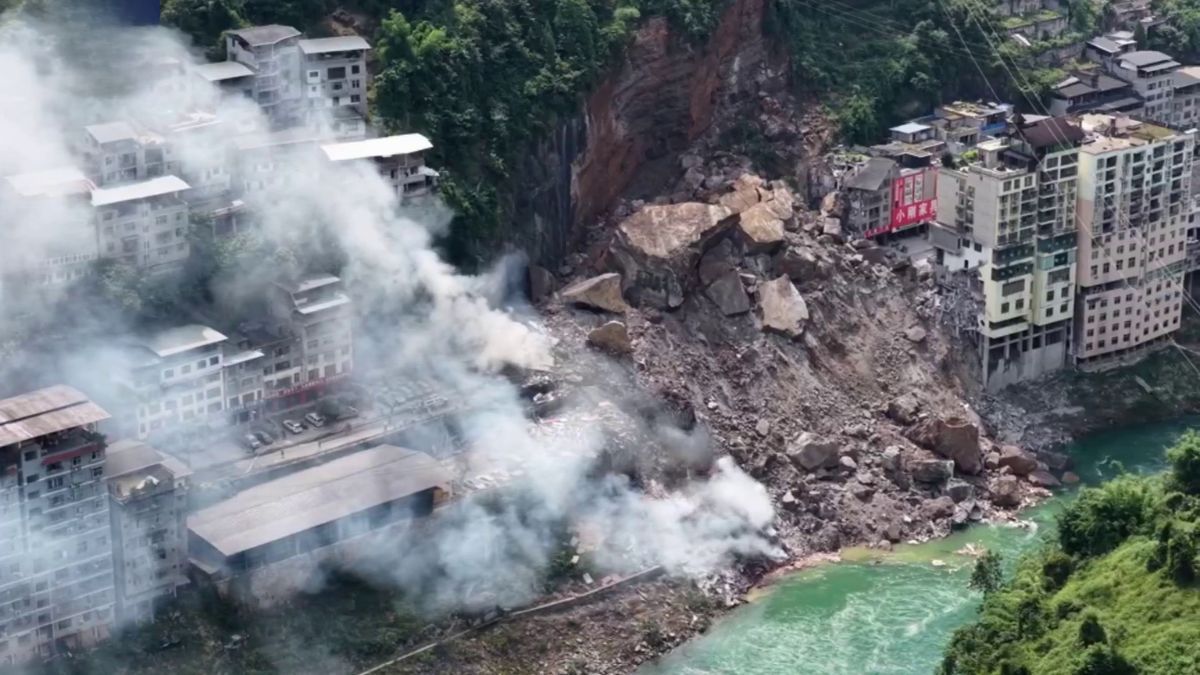
- Slope collapse at 9.08am on 17 July buried buildings on Hualang Road, Pengshui County.
- Eight confirmed dead, 18 rescued and 34 unaccounted for by the night of 17 July.
- Over 800 rescuers deployed; Vice Premier Zhang Guoqing sent to oversee operations.

At least eight people have been confirmed dead and 34 remain unaccounted for after a section of mountain slope collapsed onto residential buildings in Pengshui County, Chongqing, on the morning of Friday, 17 July 2026.
The collapse struck multi-storey residential blocks along Hualang Road in Hanjia Street, near the Wujiang No. 3 Bridge.
The force of the slide pushed several structures directly into the adjacent Wujiang River.
According to Chinese state media, the landslide buried buildings, vehicles and surrounding infrastructure as tonnes of rock and earth swept down the hillside.
The warning that came too late
The first sign of instability appeared roughly an hour before the collapse.
At around 8am, a community grid worker patrolling the area noticed stray rockfalls tumbling down the hillside above the residential blocks.
The worker issued an emergency warning.
Local authorities responded immediately, beginning the evacuation of more than 60 residents living directly beneath the slope.
That evacuation was still underway at 9.08am when the slope gave way.
A massive section of the mountain came down onto the street below, crushing the buildings and burying residents and vehicles caught mid-evacuation.
The hour of warning is likely to become a central question in any subsequent inquiry into the disaster.
It is not yet clear how many of those unaccounted for had been inside the evacuation zone at the moment of collapse.
Rescue operation
By the night of 17 July, 18 people had been pulled from the rubble, according to official figures released by local authorities.
Eight of those recovered were confirmed dead.
The fate of a further 34 residents remained unknown as search efforts continued.
More than 800 rescue personnel have been deployed to the site.
The contingent includes engineering forces from the China Anneng Group alongside fire and emergency rescue units.
Rescue teams are working with edge-radar equipment, life detectors and heavy machinery to locate survivors trapped beneath collapsed structures.
According to state media reports, drones have also been used to survey the disaster zone and assist rescue operations.
Portions of the debris field extend into the Wujiang River, creating additional challenges for rescue teams working in unstable terrain.
Authorities have shut off power, water and gas supplies within a one-kilometre radius of the site to prevent secondary incidents caused by damaged infrastructure.
More than 1,100 residents living near the collapse zone have been displaced or evacuated as a precaution.
Central government response
Chinese Vice Premier Zhang Guoqing travelled to the scene following emergency directives issued from Beijing in the aftermath of the disaster.
The dispatch of a vice premier to a disaster site is a standard signal of central government attention in China, typically reserved for incidents involving significant casualties or heightened public concern.
Chinese President Xi Jinping also called on authorities to determine the cause of the landslide and ensure that rescue efforts proceed without delay.
Background
Pengshui Miao and Tujia Autonomous County is located in the south-eastern part of Chongqing municipality, bordering the provinces of Hubei and Guizhou.
The county sits within mountainous terrain along the Wujiang River, where communities are often built on narrow strips of land between steep slopes and waterways.
The geography of the region places residential development in close proximity to unstable hillsides, a pattern common across mountainous south-west China.
Landslides remain a recurring hazard in the region, particularly during periods of heavy rainfall and seasonal weather extremes.
Rescue operations are continuing.
Official casualty and missing-person figures remain provisional and may change as search efforts progress.