Mahathir urges Malays to back only Malay candidates, sparking criticism over race-based voting
Malaysia's former prime minister, Dr Mahathir Mohamad, has triggered widespread criticism after urging Malays to vote only for Malay candidates in future elections regardless of political party, prompting renewed scrutiny of race-based politics in the country's multi-ethnic democracy.
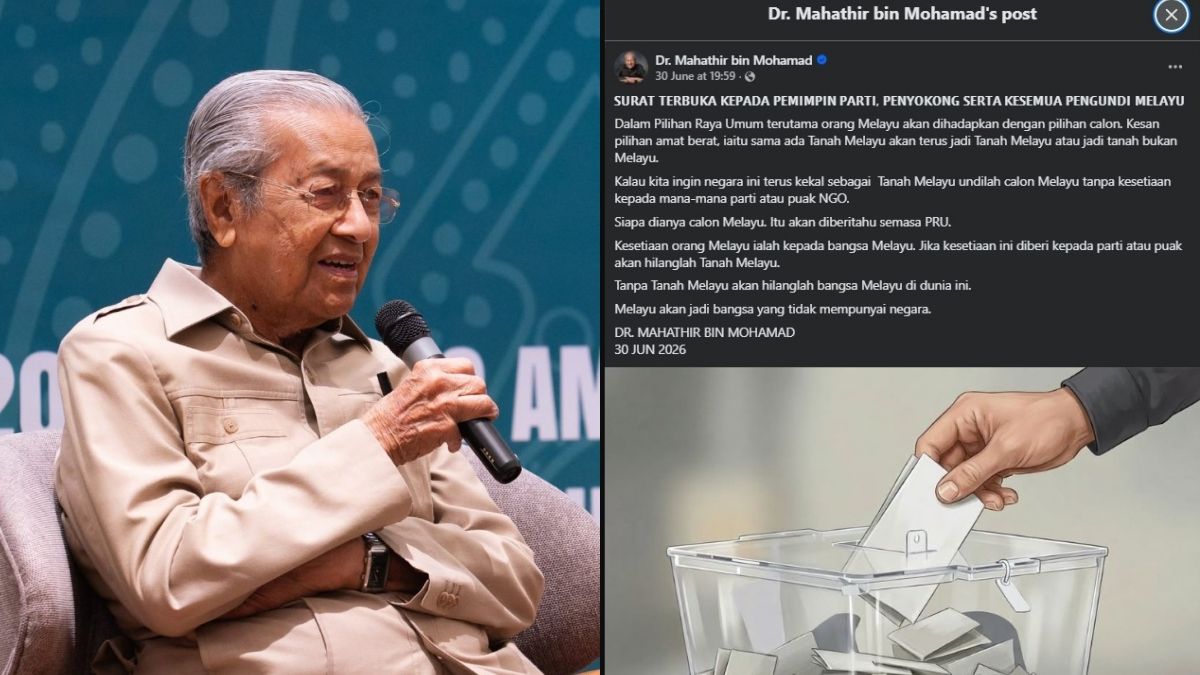
- Dr Mahathir Mohamad urged Malays to support only Malay candidates regardless of political party in future elections.
- The remarks drew widespread criticism from politicians, academics, lawyers and social media users who favoured merit-based leadership.
- The episode has reignited national discussion over race, democracy, constitutional protections and Malaysia's multicultural identity.

KUALA LUMPUR, MALAYSIA: Malaysia's former prime minister, Dr Mahathir Mohamad, has sparked widespread criticism after urging Malay voters to support only Malay candidates in future elections regardless of political party, with critics arguing that the appeal reinforces race-based politics in Malaysia's multi-ethnic society.
The remarks prompted swift reactions from politicians, academics, human rights advocates and members of the public, many of whom rejected the idea that ethnicity should determine electoral choices. Instead, they argued that leadership should be judged by integrity, competence and accountability.
Mahathir calls for ethnic-based voting
In an open letter published on Facebook on 30 June 2026, the 100-year-old political veteran appealed directly to Malay political leaders, supporters and voters ahead of the next general election.
Dr Mahathir argued that Malays faced a defining electoral choice over whether "Tanah Melayu" would remain a Malay land or become "a land of non-Malays".
He urged Malays to vote for Malay candidates regardless of party affiliation, saying loyalty should be directed to the Malay race rather than political parties or non-governmental organisations.
He wrote: "If we want this country to remain Tanah Melayu, vote for Malay candidates without loyalty to any political party or NGO faction."
He also warned that without "Tanah Melayu", "the Malay race will disappear from the world" and become "a people without a country".
Critics reject claims of declining Malay political influence
The comments quickly drew criticism across social media, where many questioned Dr Mahathir's assertion that Malays were at risk of losing political dominance.
Critics pointed to Malaysia's electoral structure and constitutional framework, arguing that Malays continue to enjoy strong parliamentary representation through Malay-majority constituencies.
Political scientist Professor James Chin said he had expected Dr Mahathir to encourage support for a particular political coalition rather than call for Malays to vote solely based on ethnicity.
"I had expected this racist call from Mahathir. What I did not expect was his call to vote for any Malay candidates regardless of party affiliation," he wrote on Facebook.
Professor Chin argued that the electoral system already strongly favours Malay-majority representation.
"More than 70% of the seats in Tanah Melayu are Malay-majority constituencies," he said.
He noted that 118 of the 165 parliamentary seats in Peninsular Malaysia, or about 71.5%, are Malay-majority constituencies, arguing that it is impossible for political control to shift to non-Malay communities under the current electoral structure.
Professor Chin also claimed Dr Mahathir's remarks risked legitimising more overt race-based political messaging by normalising calls for voters to support candidates solely because of their ethnicity.
Human rights lawyer questions race as voting criterion
Separately, human rights lawyer Siti Kasim challenged whether elections should be decided primarily by ethnic identity.
She questioned whether Members of Parliament should represent only Malays or serve every constituent regardless of race, saying the issue reflected broader tensions within Malaysia's multicultural democracy.
Reviewing Malaysia's political development, she noted that ethnic-based political parties emerged during the country's early post-independence years as part of a power-sharing arrangement among Malays, Chinese, Indians, Sabahans, Sarawakians and Orang Asli communities.
While acknowledging that the model may have provided stability in the past, she questioned whether a framework developed during the 1950s remained appropriate for contemporary Malaysia.
Siti also examined Dr Mahathir's long-standing arguments that Malays required government support to overcome historical economic disadvantages.
She said policies such as the New Economic Policy had helped expand the Malay middle class and professional workforce but had also been criticised for reinforcing identity politics and strengthening political-economic patronage.
Addressing Dr Mahathir's latest appeal, she argued that voting solely on ethnic grounds was no longer suitable for modern governance.
Issues including the cost of living, corruption, education and healthcare, she said, affect all Malaysians regardless of race.
Rejecting the suggestion that Malays could become "a people without a country", she argued that Malaysia's identity is founded on citizenship rather than ethnicity.
Siti also stressed that Article 153 of the Federal Constitution protects the special position of Malays and the natives of Sabah and Sarawak but does not create exclusive political rights.
"Votes are determined not by blood but by values, integrity and capability," she said.
She argued that ethnic-based voting weakens democratic accountability and that Malaysia's future should be built upon fairness, competence and equal citizenship.
Public criticism of legacy and development gap
Comments posted on Dr Mahathir's Facebook page reflected sharply differing views over race, leadership and national identity.
Many rejected ethnic-based voting and instead argued that competence should remain the deciding factor.
One commenter wrote: "I will cast my vote for the best person who can do the best for the country, regardless of race or religion."
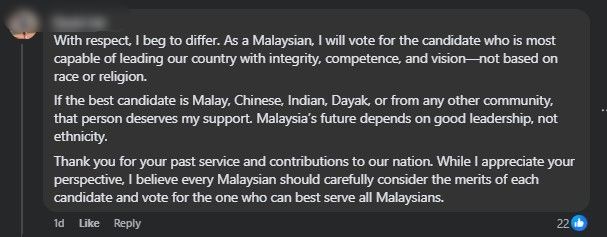
Another added: "If the best candidate is Malay, Chinese or Indian, I would definitely vote for him or her."
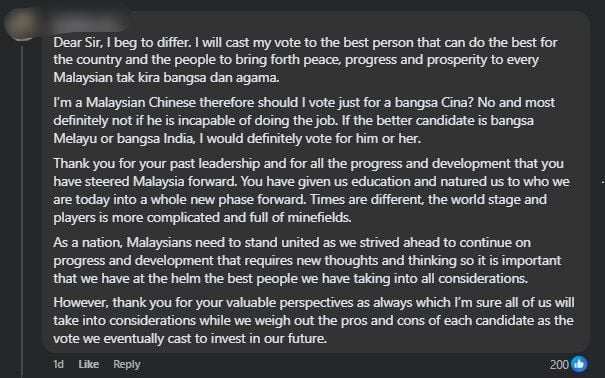
Others thanked Dr Mahathir for his past contributions while suggesting that Malaysia now requires a more inclusive political approach.
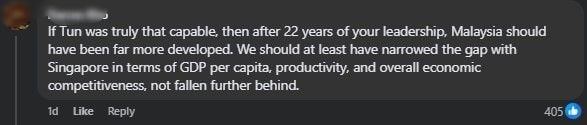
Some questioned his legacy, arguing that Malaysia's economic progress had failed to keep pace with neighbouring Singapore despite his lengthy periods in office.
Religious perspective stresses justice over ethnicity
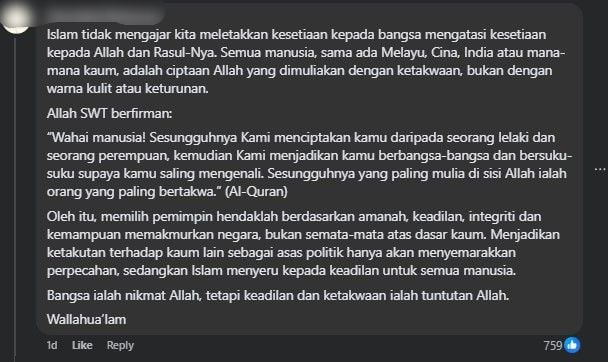
Some commenters argued that Islam does not place loyalty to race above loyalty to God, stressing that all people are equal regardless of ethnicity.
Citing the Quran, one wrote that the most honoured are "those who are most righteous", not those of a particular race.
The comment argued that leaders should be chosen based on "trustworthiness, justice, integrity and capability" rather than ethnicity, warning that using fear of other communities as a political tool risks deepening divisions instead of promoting justice for all.
Call for inclusive, integrity-based leadership
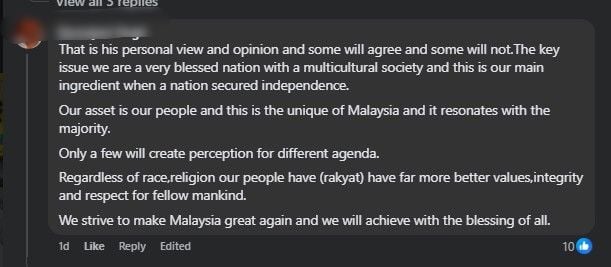
Others defended Malaysia's multicultural character, describing diversity as one of the country's greatest strengths and warning against narratives that could deepen ethnic divisions.

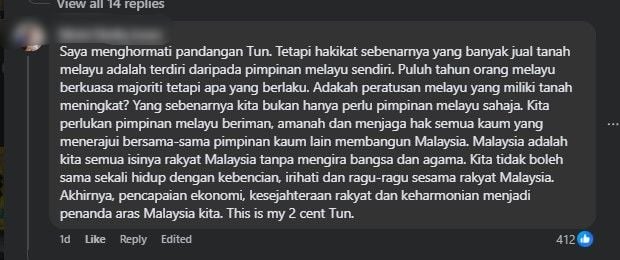
A comment expressed respect for Tun’s views but argued that “many who sold Malay land were Malay leaders themselves,” questioning whether decades of Malay-majority rule improved ownership outcomes.
The user stressed Malaysia needs not only Malay leadership but “Malay leaders who are faithful, trustworthy and protect all communities,” working alongside other races.
The view emphasised that “Malaysia belongs to all its people regardless of race or religion,” rejecting hatred and urging economic performance, welfare and harmony as national benchmarks.
Not all reactions were critical.
"Loving one’s own race is not wrong. Racism begins when we believe that other races are inferior to us. Do not confuse identity with hatred. Defending one’s own identity does not necessarily mean oppressing the identities of others, " a comment wrote.
Some commenters expressed concern over demographic change and preserving Malay political influence, while others responded with sarcasm, asking whether voters should support independent candidates if every contestant happened to be Malay.