Anak Krakatau records 14 eruptions as Level III alert remains in place
Mount Anak Krakatau recorded eight eruptions on 16 August and six more before dawn on 17 August, with incandescent lava and a 400-metre ash column observed.
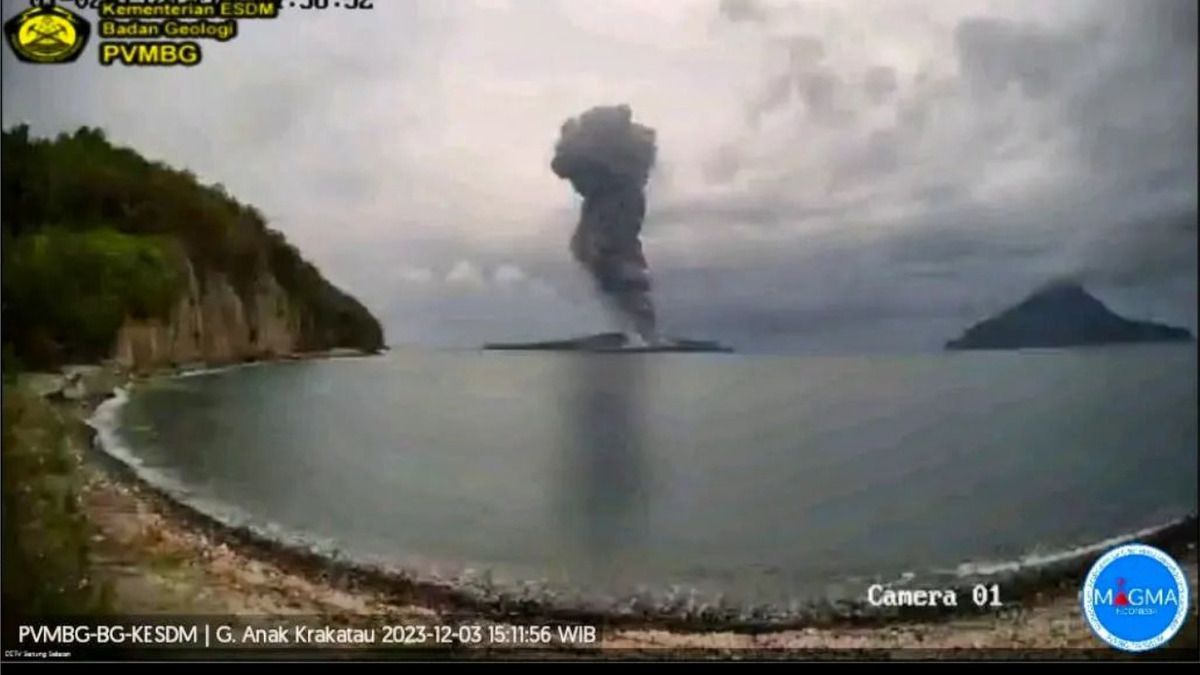
- Anak Krakatau recorded eight eruptions during 16 August, accompanied by incandescent lava ejections.
- Six additional eruptions occurred before dawn on 17 August, followed by a 400-metre ash column.
- PVMBG continues to enforce a 2–3 kilometre danger zone while the volcano remains at Level III.

Mount Anak Krakatau in South Lampung, Lampung, recorded eight eruptions accompanied by incandescent lava ejections during the 24-hour observation period from 00:00 to 24:00 WIB on Sunday, 16 August 2026.
The volcano's activity status remains at Level III, or Siaga (Alert).
Muhammad Dika Nurzaman, an officer at the Mount Anak Krakatau Observation Post operated by the Volcanology, Geological Hazard Mitigation Centre (PVMBG) of Indonesia's Geological Agency, said the eruptions produced columns reaching between 200 and 300 metres above the crater summit.
“Eight eruptions were observed, reaching heights of 200 to 300 metres above the crater summit, with grey and black smoke observed. In addition to the eruptions, incandescent lava ejections were also observed,” Muhammad Dika said in an official report issued in Jakarta on Monday.
Visual observations showed that Mount Anak Krakatau was clearly visible at times before becoming covered by fog. Crater smoke was observed in white, grey and black, with intensity ranging from thin to moderate and thick.
The smoke rose between 10 and 300 metres above the summit.
Six eruptions recorded before dawn
Mount Anak Krakatau continued to show volcanic activity during the early hours of Monday, 17 August, with six eruptions recorded before dawn.
The ash columns from those eruptions could not be observed visually because the events occurred during the night and early morning. However, each eruption was recorded by the volcano's seismograph.
The first eruption occurred at 01:30 WIB, with a maximum amplitude of 57 millimetres and a duration of 36 seconds. Another eruption followed at 02:13 WIB, with a maximum amplitude of 61 millimetres and a duration of 53 seconds.
An eruption was then recorded at 03:04 WIB, with a maximum amplitude of 64 millimetres and a duration of 55 seconds.
Further eruptions occurred at 03:29 WIB, 04:05 WIB and 04:20 WIB, with maximum amplitudes of 57, 58 and 55 millimetres respectively.
Andi Suwardi, head of the Mount Anak Krakatau Observation Post in Hargo Pancuran Village, Rajabasa District, South Lampung, said the absence of a visible ash column did not mean that the eruptions had gone undetected.
“In the early hours, the eruption columns could not be observed visually. However, each event was still recorded by the seismograph and became part of our monitoring,” Andi said.
He said visual observations became more effective after daylight returned.
“After conditions became brighter, the eruption activity could be observed visually. At 06:26 WIB, an ash column of about 400 metres from the summit was visible,” he said.
Ash column rises 400 metres
At 06:26 WIB on Monday, Mount Anak Krakatau produced an eruption that generated an ash column approximately 400 metres above the summit, or about 557 metres above sea level.
The column was grey to black and thick, and moved towards the north and north-west.
The eruption was recorded by a seismograph with a maximum amplitude of 57 millimetres and a duration of 107 seconds.
Volcanic activity has increased since June
Mount Anak Krakatau has recorded high levels of volcanic activity throughout 2026, with 24 eruptions recorded by mid-August.
An increase in volcanic activity was detected from early June, marked by the appearance of crater glow and a rise in shallow volcanic earthquakes.
On 18 and 19 June, shallow earthquake activity exceeded 50 events per day.
The volcano's activity status was subsequently raised from Level II, Waspada (Alert), to Level III, Siaga (Alert) after an eruption on 2 July produced an ash column approximately 200 metres above the summit.
Suwarno, an officer at the Mount Anak Krakatau Observation Post, said intensive monitoring was being conducted continuously for 24 hours because the volcano's magma activity remained subject to change.
Mount Anak Krakatau remains under continuous monitoring
Mount Anak Krakatau is located in the Sunda Strait between the Indonesian islands of Java and Sumatra.
PVMBG continues to monitor the volcano through visual observations and seismic instruments, recording eruptions, ash columns, crater smoke and other changes in volcanic activity.
The latest observations showed continued eruptive activity, including incandescent lava ejections and ash emissions.
Public urged to remain outside danger zone
PVMBG has urged fishermen, tourists and residents to comply with the designated danger zone around Mount Anak Krakatau.
People have been advised not to approach the crater within a radius of 2 to 3 kilometres because of the potential for incandescent rock ejections, hot clouds and ashfall.
The restriction remains in place while the volcano's activity status is at Level III, or Siaga.
Authorities continue to monitor Mount Anak Krakatau around the clock and have urged people in surrounding areas to follow official information and instructions concerning volcanic activity.